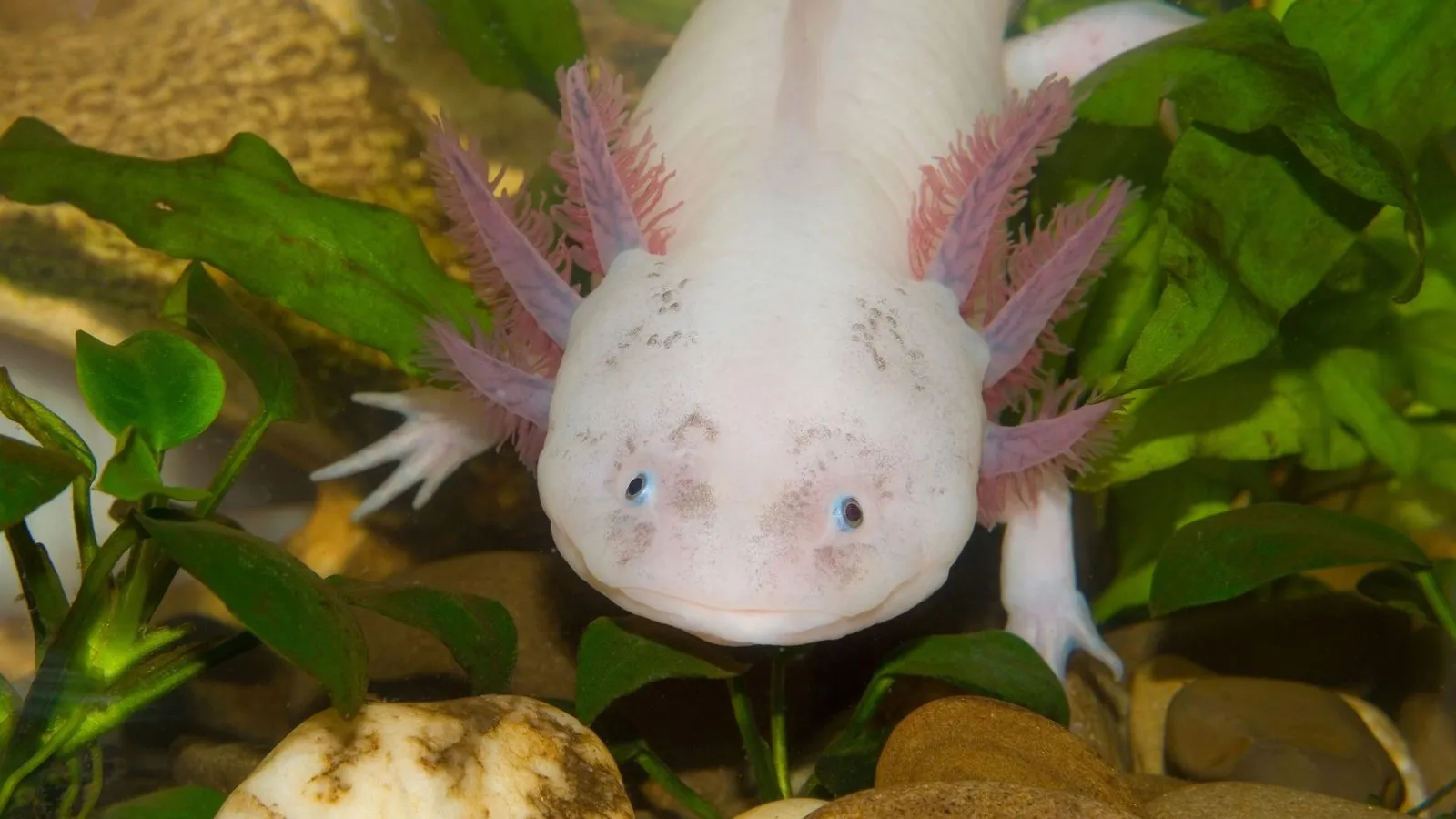
An axolotl can live for 10 to 12 years in a home aquarium, and some have passed 20, so taking one on is a long commitment. These salamanders also need cool, still, carefully kept water, and getting that right takes some work.
A salamander that stays young
Axolotls are amphibians from the high-altitude freshwater lakes of Mexico. They keep their larval form for life, a trait called neoteny. The feathery gills and the fin along the tail stay in place, and the animal grows to full size and breeds without going through normal metamorphosis. They breathe mainly through those gills and partly through the skin. In rare cases, according to the Royal Veterinary College in London, an axolotl can transform on its own.
Wild axolotls are black to dark brown with black spots. In captivity they come in many colors, including white, golden, multicolored and albino. They reach full size at around 18 to 24 months, usually 25 to 30 centimeters long, though the college advises planning a tank for a full-grown axolotl of up to 35 centimeters.
Cool, still water comes first
Temperature is the big one. The Royal Veterinary College’s exotics service gives the ideal range as 16 to 18°C and says the water should never go above 24°C. Axolotls are cold-blooded, so their body temperature follows the water around them.
The water should have a pH of 7.4 to 7.6. Chlorine in tap water harms axolotls, so owners either use a dechlorinator or leave the water to stand for 24 hours before adding it. Where the local supply uses chloramines, a dechlorinator is essential. The college suggests changing 10 to 20 percent of the water every week, adjusted to the filter and to the results of water tests.
A filter is strongly advised to keep toxic ammonia low, but it must not create a strong current. Strong flow can badly stress an axolotl. A new tank should also be left empty for several weeks to mature before any animal goes in.
Setting up the tank
Fine aquarium sand is the best floor. Axolotls sometimes swallow gravel, which can cause a fatal blockage. Caves and pipes give them places to retreat out of sight.
Live plants are usually left out, because axolotls tear them up quickly. Axolotls are mostly active at night and are sensitive to sudden changes in light and to ultraviolet (UVB) light, so tanks are often left unlit. A quiet spot away from vibration suits them best.
Company is a risk. The college says axolotls are best kept alone. Young ones can share a large tank, but animals of different sizes should never be left together, because they may eat each other.
Feeding without overfeeding
Axolotls are carnivores and will take live or dead food, though moving prey helps tempt young ones to eat. Suitable foods for grown axolotls include earthworms, bloodworms, blackworms, salmon pellets and brine shrimp. Tiny water fleas called daphnia suit larvae.
The college recommends offering only as much food as each animal can finish in two to three minutes. Young axolotls can be fed daily, grown ones only two or three times a week. Some owners hand-feed their axolotls. They may nip, but their small teeth can rarely break human skin.
Handling should be kept to a minimum, because an axolotl’s skin is easily harmed by toxins and by injury.
Pets in tanks, trouble in the wild
Most breeding for the pet trade happens in captivity, and many thousands of axolotls now live in laboratories, zoos and homes. Researchers value them for their ability to regrow lost limbs.
The wild story is very different. The San Diego Zoo Wildlife Alliance notes that the axolotl was assessed as Critically Endangered in 2019 and survives at only three isolated sites in southern Mexico City, linked with the cold-water springs of Xochimilco. Its estimate of the number of grown axolotls left in the wild is roughly 50 to 1,000. Wild axolotls are protected in Mexico, and international trade in the species is controlled under the CITES treaty.
Back in 2009, Scientific American reported that the species lived only in the Xochimilco area, in about 10 square kilometers. Habitat loss, poor water quality, city growth and introduced fish such as carp and tilapia have all pushed it toward the edge.
That contrast is worth remembering. A well-kept axolotl in a cool, quiet tank is a reminder of a remarkable animal whose wild relatives now survive in just a few small sites in Mexico City.