Some of the oddest animals on Earth are easier to see than you might think. A mammal that is essentially cold-blooded, a turtle that vacuums up fish and a pig with tusks growing through its own face all live in zoos today, and each one has a story worth knowing.
Naked mole-rat
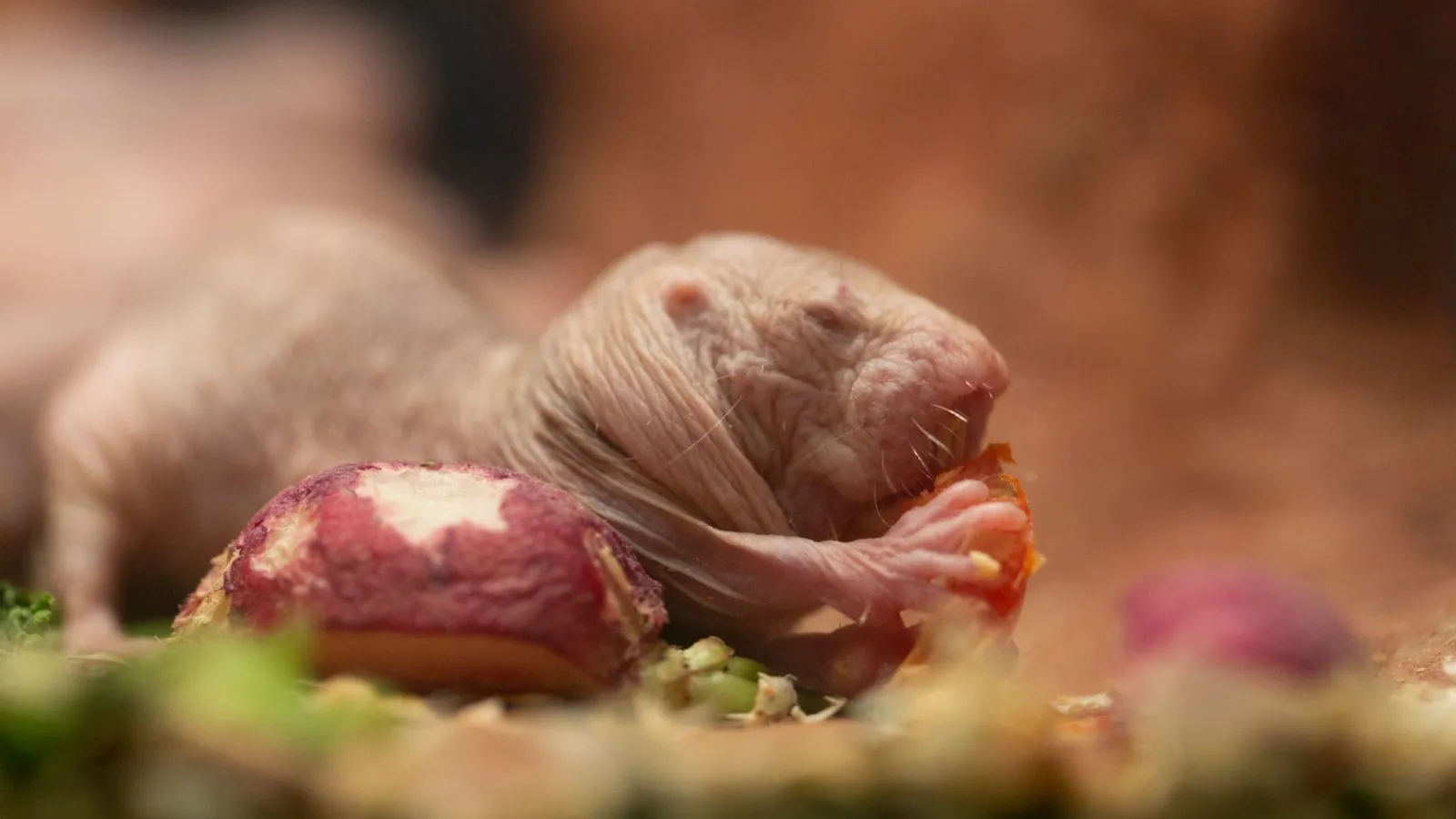
Despite the name, naked mole-rats are not completely hairless. They are burrowers from eastern Africa, found in Ethiopia, Kenya, Djibouti and Somalia. Their short, broad heads carry powerful jaw muscles and very large front teeth, which they use to dig tunnels.
Their family life is unusual too. Only one female in a colony breeds, and she is called the queen. Colonies average 70 animals, and groups of up to 295 have been recorded. Unlike most mammals, naked mole-rats cannot hold a steady body temperature, so it rises and falls with their surroundings, making them essentially cold-blooded. They may live for 10 to 30 years. The Smithsonian’s National Zoo keeps a colony in its Small Mammal House.
Okapi
The okapi has bold stripes, yet it is no kind of zebra. It is the only close living relative of the giraffe. It lives in the tropical rainforests of the northeastern Democratic Republic of the Congo, and scientists did not know it existed until 1901.
Those bold stripes give good camouflage in the forest. Okapis stand about 5 feet (1.5 meters) tall and pull leaves into their mouths with a dark blue or black tongue that can grasp like a hand. The tongue is long enough to reach the animal’s own eyes and ears. Okapis also eat clay, probably for its minerals, and some of their calls are so low that people cannot hear them at all. The San Diego Zoo lists the species as Endangered.
Binturong
The binturong’s party trick is its smell. It smells like buttered popcorn, because its urine contains the same chemical compound that gives popcorn its scent.
It is also called a bearcat, but that name is misleading. Binturongs are not related to bears or cats. They are relatives of civets, shaggy tree dwellers that the San Diego Zoo describes as looking like gigantic dust mops. The last third of the tail is prehensile, which means it can grip like an extra hand as the animal moves slowly through the branches at night. Binturongs are classed as carnivores but eat mostly fruit, and grown binturongs weigh 30 to 50 pounds (13 to 22 kilograms).
Matamata turtle
At first glance, a matamata hardly looks like a turtle at all. Its large, flat, triangular head has fleshy flaps along the sides, a wide mouth and a long, snorkel-like snout. Its shell is rough and knobby, studded with bumps that look like small cones.
This South American turtle lives throughout the Amazon, on the soft, muddy bottoms of slow, shallow water. It hunts by staying almost perfectly still and camouflaged, then “vacuuming” up small fish and invertebrates that swim too close. According to the Smithsonian’s National Zoo, its shell can grow to nearly 45 centimeters (about 1.5 feet) long, and the turtle can weigh 17.2 kilograms (38 pounds).
Malayan tapir
Tapirs are most closely related to horses and rhinos. Their nose and upper lip form a flexible snout that can move in all directions, a little like an elephant’s trunk.
The Malayan tapir has a striking coat, black at the front and white at the back, a pattern that works as camouflage. Babies look completely different. The San Diego Zoo describes tapir calves as looking like brown- and beige-striped watermelons on legs, before the markings fade. Tapirs love water, and even young ones can swim when only a few days old. There are four species, and the group has been around for 20 million years with very little change.
Babirusa
The male babirusa has remarkable teeth. Its upper tusks start out growing downward, then curve back and grow up through the top of its snout. Only males have these upper tusks, though both sexes have lower ones.
The name means “pig deer” in the Malay language, because the curling tusks are reminiscent of deer antlers. Babirusas live only on the Indonesian islands of Sulawesi, Togian, Sula and Buru, where they will eat almost anything, from leaves and fruit to insects and fish. Their wild population is estimated at fewer than 10,000.
Article Sources
- Naked mole-rat | Smithsonian's National Zoo and Conservation Biology Institute
- Okapi | San Diego Zoo Animals & Plants
- Binturong | San Diego Zoo Animals & Plants
- Matamata turtle | Smithsonian's National Zoo and Conservation Biology Institute
- Tapir | San Diego Zoo Animals & Plants
- Babirusa | San Diego Zoo Animals & Plants