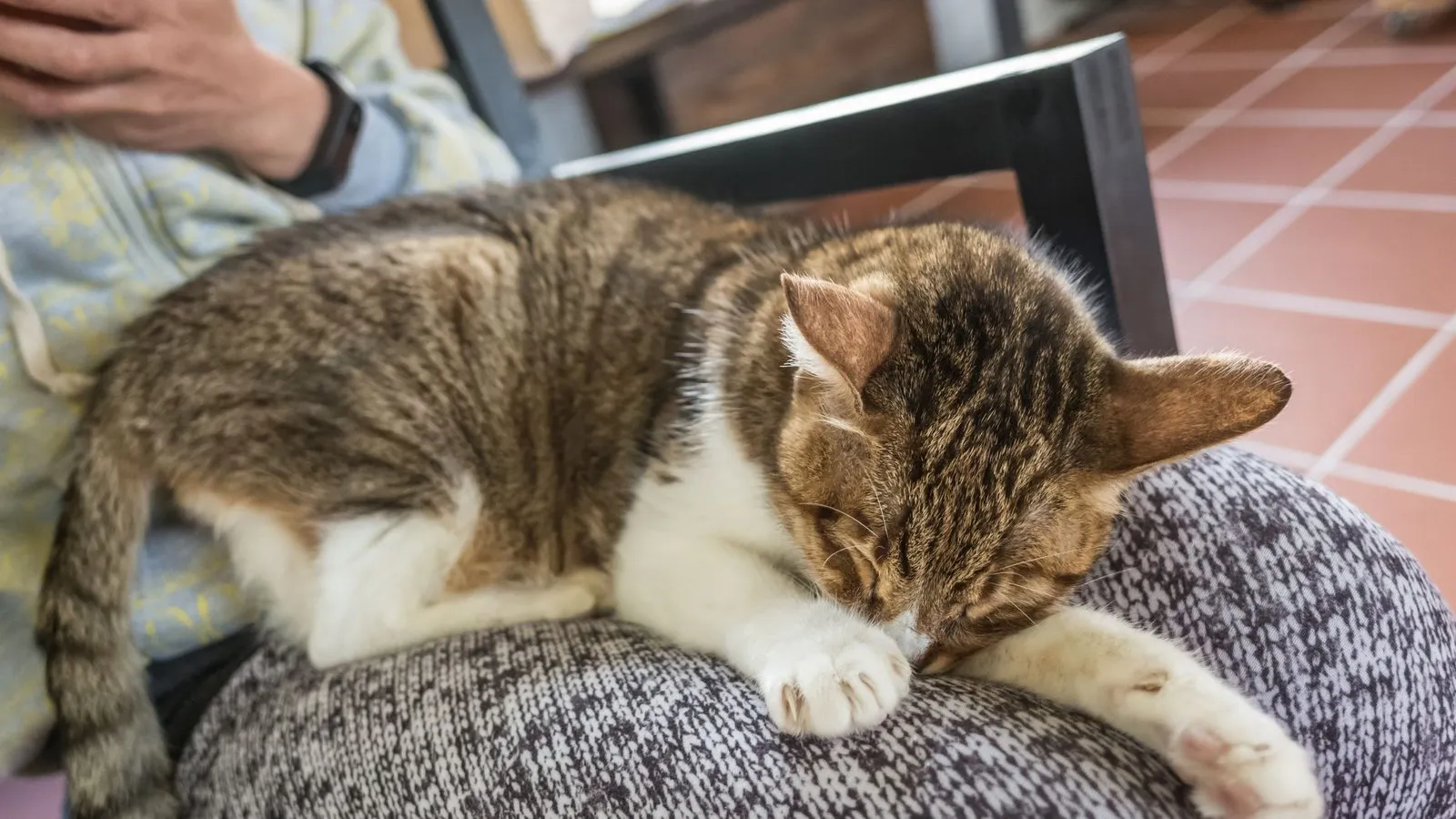
Cats purr mostly to stay in touch, with their kittens, with other cats and with the people they live with. But a purr is not a simple “I’m happy” signal, because cats also purr when they are stressed, in pain or about to fall asleep.
A sound with more than one meaning
Dr. Barbara Sherman, who led the behavioral medicine service at North Carolina State University’s veterinary hospital, explains that cats are thought to purr to keep contact with other cats or humans. That often happens when a cat looks content, such as when it settles on the lap of someone it knows. In general, she says, purring goes with friendly moments between cat and person, or between cat and cat.
It starts early in life. A mother cat purrs while she nurses her litter, and the kittens purr while they feed. Leslie Lyons, writing for Scientific American from the University of California, Davis, School of Veterinary Medicine, notes that purring in house cats is most noticeable during nursing.
Some moments switch the purr off. Sherman lists aggressive and mating encounters as situations where cats tend to stop.
Why a purr does not always mean happy
The surprise is that cats purr under stress too. Lyons points out that cats often purr during a trip to the vet or while recovering from an injury. Sherman goes further: purring has even been heard when vets examine a cat brought in as an emergency after being hit by a car. Cats may also purr just before they drop off to sleep. So a purring cat is not always a relaxed cat.
How the voice box makes the sound
The purr comes from the larynx, the voice box in the throat. As the cat breathes in and out, the muscles of the vocal folds vibrate and make tiny bursts of sound. Those bursts come every 30 to 40 milliseconds, or about 25 times a second. Lyons gives the overall range of a purr as between 25 and 150 Hertz, and notes that cats purr on both the in-breath and the out-breath with a steady pattern.
Purring does not stop a cat from making other noises. A cat can purr and cry at the same time, which anyone who has opened cat food for a hungry cat may have heard. The pitch of a purr does not depend on a cat’s age, size, weight or sex, and it is easy for a nearby person or cat to hear.
A 2023 surprise from Vienna
For a long time, the leading explanation was that bursts of nerve signals drive the throat muscles to make each purr. Sherman’s account says purring is triggered by a signal from the central nervous system.
In 2023, a team led from the University of Veterinary Medicine Vienna published a study in the journal Current Biology that complicated that picture. The researchers worked with eight larynges taken from domestic cats after death. When air was passed through them, all eight produced steady vibrations at normal purring rates, with no nerve signals and no muscle contractions involved. The voice boxes made sounds of 25 to 30 Hertz on their own.
The team also found small masses of connective tissue, up to 4 millimeters across, set into the cats’ vocal folds. The study does not mean the brain plays no part in a living cat. It shows that the voice box itself can make purring sounds without being driven by nerves.
Which cats purr and which roar
Most members of the cat family make a purr-like sound, Lyons writes. But big cats split into two camps. BBC Wildlife’s Discover Wildlife explains that four big cats can roar: the lion, tiger, leopard and jaguar, all in the genus Panthera. In these species, a small bone in the voice box is replaced by a ligament, which lets them roar. Those four are not able to purr.
Every other cat can purr but not roar, and that includes some large ones. The cheetah has a fixed set of bones in its voice box, which lets it purr continuously. Despite its size, it has the anatomy of a small cat. The snow leopard is a member of Panthera, yet it cannot roar either.
Still an open question
Scientists have suggested other reasons for purring. One idea, which Lyons describes, is that purring is a low-energy way of keeping a resting cat’s muscles and bones working. That idea remains a hypothesis rather than a settled answer.
The NC State account puts the main purpose simply: purring is thought to help a cat keep in contact with other cats and people, and what it means depends on the moment. A purr on a warm lap and a purr on the examining table may sound alike, but they can carry very different messages.
Article Sources
- Why Do Cats Purr? NC State University College of Veterinary Medicine Behavior Expert Explains
- Why do cats purr? | Scientific American
- Domestic cat larynges can produce purring frequencies without neural input | Current Biology (Vetmeduni repository)
- Why can only big cats roar and not purr? | Discover Wildlife