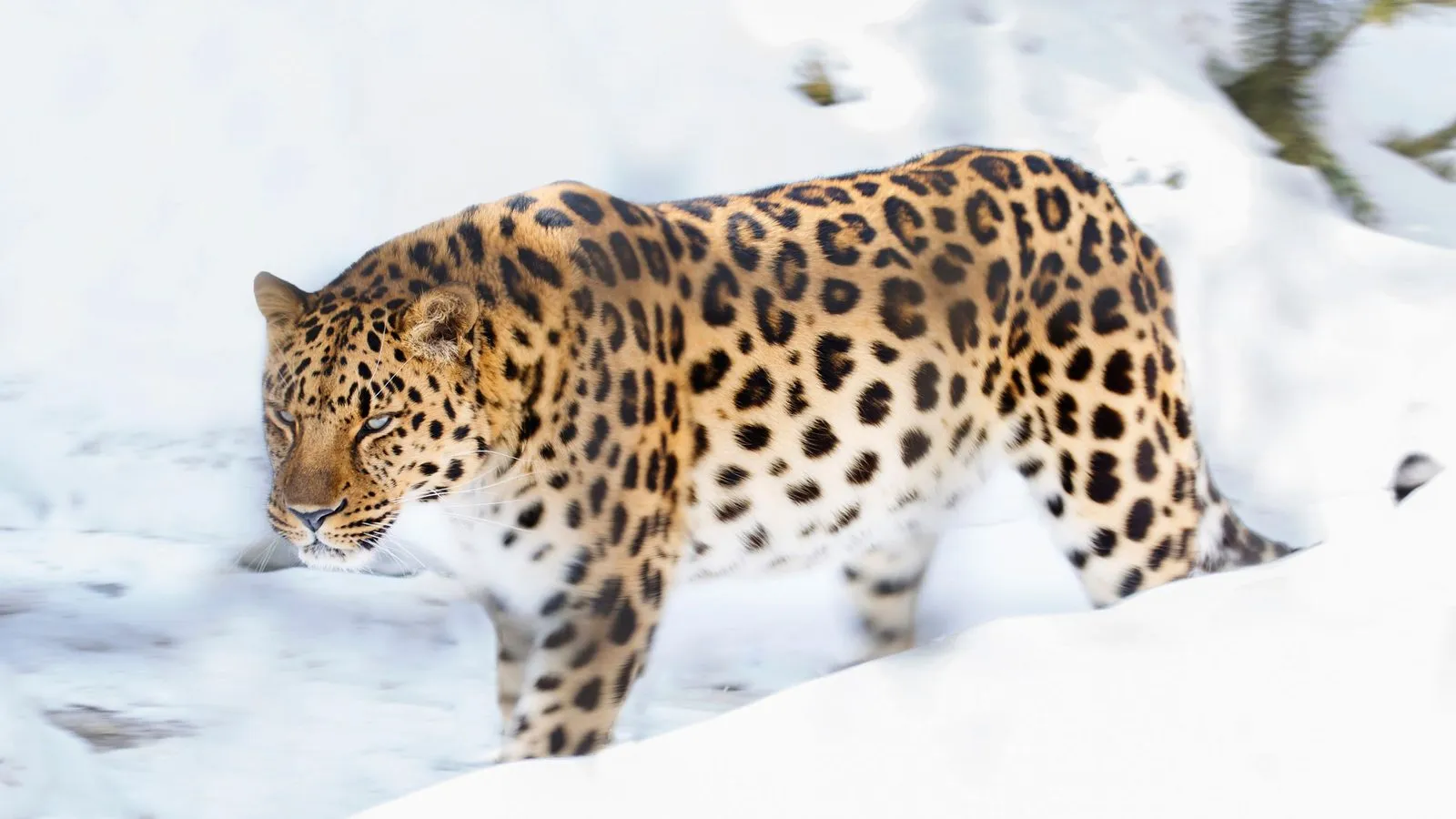
There are only about 130 mature Amur leopards left in the wild, which makes this snow-country cat one of the rarest big cats on Earth. That figure comes from the IUCN’s 2023 assessment, and it is the whole world population, spread across a strip of forest where Russia, China and North Korea meet.
A leopard built for snow
Most people picture leopards on the African savanna, but the Amur leopard is the northernmost of all leopard subspecies. It lives in temperate forests that face long, freezing winters with deep snow. It is also known as the Far East leopard, the Manchurian leopard or the Korean leopard.
Its coat is made for the cold. In winter the fur grows up to 7.5 cm long, and it is paler than the coats of other leopards, which helps it blend into snow. The dark rosettes on its fur are larger and more widely spaced than on other leopards.
An Amur leopard weighs about 70 to 105 pounds. It can run at up to 37 miles per hour and has been reported to leap more than 19 feet forward and up to 10 feet straight up. It lives and hunts alone, mostly at night, and it carries off and hides any food it does not finish so other predators cannot steal it. Its main prey includes roe deer, sika deer and hares. In the wild it lives 10 to 15 years, and up to 20 years in zoos.
Females give birth after about 12 weeks of pregnancy to litters of 1 to 4 cubs. The cubs stay with their mother for up to two years.
How close it came to the end
Amur leopards once ranged across northeastern China, the far southeast of Russia and the mountains of the Korean Peninsula, where they were once quite common. Uncontrolled hunting and the clearing of forests pushed them back. During the 20th century the area they lived in shrank about 40 times over.
By the end of that century, only 27 to 32 Amur leopards were left in southwest Primorsky province in the Russian Far East, with at most 7 to 12 more across the border in China.
Why “fewer than most think”
It is easy to assume a famous big cat must be fairly common. The real wild count is tiny. In 2019, researchers counted 49 grown leopards in northeast China and 105 in the Russian Far East. Because some animals cross the border and get counted twice, the IUCN puts the true total at about 128 to 130 grown and nearly grown leopards.
That population is so small that inbreeding has become a real problem. Camera traps have caught wild leopards with white paws and short tails, signs that could point to genetic mutations, and the IUCN notes that physical deformities are already showing up. Disease is another worry, including canine distemper virus. Leopards are also still poached for their spotted fur, and forest fires turn their woodland into grassland they avoid. Heavy snowstorms make it hard for deer to move and feed, which leaves leopards short of food.
On the IUCN Red List, the Amur population is rated Critically Endangered.
The slow climb back
The good news is that the total population has doubled since the previous IUCN assessment in 2008, thanks to steady work on both sides of the border. Russia created Land of the Leopard National Park in 2012, and China opened the Northeast China Tiger and Leopard National Park in 2021. In 25 years, the network of protected areas grew from 1,532 km2 to 18,045 km2 and now covers 90% of the leopard’s current range.
Better ranger patrols have cut poaching. A program to help deer, with mineral licks and extra winter food, has kept the leopards’ prey from dying off in hard winters. In Land of the Leopard National Park, sika deer are now at record levels, and their comeback is thought to be a major reason the leopards are doing better.
In early 2024, the Wildlife Conservation Society and the park set up 130 hidden cameras. They captured over 9,000 wildlife images, nearly 1,000 of them showing Amur leopards. The team identified 28 individual leopards in the study area, up from 16 in 2015, and measured a leopard density 183% higher than the first estimate.
What comes next
Scientists now want to keep the population genetically healthy and make sure leopards can move between patches of habitat. In 2023, conservationists began moving leopards from Land of the Leopard National Park to other places. Zoos also hold a backup population. As of July 2018, there were 217 Amur leopards in 88 zoos and other institutions under a global breeding plan.
The Amur leopard is still on a knife’s edge, but it shows what protection and plenty of prey can do for even the rarest big cat.