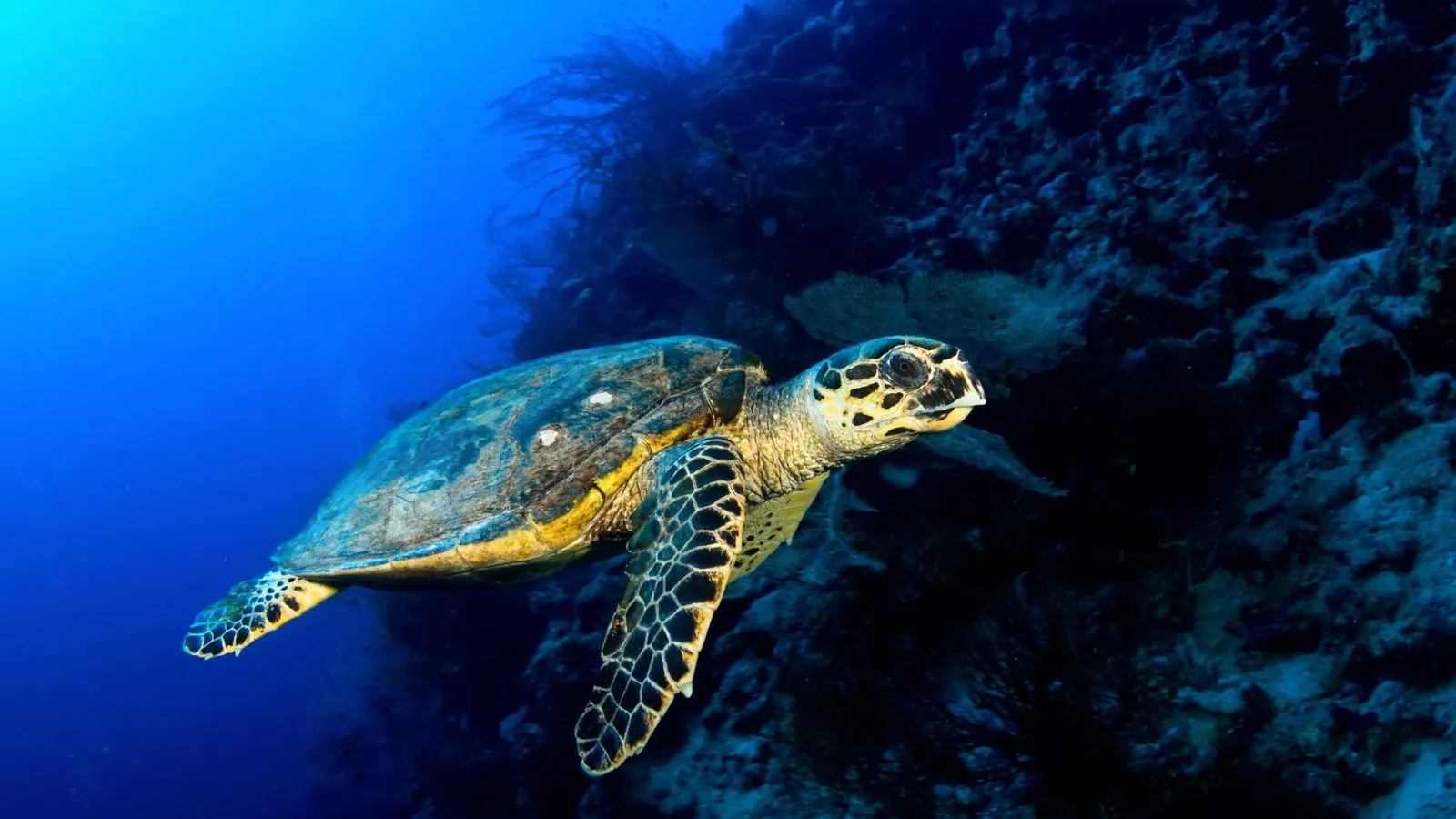
The hawksbill turtle’s shell is so beautiful that people hunted the species almost to extinction for it. The IUCN Red List rates the hawksbill Critically Endangered, and its 2008 assessment found an 84 to 87% drop in the number of females nesting each year at 25 key beaches around the world.
A shell like stained glass
The hawksbill’s shell is mottled with amber, orange, red, yellow, black and brown, and its edges are jagged like a saw. The plates on its back, called scutes, overlap like roof tiles. A grown hawksbill has a shell 2 to 3 feet long and weighs 100 to 150 pounds. Hatchlings are only 2 to 3 inches long and mostly brown.
The turtle gets its name from its head. It narrows to a point, and the lower jaw forms a V, giving it a sharp, beak-like mouth that looks like a hawk’s.
A sponge eater on the reef
That pointed beak is a precision tool. Hawksbills use it to reach into small holes and cracks in coral reefs to pull out food. Their favorite food in many places is sea sponges, and they are the only sea turtle that can live on a diet made mostly of sponges. They also eat algae, corals, mollusks, sea urchins, crustaceans, small fish and jellyfish.
Eating sponges makes hawksbills important to reefs. Where they feed mainly on sponges, they help keep the sponges in check, which would otherwise crowd out the corals that build the reef. Hawksbills rest in the ledges and caves of reefs and are found in the coastal waters of more than 108 countries.
They can also travel far. One female that nested on Buck Island in the U.S. Virgin Islands was tracked 1,160 miles to her feeding grounds off Nicaragua.
A slow start to life
Hawksbills grow up slowly. After hatching, most young turtles head out to the open sea, where they shelter among floating mats of seaweed for about 1 to 5 years before moving to coastal reefs. They take 20 to 35 years to reach breeding age, and they are thought to live 50 to 60 years.
Every 1 to 5 years, females return to nest near the beaches where they themselves hatched decades earlier. They usually come ashore at night on small, hidden beaches and dig their nests high up, often under plants. A female lays three to five nests in a season, each holding an average of 130 to 160 eggs. About two months later, the hatchlings dig out and crawl toward the brightest horizon, which on a natural beach is the sea.
Hunted for tortoiseshell
The hawksbill’s shell is the source of “tortoiseshell,” which craftspeople carve into combs, hair clips, jewelry and trinkets. The trade was enormous. Japanese records show imports of shell equal to more than 1.3 million large hawksbills from around the world between 1950 and 1992, plus more than 575,000 stuffed young hawksbills from Asia between 1970 and 1986.
Today, CITES, the treaty that governs international wildlife trade, forbids international trade in sea turtle products, including hawksbill shell. The IUCN notes that the trade has shrunk but is still active and substantial. In many places, people still kill hawksbills for their shell and meat and dig up their eggs to eat or sell.
Other dangers
Hawksbills also drown when they are caught by accident in fishing gear. Coastal building, seawalls and rising seas destroy nesting beaches, and pollution, coral bleaching and coral disease damage the reefs they depend on. Turtles sometimes swallow fishing line, balloons and plastic bags, mistaking them for food. Hotter sand can kill eggs or change how many hatchlings turn out male or female, since the temperature of the nest decides a sea turtle’s sex.
Because hawksbills take decades to mature, a population can be in trouble for years before anyone notices fewer turtles on the beach.
Where they still nest
Hawksbills usually nest in small numbers on remote beaches, but a few places stand out. According to NOAA Fisheries, about 6,000 to 8,000 hawksbills nest each year near the Great Barrier Reef, and about 2,000 nest on the northwest coast of Australia. In Hawaii, only 10 to 25 females nest each year.
In the United States, the hawksbill has been listed as endangered under the Endangered Species Act since 1970. There is some good news. The IUCN says some protected populations are now stable or growing, a sign that protection can make a difference.