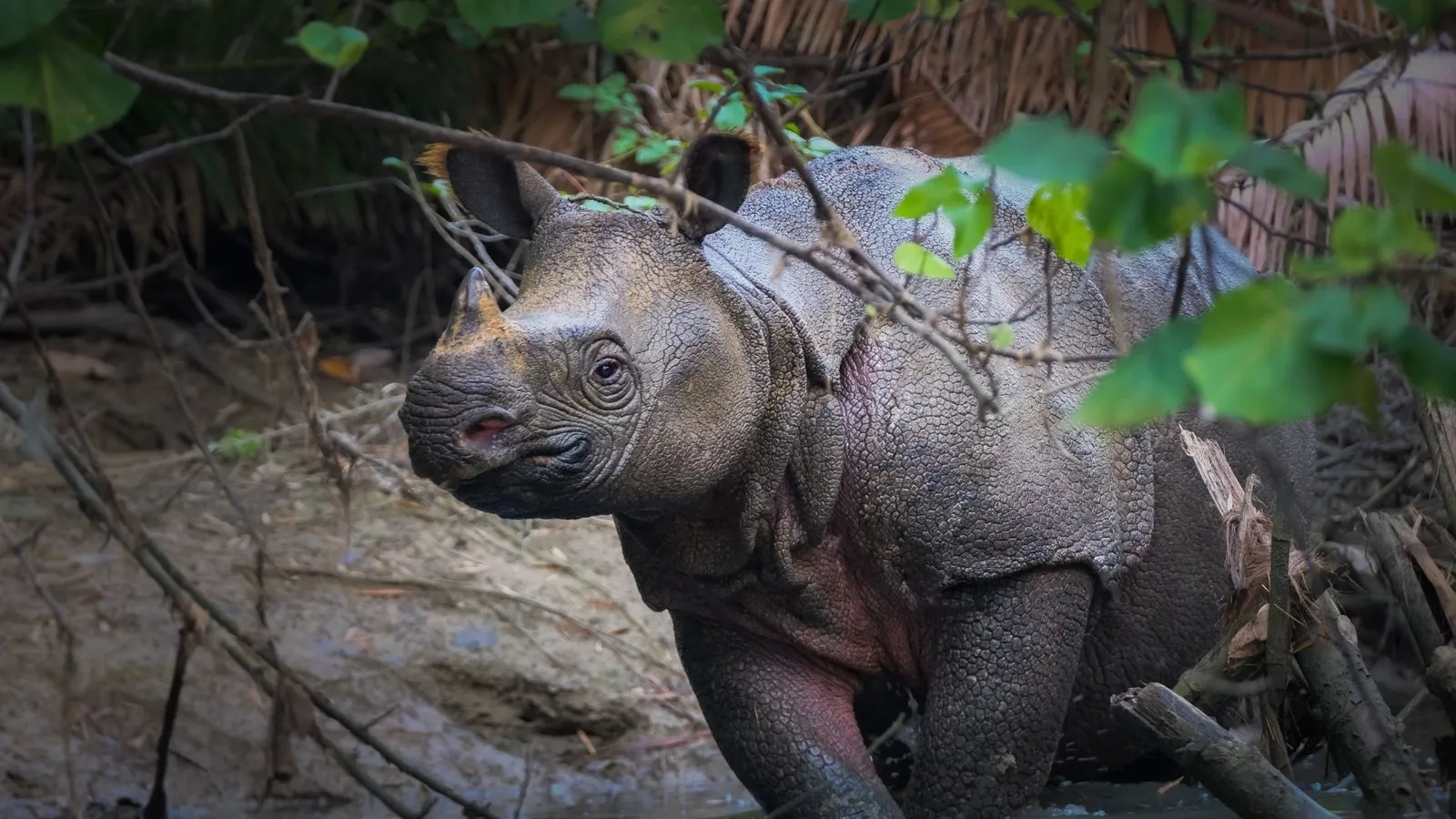
Every Javan rhino left on Earth lives in a single national park on the western tip of the Indonesian island of Java. There are thought to be only about 50 of them, after poachers killed up to 26 between 2019 and 2023, according to the International Rhino Foundation’s 2025 report.
The rarest rhino
There are five living rhino species, and the Javan rhino is the rarest. It is a big animal, weighing 900 to 2,300 kg (2,000 to 5,060 pounds) and standing 1.5 to 1.7 m tall at the shoulder. Its skin is gray and hairless, with folds that look like plates of armor.
It also has the smallest horn of any rhino. Males carry a single horn about 25 cm (10 in) long, while females have a smaller horn or none at all. Because it is smaller than its cousin, the greater one-horned rhino, it is sometimes called the Asian lesser one-horned rhinoceros.
Javan rhinos are solitary animals that are rarely seen. In the rainforest they are pure browsers, feeding on plants rather than grazing on grass, and biologists have counted more than 300 kinds of plants in their diet. They need water, mineral salt and muddy wallows to stay healthy. They probably live 30 to 40 years. Females are thought to carry a calf for about 15 to 16 months and give birth roughly once every 2 to 3 years. Females start breeding at around 5 to 7 years old, and males at around 10.
From all of Southeast Asia to one park
Javan rhinos once lived from Thailand down through Malaysia to Java and Sumatra, with a separate subspecies in Vietnam, Laos, Cambodia and eastern Thailand. Hunting for their horn and other body parts, used in traditional medicine, drove them toward extinction across almost all of that range.
On Java, they have been confined to the Ujung Kulon Peninsula since around the 1930s. The last mainland population held out in Vietnam’s Cat Tien National Park until 2010, when the last rhino there was killed by a poacher. No Javan rhinos live in zoos. Only 22 have ever been known in captivity.
A slow climb, then a crash
Ujung Kulon National Park has been closely watching its rhinos since 1967, when only about 25 were thought to remain. Over the following decades, guarded by park staff and Rhino Protection Units, the population crept upward. It stood at 40 to 50 in 2007 and reached an estimated 76 by 2021.
Then it went wrong. In 2023, police near the park learned that camera traps, the main tool for keeping track of the rhinos, had gone missing, and rhino activity seemed to have dropped. Footage from other cameras showed armed poachers inside the park. Investigators identified 13 suspects from a nearby village, including two brothers who led poaching gangs. The gangs confessed to killing 26 rhinos between 2019 and 2023, a loss of about a third of the whole species.
After a 2024 investigation, the poachers were convicted. Courts handed down fines and prison sentences of up to 12 years, the longest ever given for wildlife crimes in Indonesia. The IUCN Red List rates the Javan rhino Critically Endangered, and the latest IUCN population estimate is 50.
Trouble beyond poachers
Even without poaching, life on one peninsula is risky. The IUCN notes that the population “absolutely cannot tolerate poaching,” and it has other problems too. There are about two males for every female, which slows breeding, and the rhinos have little genetic variety.
Their habitat is also shrinking from the inside. A native palm called langkap now covers an estimated 60% of the park’s peninsula and crowds out the plants rhinos eat. The park also holds up to 800 banteng, a kind of wild cattle that competes with rhinos for food. Experts think the park is close to the number of rhinos it can support.
Then there is the volcano. In 1883 the eruption of the Krakatau volcano devastated Ujung Kulon and the land around it. In December 2018, its successor, Anak Krakatau, collapsed into the sea and caused a tsunami. The rhinos escaped harm that time, but a single disaster could wipe out the only population of an entire species.
What could save it
Conservationists have long argued for a second population somewhere else, as an insurance policy against disaster. For its October 2025 meeting in Abu Dhabi, the IUCN World Conservation Congress put forward a motion calling attention to the Javan and Sumatran rhinos and urging Indonesia to aim for rapid population growth through scientific management.
For now, the future of the Javan rhino rests on one patch of rainforest, five Rhino Protection Units and the hope that the poaching gangs are gone for good.