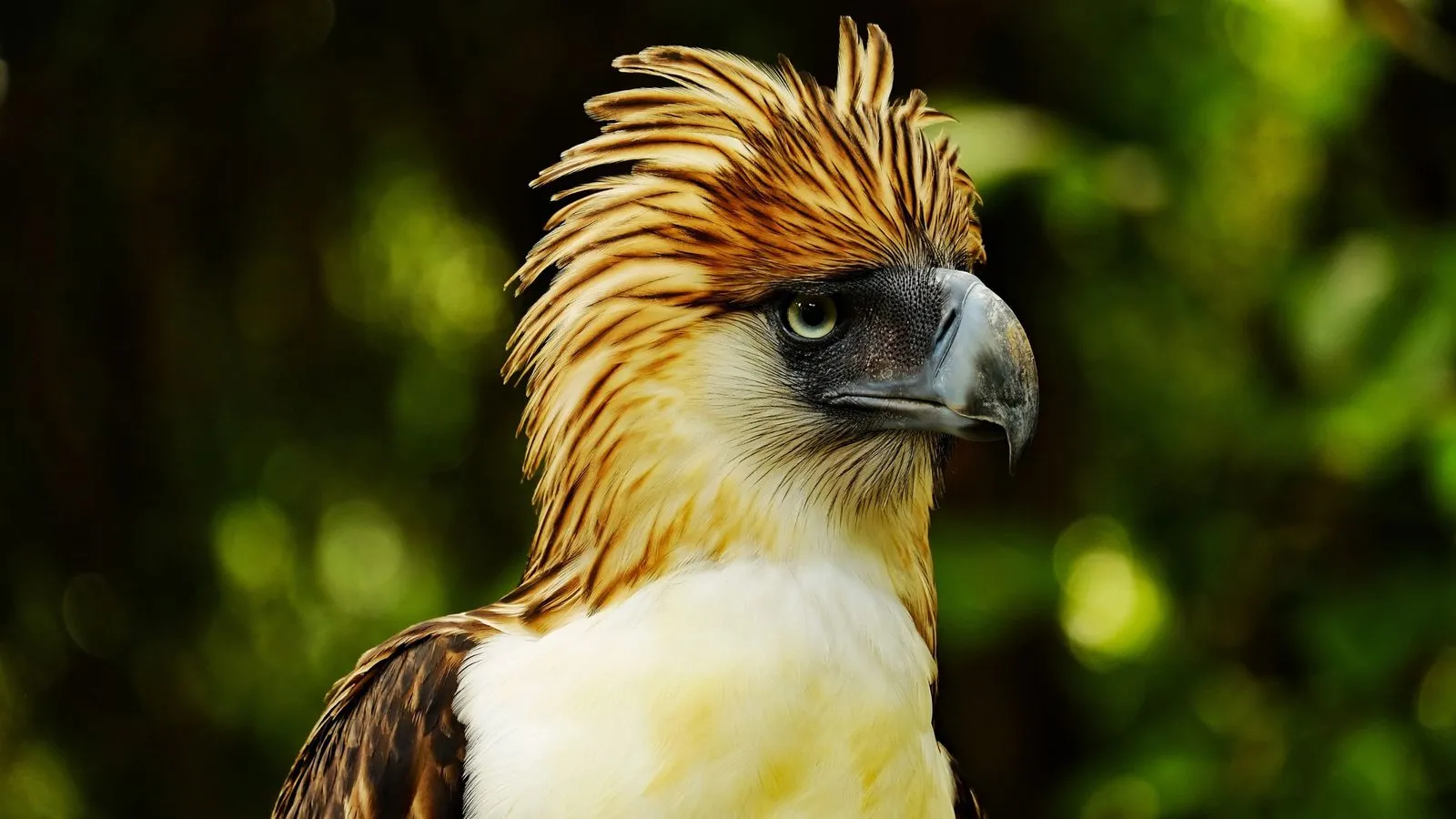
The Philippine eagle is one of the rarest eagles in the world, and the 2025 IUCN Red List assessment puts its population at somewhere between 64 and 462 pairs. It is the largest forest raptor in the Philippines and the country’s national bird, and it lives nowhere else on Earth.
The bird once called the monkey-eating eagle
This giant used to be called the monkey-eating eagle, a name that still appears in the title of a 1977 scientific paper about it. Monkeys are on the menu, but they are not its main meal. On the island of Mindanao, its main prey is the Philippine flying lemur. On Luzon, where flying lemurs do not live, it hunts cloud rats instead. It also takes palm civets, snakes, monitor lizards, birds and bats.
It hunts in old rainforest, especially on steep slopes, from the lowlands up to at least 1,800 m. The eagle is found on only 4 islands: Luzon, Samar, Leyte and Mindanao.
A family that takes two years
Philippine eagles pair up for life. Females are ready to breed at around five years old and males at around seven. A pair usually nests in a large dipterocarp tree, such as the native lauan, and lays just one egg every two years.
Both parents take turns keeping the egg warm for about 58 to 60 days. For the first 40 days after the chick hatches, the female stays with it while the male does most of the hunting. The young eagle leaves the nest after 4 to 5 months but stays near home for almost a year and a half. Only when it can fend for itself does the pair breed again, so a complete breeding cycle takes two years. In captivity, Philippine eagles have lived for more than 40 years.
Why it needs so much forest
Each pair needs an enormous territory. Tracking studies found that a pair uses about 68 to 72 km2, and the Philippine Eagle Foundation says a pair needs about 4,000 to 11,000 hectares of forest to thrive, depending on how much prey is around. That means even a small number of eagles needs a huge amount of forest.
That forest has been disappearing for more than a century. Before large-scale logging began around the start of the 20th century, there may have been up to 6,000 Philippine eagles. Clear-felling for timber and, from the late 1980s, widespread slash-and-burn farming took much of their home. One government study found that forest cover in the Philippines fell from 34.9% of the land in 1969 to 22.2% in 1987. BirdLife International describes the eagle’s decline over the past 125 years as catastrophic.
Shot, trapped and pushed out
Hunting makes the problem worse. Young eagles that have not learned to fear people are easily shot or trapped, and so are grown birds nesting near the forest edge. Some eagles are caught by accident in traps set for wild pigs and deer. The Philippine Eagle Foundation says at least one Philippine eagle is killed by shooting every year.
As forests shrink, eagles must travel farther to find food. That brings them closer to villages and farm animals, which often leads to conflict that the eagle loses.
How many are left?
Nobody knows exactly, and the estimates vary widely. The Philippine Eagle Foundation cites about 400 pairs. In its 2025 assessment, BirdLife International, which assesses birds for the IUCN Red List, gave a range of 64 to 462 pairs, or 128 to 924 grown birds, and noted that even the most hopeful estimates suggest fewer than 500 pairs. Searches have turned up only 3 nests on Luzon and 35 on Mindanao in recent years, despite a lot of effort. The species is rated Critically Endangered.
Protecting the national bird
The Philippine eagle is protected by Philippine law and listed on CITES Appendix I. The Philippine Eagle Foundation runs the Philippine Eagle Center and the National Bird Breeding Sanctuary, the only two places in the world that breed and rehabilitate these eagles. Rescued birds are released when they can be, or join the breeding program.
Protecting forest is the biggest task. Only about one-third of the eagle’s suitable habitat lies inside protected areas, and scientists have urged that all remaining lowland forest in its range be protected. The eagle also matters to people in other ways. It appears in the oral histories and traditions of several Indigenous groups in the Philippines, a reminder that saving this giant means saving a piece of the country’s heritage too.