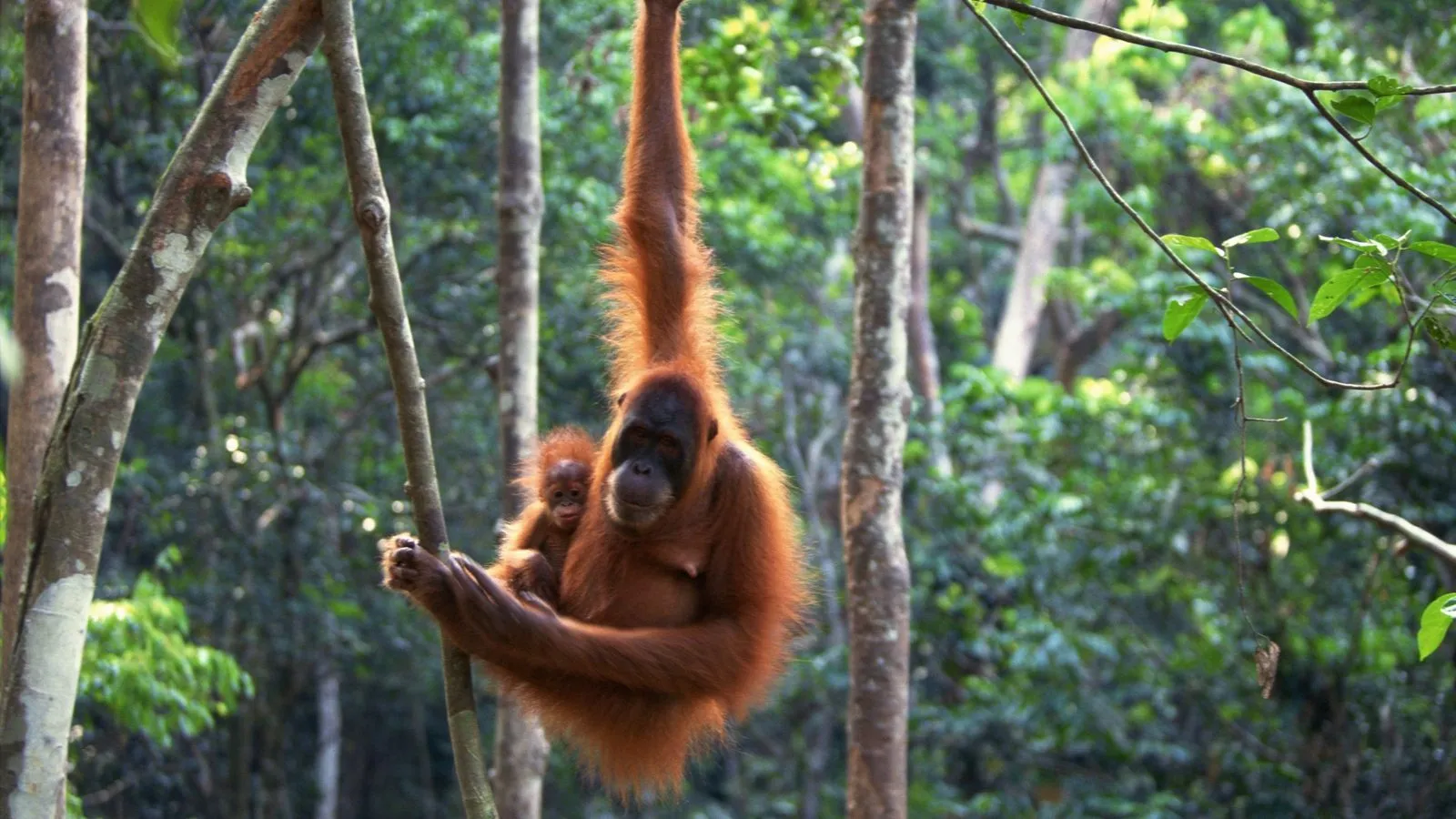
Only about 13,846 Sumatran orangutans are left in the wild, all of them in the north of one Indonesian island. That number, from a 2016 survey used in the IUCN Red List assessment, sounds larger than older counts, but experts warn that the population is still falling fast and the species is rated Critically Endangered.
Asia’s red ape
Orangutans are Asia’s only great apes. A century ago they lived in forests across Southeast Asia, from southern China to Java. Today wild orangutans live only on two islands, Sumatra and Borneo. The Sumatran orangutan lives only in the north of Sumatra, with 82.5% of the population in Aceh Province at the island’s northern tip. Few, if any, breeding groups live above 1,500 m.
A grown male stands nearly a meter tall and weighs 60 to 85 kg, while females weigh about half as much. Their arms are extraordinary, with a span of about 2.2 meters from fingertip to fingertip.
Sumatran orangutans live almost entirely in the trees. Females virtually never come down to the ground, and grown males do so only rarely. That sets them apart from their Bornean cousins, which travel on the ground more often.
Gardeners of the forest
Fruit is the center of an orangutan’s diet, but it also eats leaves, seeds, shoots, flowers, bark, termites and ants, and very occasionally the meat of a slow loris. Because orangutans swallow fruit and pass the seeds elsewhere, they are known as the gardeners of the forest. They are especially important for spreading large seeds that smaller animals cannot carry.
The slowest family life of any mammal
Orangutans breed very slowly, which is a big reason they struggle to recover. A female has her first baby at about 15 years old. Pregnancy lasts about 254 days, and the baby is not weaned until it is around 7. Sumatran orangutans have the longest gap between births of any mammal, 8.2 to 9.3 years. Over her whole life, a female gives birth to only 4 to 5 young on average. Wild females may live to about 53 and males to about 58.
With so few babies, the population cannot cope with steady losses.
Why the numbers are falling
An earlier estimate, published in 2008, put the Sumatran orangutan population at around 6,600. The newer figure of 13,846 is not a sign of recovery. Surveyors found orangutans higher up mountains, in more logged forests and in forest patches nobody had checked before. Better counting, not more apes, explains the jump, and the IUCN stresses that overall numbers continue to decline dramatically.
The main problem is the loss of forest. The lowland forest that orangutans need most, below 500 meters, shrank by 60% between 1985 and 2007. Forests are still being cleared for oil-palm plantations that can each cover hundreds of square kilometers, along with logging, mining and farming. New roads split up populations and let in illegal settlers and poachers. Even selective logging can cut orangutan numbers in an area by up to 60%.
Orangutans are also killed illegally. When forest is cleared, an orangutan caught in an isolated patch of trees is likely to be killed, and surviving babies often end up in the illegal pet trade. Some are killed after raiding fruit crops on farms at the forest edge.
The biggest single threat named by the IUCN is a land-use plan approved by Aceh Province in 2013, which opens large areas of orangutan habitat to plantations, timber and mining. Modeling suggests about 4,000 more Sumatran orangutans could be lost by 2030, and that by 2060 the population could be 81% smaller than in 1985.
A close relative in trouble too
In 2017, scientists proposed that the orangutans of the Batang Toru forest, also on Sumatra, are a separate species, now called the Tapanuli orangutan. According to WWF, fewer than 800 of them are left.
Where hope lies
Almost all Sumatran orangutans, about 95%, live in the Leuser Ecosystem, a stretch of mostly connected forest covering 26,000 km2. Under Indonesian law, it is illegal to capture, injure, kill, own, keep, transport or trade a Sumatran orangutan, and the species is also protected by international law under CITES Appendix I.
Conservationists are also building two new wild populations from scratch, using orangutans rescued from the illegal pet trade. One is in and around Bukit Tigapuluh National Park, and the other in the Jantho Pine Forest Nature Reserve in the far north of Aceh. More than 260 orangutans have been released so far, with the goal of creating self-sustaining populations as a safety net. Shoppers can help too, says WWF, by asking for palm oil from certified sustainable sources.