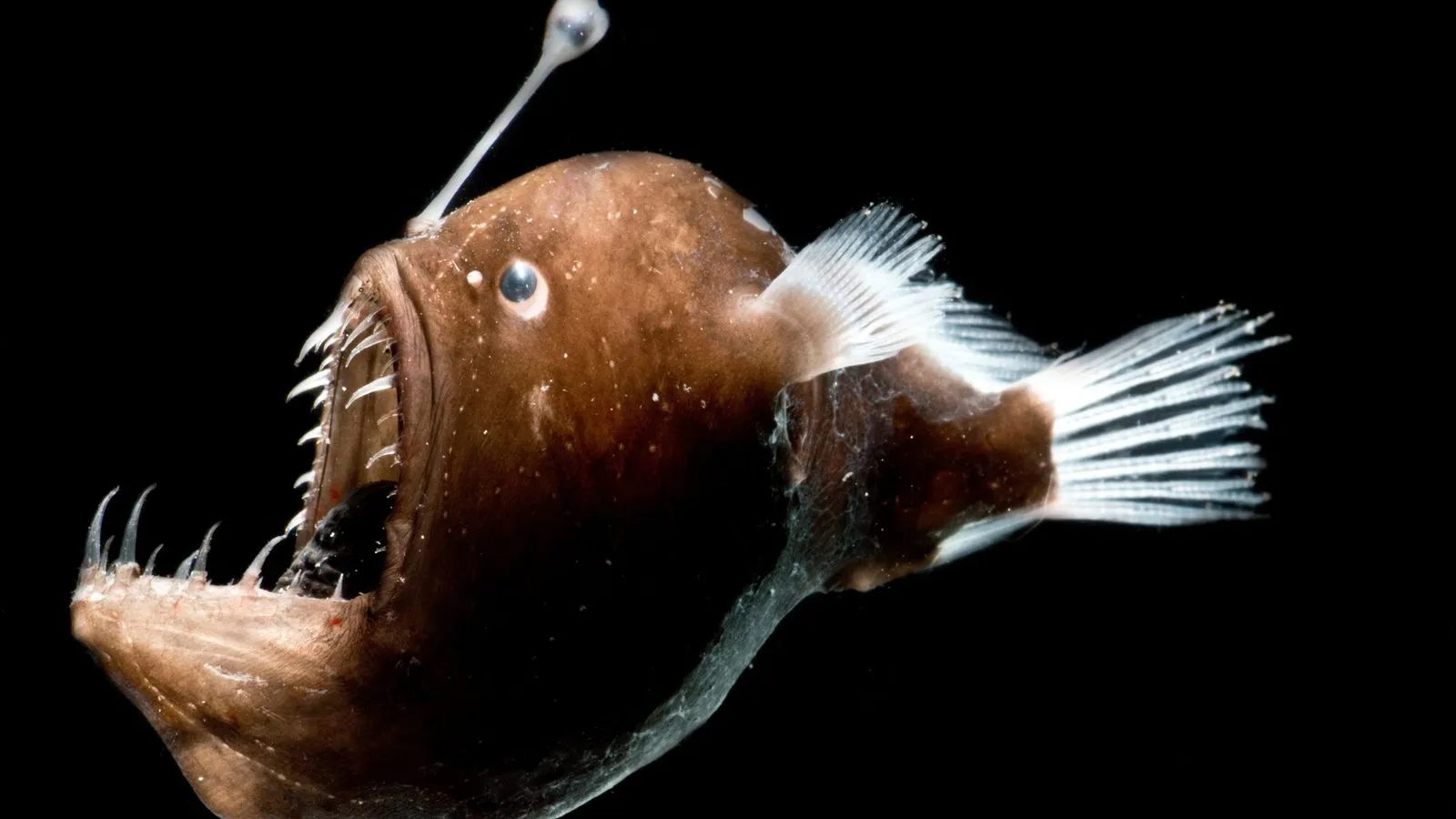
A deep-sea anglerfish carries its own fishing rod, and the bait at the end glows. The light does not come from the fish itself but from bacteria living inside the lure, which shine in the pitch-black water and draw prey close to a very large mouth.
A fin turned into a fishing rod
True anglerfish belong to the order Lophiiformes, and more than 200 species have been documented around the world. Their “fishing rod” is a modified fin called an illicium, which sticks out from the head. At its tip hangs a fleshy lure called an esca.
Some anglerfish, such as the striped anglerfish, live in shallow coastal water. Their lure imitates favorite foods of their prey, such as marine worms or small fish. The fish rests, well camouflaged, and swings the rod in front of its mouth, wiggling the lure until something comes close enough to grab.
The deep-sea anglerfish take this trick into total darkness. There are roughly 160 known species, found in all the world’s oceans, and they are rarely seen. They hunt at depths between 300 and 5,000 meters (980 and 16,400 feet).
Light borrowed from bacteria
In deep-sea anglerfish, the esca lights up. The glow is made by a group of bioluminescent bacteria that live in partnership with the fish, inside the lure.
Some anglerfish have a second light as well. Female leftvent anglerfish, a family that includes the netdevils, have two separate light systems. Their lure glows because of the bacteria inside it. But most species also carry an elaborate chin barbel, a whisker-like growth under the jaw, and the light there is made by the fish’s own body. Females use the lure and the glowing barbel together to attract prey.
Built to swallow big meals
Female leftvent anglerfish have huge heads, enormous mouths and long, dagger-like teeth. Deep-sea anglerfish in general have an expandable stomach and can swallow prey larger than themselves in a single gulp.
Females are poor swimmers. Rather than chasing food, they wait in the dark and let the light do the work.
Tiny males that fuse for life
The strangest part of the anglerfish story is how they mate. In many deep-sea species, the males are dwarfs. On average, females are about 10 times larger, and in the most extreme cases a female may be more than 60 times the length of a male and around half a million times as heavy.
Males do not have a lure. Instead, most have large eyes and huge nostrils, which help them track down a chemical scent that females give off. In the vast, dark deep sea, males and females rarely meet, so once a male finds a female, he does not let go.
A male bites into the female’s body and holds on with special toothy hooks on his jaws. Over time his tissue fuses with hers, and their blood supplies join. From then on he depends on her for all his food, and he lives and dies when she does. Scientists call this sexual parasitism. In some species only one male attaches, but in others several do, sometimes up to eight on a single female.
The Max Planck Society describes one black seadevil female of about 75 millimeters with a 23.5 millimeter male fused to her belly. Another female, a spinyhead seadevil measuring 46 millimeters, carried a male just 6.2 millimeters long on her back.
The first attached pair was found by an Icelandic fisheries biologist in 1920. A mating pair of the deep-sea anglerfish Caulophryne jordani was first documented on film in 2018.
Why the female does not reject him
Joining two separate animals like this was a long-standing puzzle. Normally, an immune system attacks tissue from another individual, which is why organ transplants are so difficult.
In 2020, scientists at the Max Planck Institute of Immunobiology and Epigenetics in Germany and the University of Washington published the answer in the journal Science. They found that anglerfishes that use permanent attachment largely lack the genes for MHC molecules, which normally help the immune system raise the alarm about infected or foreign cells. Killer T cells, which usually attack foreign tissue, were weakened or missing, and some species had no antibodies at all.
Instead, the fish seem to rely on other, built-in defenses to fight infections. Anglerfish expert Ted Pietsch said the team found it remarkable that this way of mating evolved several times independently among these fishes.