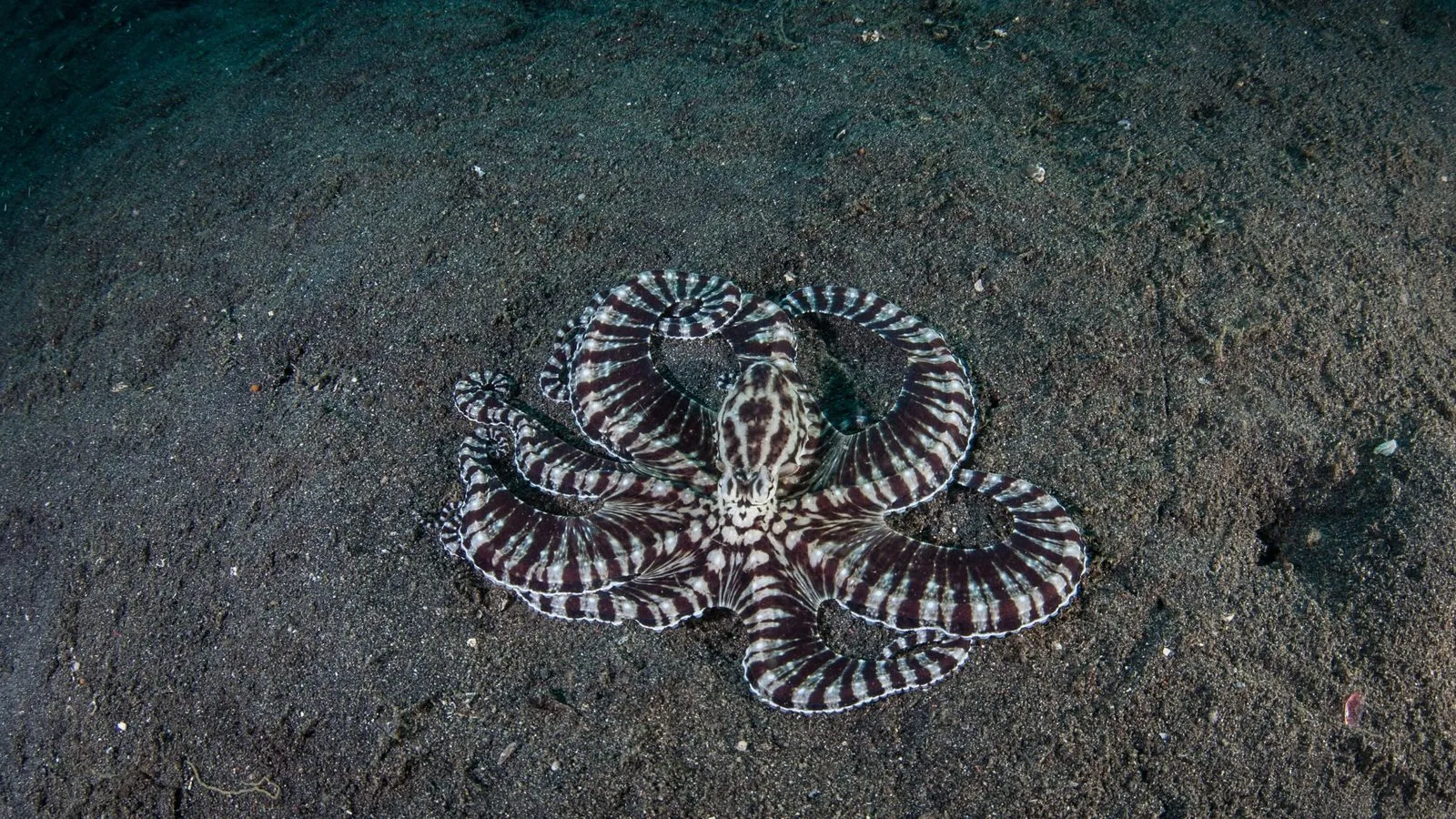
The mimic octopus does not just hide from predators. It impersonates dangerous animals, shifting its shape, color and movement to pass for a toxic flatfish, a spiny lionfish or a venomous sea snake, and it can switch from one act to another.
A late arrival to science
Thaumoctopus mimicus lives in the seas of Indonesia and was not described by scientists until 1998. Octopus specialist Mark Norman of the University of Melbourne and his colleagues filmed it during research dives off Sulawesi and Bali, and they called it the mimic octopus.
The species stood out for when and where it feeds. Diving over 24-hour periods, Norman’s team found that the mimic octopus comes out in daylight to forage across open sand, in full view of fish that might eat it. On bare sand there is nowhere to hide. As Norman put it, a soft octopus caught in the open by a passing fish has to look either deadly or inedible.
The researchers watched nine individuals use a whole repertoire of body postures and color patterns. Several of these were clear impersonations of venomous animals that share the same habitat.
The impressions
Its best-known act is the flatfish. When it swims, the mimic octopus can pull all of its long arms behind its body and glide over the seafloor like a toxic sole, such as a zebra sole. It does not just copy the shape. It also matches the sole’s colors and ripples its body to copy the way a flatfish swims.
Its brown-and-white striped arms also look like the patterning of venomous sea snakes and the coloring of spiny lionfish.
The sea snake routine is the most surprising. The octopus pulls its head and six of its arms into a burrow, then waves the other two in opposite directions, so they wriggle like a banded sea snake. It has been reported to use this act when territorial damselfish come to chase it, and sea snakes prey on damselfish.
Some reports suggest it may also imitate sea anemones, stingrays and jellyfish, though these are less certain.
Switching acts on the fly
Plenty of animals copy something dangerous, but most stick to a single disguise. What made the mimic octopus so unusual was how it switched between several. Tom Tregenza of the University of Leeds, a co-author of the paper that first described its behavior, said no other animal had been found that could rapidly change between different forms of mimicry.
The researchers called this dynamic mimicry. Having many acts may help. If every mimic copied the same lionfish, predators would meet fakes more often than the real thing and might learn they are safe to bite. Spreading the disguises around makes each one harder to see through. The scientists also suggested the octopus chooses the act that best suits the threat in front of it.
Some people wondered whether human eyes were simply reading too much into the octopus’s movements. In 2000, a film crew from the BBC and Discovery captured six hours of footage of the mimic. The mix of color, posture and very un-octopus-like movement convinced many doubters.
How the trick evolved
Like other octopuses, the mimic has no shell or skeleton, so it can bend into almost any shape. Its skin holds sacs of pigment called chromatophores that can be stretched or squeezed to change color and pattern quickly. Its ancestors probably lived unnoticed on nearby coral reefs before moving out onto the open sand.
In 2010, scientists from the California Academy of Sciences and Conservation International Indonesia used DNA from the mimic octopus and 35 of its relatives to build a family tree. They found that the octopus began to swim like a flatfish around the same time it evolved very long arms. The bold brown-and-white patterning came later.
That was a risky step. The mimic’s close relatives use dull colors and camouflage to stay hidden, and the mimic can do the same. Yet it often makes itself stand out. Healy Hamilton of the California Academy of Sciences said its flatfish act is far from perfect, but it may be good enough to fool predators. In the time it takes a predator to look twice, the octopus may get away.
The bright pattern might also be an honest warning that the octopus tastes bad, though this has not been confirmed. Scientists have seen at least one flounder spit out a mimic octopus after trying to eat it.
A fish that copies the copycat
The mimic octopus even has its own imitator. During a dive in Indonesia, researcher Godehard Kopp of the University of Gottingen filmed a small black-marble jawfish following close behind a mimic octopus as it crossed the sand. The jawfish had brown-and-white markings much like the octopus, which made it hard to spot among the arms.
Jawfish usually stay close to their burrows. Ichthyologist Luiz Rocha of the California Academy of Sciences suggested this one was hitching a ride, using the octopus as cover to look for food out in the open where a grouper or snapper would otherwise grab it.
Rocha warns that reefs in the Coral Triangle area of Southeast Asia are declining fast, mostly because of harmful human activity. Christine Huffard of Conservation International Indonesia says the mimic octopus will keep evolving as long as it and its habitat are protected from threats such as trawling, land reclamation and runoff.