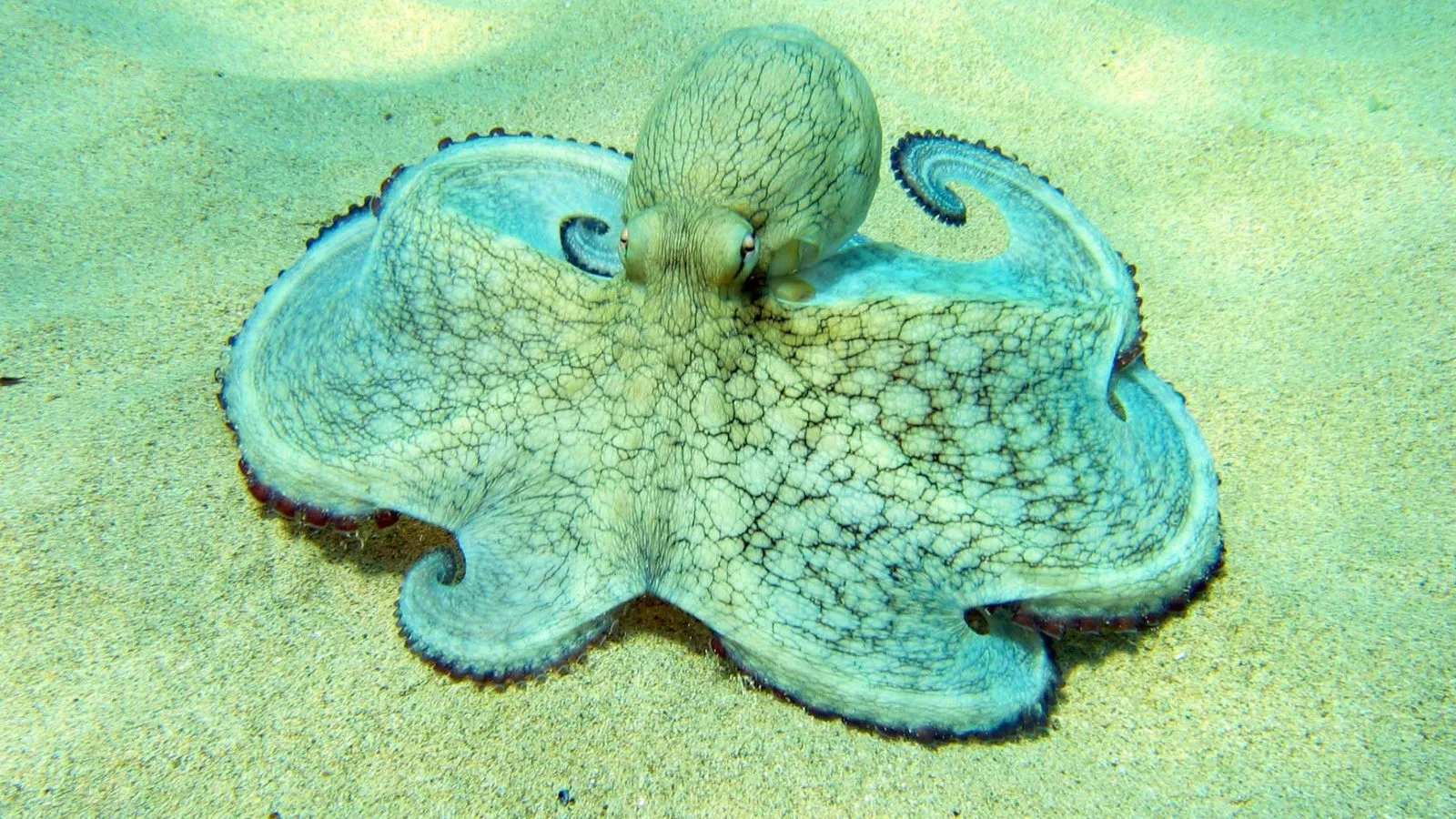
An octopus changes color using thousands of tiny, stretchy pigment sacs in its skin called chromatophores. Muscles around each sac, controlled directly by signals from the brain, pull it open or let it shrink, and the fastest color changes take less than a tenth of a second.
Pigment sacs in the skin
Chromatophores are dotted all through an octopus’s skin. Depending on the size of the species, there can be tens of thousands or even millions of them.
At the center of each chromatophore is a sac filled with tiny particles of a pigment called xanthommatin. The sac sits inside an elastic casing, which is attached to muscle cells arranged around it in a pointed star shape. When those muscles contract, the sac is stretched wide. More light can then enter and bounce off the pigment, so a bigger patch of color shows on the skin. When the muscles relax, the sac shrinks back to a tiny dot.
Octopus skin has three layers of chromatophores. According to biochemist Leila Deravi of Northeastern University, who studies octopus camouflage, the top layer produces yellow, the middle layer red and the bottom layer brown. By opening and closing sacs in different layers, an octopus can mix these into a wide range of shades and patterns.
Wired straight to the brain
Each chromatophore is controlled by nerve signals from the octopus’s brain. Deravi compares it to flexing your biceps. The brain sends a signal, the muscles pull, and the sac opens.
That direct wiring is why octopuses are so fast. Deravi says the quickest color changes take under 100 milliseconds, faster than the blink of an eye. A chameleon, by contrast, can take several seconds to more than a minute to change color completely.
Octopus nerve tissue is not packed into the head alone. Octopuses have clusters of nerve cells throughout their bodies and arms, which link the brain closely to the skin. They also have more chromatophores per square inch of skin than squid and cuttlefish, which lets them make very finely detailed patterns.
Shine and sparkle from reflecting cells
Pigment is only part of the story. Some octopus species have two more kinds of skin cells that work with light.
Iridophores are a little larger than chromatophores. They contain a protein called reflectin, which stacks up inside them to make a mirror-like effect, producing shiny, metallic colors. Leucophores hold white material that scatters light, helping to control how bright and how contrasting the colors look. Both kinds are also controlled by signals from the brain.
Changing texture too
Color is not the only thing an octopus can change. Its skin is covered in tiny bumps called papillae. Relaxed, they leave the skin smooth like seaweed. Tightened, they make it lumpy and rough like a rock. Changing texture adds another layer to the disguise.
A color-blind master of color
Here is the puzzle. Most octopuses are color-blind. Their eyes have only one type of light-detecting cell, so they can sense differences in brightness but not in color. Scientists still do not know how they match their surroundings so well.
One clue may lie in the skin itself. In 2015, Desmond Ramirez and Todd Oakley of the University of California, Santa Barbara, tested skin from the California two-spot octopus. When they shone white light on samples of skin removed from the animal, the chromatophores expanded, with no eyes or brain involved. When the light went off, they relaxed again.
The skin contained the same family of light-sensing proteins, called opsins, that the octopus uses in its eyes. It responded fastest to blue light, with peak sensitivity at about 480 nanometers. Ramirez explained that the skin does not see detail, edges or contrast, but it can sense a change in brightness. There is no evidence yet that this helps octopuses see colors, and Oakley cautioned that it is early days.
Why octopuses change color
An octopus has no shell or other armor. Cephalopod expert Jennifer Mather of the University of Lethbridge told Live Science that to a predator, an octopus is an unprotected package of protein, so it had to evolve ways not to be seen. Hiding from predators is the main job of all that color changing.
Camouflage also helps an octopus sneak up on prey. Some octopuses do the opposite of hiding, flashing sudden, rapid color changes that startle prey before they grab it. A few species use solid bands of color to attract mates or warn off rivals, and the four species of blue-ringed octopus show off bright rings that warn other animals away from their poison.
The skill is there from birth, but Mather thinks octopuses get better at it with practice over their lives, which normally last around one to two years.