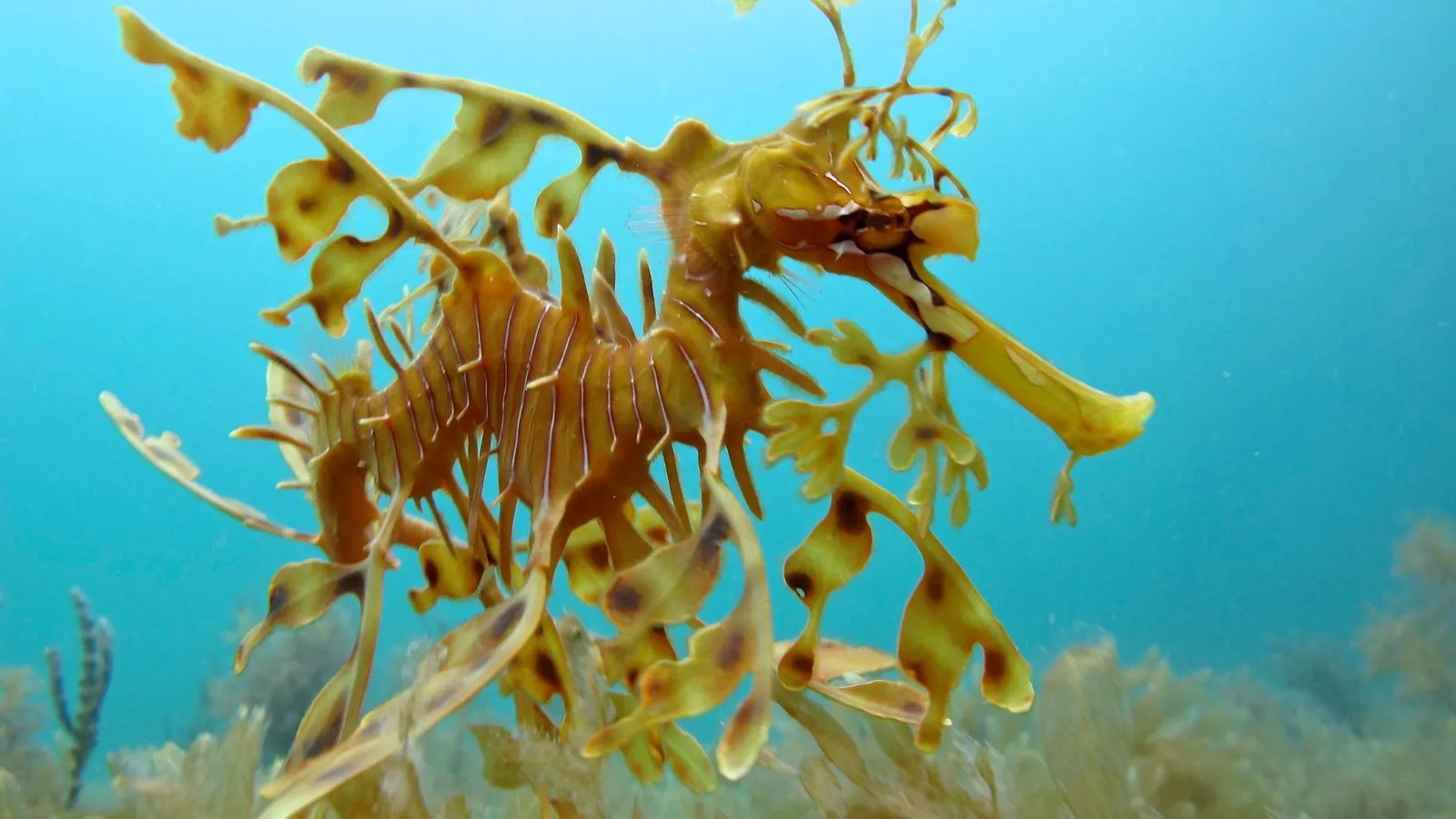
The leafy seadragon looks like a piece of drifting seaweed that has learned to swim. Its body is covered in leaf-like flaps, and it sways back and forth with the waves among the kelp of southern Australia, where it is almost impossible to spot.
A seahorse relative in disguise
The leafy seadragon, Phycodurus eques, is a relative of seahorses and pipefishes. It grows up to 35 centimeters long and can live for up to 10 years. It was first described in 1865, from a specimen collected at Port Lincoln in South Australia.
Like a seahorse, its head and body are encased in rings of bony plates. Its head sits at a right angle to the body and ends in a long, tube-shaped snout. On top of that armor it carries long spines and large leafy appendages that branch out from its body.
It is greenish to yellowish or brownish-yellow, crossed by many thin pale lines with dark edges. With that coloring and its frond-like flaps, it closely resembles kelp. It even rocks back and forth with the moving water, looking still more like a waving seaweed frond. Australian Geographic notes that its disguise is so good that even predators often overlook it.
Beneath all the leafy decoration, it has a pectoral fin on its “neck” and a dorsal fin on its “back.”
Where it lives
The leafy seadragon is found only in the temperate waters of southern Australia, from around Victor Harbor and Kangaroo Island in South Australia west to Western Australia. It lives on rocky reefs covered in kelp, in seagrass beds and among other seaweeds, usually in sheltered bays, at depths of about 3 to 50 meters.
Its best-known cousin is the common seadragon. The common seadragon is reddish, with simple, unbranched flaps and no long body spines, and the two are rarely found together.
Sucking up its food
Leafy seadragons feed on mysids, small shrimp-like animals, and other tiny crustaceans. Like seahorses and pipefishes, they suck prey in through their long, tube-shaped snouts.
They are slow-moving, solitary and fairly sedentary animals, depending on camouflage rather than speed to avoid being eaten.
Fathers carry the eggs
As with seahorses, it is the male leafy seadragon that looks after the eggs. Seadragons gather in late winter to form monogamous pairs. Spawning usually happens in summer, when the female lays her eggs onto a patch of spongy tissue on the underside of the male’s tail. The eggs sink partly into this tissue as they develop.
A male carries 250 to 300 pear-shaped eggs, each about 4 by 7 millimeters, and may care for two broods in one season. After 6 to 8 weeks, males often move into deeper water, down to about 25 meters, before the young hatch. The brood hatches over 6 to 7 days, while the father spreads his offspring over a wide area.
The newborn seadragons are well developed, very slender and 30 to 35 millimeters long. Their leafy flaps start small and grow longer and more elaborate as they grow. Young seadragons live in shallow, sheltered water at depths of 5 to 7 meters and grow quickly.
A third dragon
For about 150 years, scientists thought there were only two kinds of seadragon. Then, in 2015, researchers at Scripps Institution of Oceanography and the Western Australian Museum announced a third, the ruby seadragon.
They found it by studying DNA from tissue samples held at the museum. The specimen had been collected in 2007, and a CT scan made of 5,000 X-ray slices showed skeleton features that set it apart. The museum later found another ruby seadragon in its collection that had first entered the museum in 1919 and sat unidentified for almost a century. The new species is bright red, while leafy seadragons have an orange tint.
Protecting the dragons
The leafy seadragon is protected throughout its range in Australia and is the official marine emblem of South Australia. Australian Geographic reports that the IUCN listed it as Near Threatened as of July 2025.
Its main threats include habitat loss from coastal development, pollution, climate change and illegal collection for the aquarium trade. It is occasionally caught by accident in commercial trawl fisheries. Because it moves so little, it is especially sensitive to changes in its local environment.