Below about 1,000 meters, the ocean is completely dark. NOAA explains that while faint light may reach that far down, there is rarely any significant light beyond 200 meters, and none at all in the layer scientists call the bathypelagic, or midnight, zone, between 1,000 and 4,000 meters deep.
Food is scarce down there, and there is nowhere to hide. The animals that live in this endless night have found clever ways to eat, avoid being eaten and make their own light. Scientists at MBARI, a nonprofit ocean research center, study them with remotely operated robot submarines. These are six of the strangest residents they have met.
Whiptail gulper eel
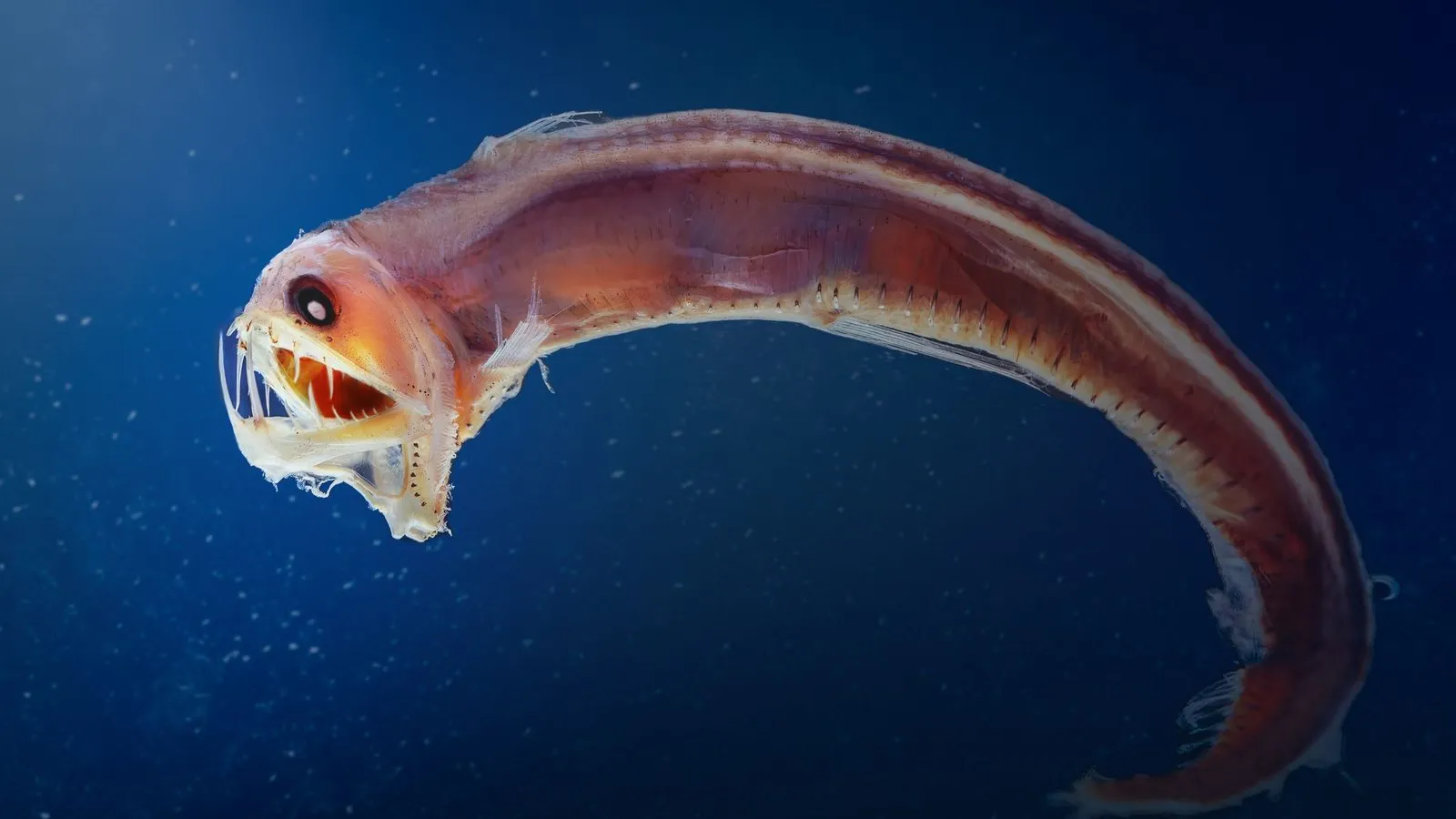
The whiptail gulper eel is mostly mouth. Its huge, gaping jaws let it swallow any scrap of food it finds, big or small, which matters in a place where meals are rare. Scientists think the glowing tip of its long, thin tail may work as a lure, drawing curious prey close enough to be gulped down.
This eel grows to about 1 meter long and lives between 300 and 2,000 meters deep in the eastern Pacific, from Northern California to Peru. It is very hard to find. MBARI has explored the deep waters of Monterey Bay for more than 30 years, and in thousands of dives its team has seen this species only seven times. They liked it so much that they put it in their logo.
Angler siphonophore
Siphonophores are close cousins of jellies. Each one is a colony of individual, specialized parts linked together in a chain. Some parts pulse and steer, while others stun and swallow prey. Their bodies are so fragile that they are best suited to open water, where there are no sharp surfaces to tear them.
The angler siphonophore, Erenna sirena, is a sneaky hunter. It dangles glowing lures that look like small red crustaceans. When a curious lanternfish swims too close, the siphonophore’s tentacles deliver a powerful sting and catch it. This species reaches about 45 centimeters long and lives in the midnight zone, 1,600 to 2,400 meters down, off the coast from Central California to Baja California.
Bomber worm
The bomber worm is only about 30 millimeters long, and it swims a few meters above the seafloor at depths of 2,700 to 3,600 meters. Out in the open, a small wriggling worm looks like an easy meal. But this one carries an escape trick.
Just behind its head, the bomber worm has eight sacs of glowing fluid. When something disturbs it, the worm drops one of these “bombs,” which bursts into a bright green glow. While the predator is distracted by the light show, the worm paddles away to safety. Then it grows a replacement, so it is ready for the next threat.
Giant phantom jelly
Out of the darkness, MBARI’s robot submarine once spotted what looked like a billowing red curtain. It was a giant phantom jelly, Stygiomedusa gigantea. Its bell can be more than 1 meter across, and it trails four ribbon-like mouth arms that can grow longer than 10 meters.
This huge jelly lives in oceans worldwide except the Arctic, typically in the midnight zone. It is so rarely encountered that in thousands of dives, MBARI’s robots have seen it only nine times. The first specimen was collected in 1899, but it took scientists about 60 more years to recognize it as a new species. Even now, very little is known about how it lives.
Fangtooth
With its gaping mouth and long, sharp teeth, the fangtooth, Anoplogaster cornuta, looks like a monster. It even has the nickname “ogrefish.” In fact, it is quite small, growing to about 18 centimeters, and it is probably a lazy hunter. Its stubby fins and mottled pattern suggest a fish that lurks and waits for prey to swim too close.
Scientists think the fangtooth has poor eyesight but an excellent sense of touch. A dark line along each side, called the lateral line, senses tiny movements in the water around it. It lives between 500 and 2,100 meters deep in tropical and temperate oceans worldwide, and eats fishes and crustaceans. MBARI teams have spotted one less than once every two years on average.
Whalefish
A whalefish lives below 1,000 meters and barely uses its eyes. They are small and lack lenses, so they cannot form images. Instead, it feels its way through the dark using large sensory pores along its head and body, which pick up vibrations from nearby predators or prey. The ridges holding these pores give it a crocodile-like look.
Like many deep-sea animals, it is bright red. Red light does not reach the deep sea, so red animals look black and seem to vanish. There are 30 species of whalefish, most about 20 centimeters long, the largest up to 40 centimeters. They are named for their broad bodies and wide, whale-like mouths. In more than 27,000 hours of robot video, MBARI has logged just 16 whalefish sightings.