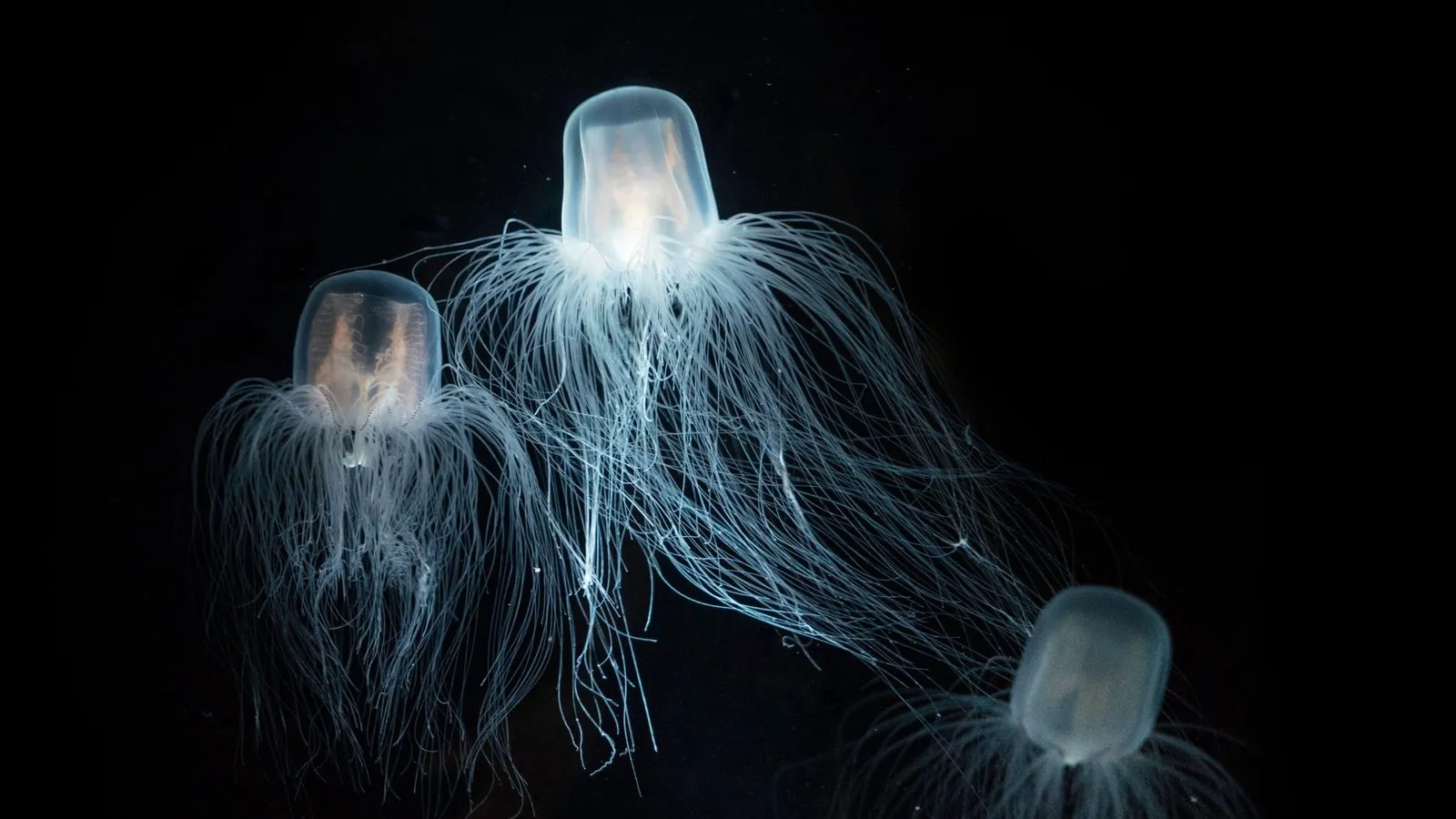
One tiny jellyfish has found a way around growing old. When Turritopsis dohrnii is injured or starving, it can turn its adult body back into a young polyp and grow up all over again, which is why it is nicknamed the immortal jellyfish.
A very small animal
The immortal jellyfish is about 4.5 millimeters wide and tall, smaller than the nail on your little finger. It is transparent, with a bright red stomach. Scientists first described the species in 1883, but nobody noticed its strange talent for another hundred years.
It is a hydrozoan, part of the same wider group of animals as corals and sea anemones. It is thought to have come from the Mediterranean Sea, but it is now found in oceans all around the world.
The normal jellyfish life cycle
To see why this animal is special, it helps to know how most jellyfish live. Adult jellyfish, called medusae, release eggs and sperm. A fertilized egg becomes a free-swimming larva that drifts until it finds a hard surface to settle on. There it grows into a polyp, a small animal fixed in place. Polyps then bud off young jellyfish, which mature into adults.
For nearly all jellyfish, that is a one-way trip. The adult breeds and eventually dies.
Running life in reverse
Turritopsis dohrnii can break that rule. When the adult is physically damaged or stressed, for example by starvation, it shrinks in on itself. It reabsorbs its tentacles, loses the ability to swim and sinks to the seafloor as a blob-like cyst.
Over the next 24 to 36 hours, the blob develops into a new polyp, the stage that normally comes before the adult. That polyp can then bud off new medusae that are genetically identical to the original. The Natural History Museum in London compares it to a butterfly that turns back into a caterpillar instead of dying, then becomes a butterfly again.
The process that makes this possible is called transdifferentiation. Cells that already had one specialized job are reprogrammed into a different type of cell, so the animal can rebuild itself with a completely different body plan. A study of the jellyfish’s genes describes the cyst as the in-between stage where this cell switching and reorganizing takes place.
The cycle can be repeated. Japanese scientist Shin Kubota has kept immortal jellyfish looping through this life cycle since the 1990s. He reported that over a two-year period, his captive colonies renewed themselves up to 10 times, sometimes as often as once a month.
Found by accident
The discovery happened by chance in the 1980s. Students Giorgio Bavestrello and Christian Sommer collected Turritopsis polyps and raised them until they released medusae. When the pair next checked the jar, they were surprised to find many newly settled polyps. Watching closely, they saw that stressed medusae fell to the bottom and turned into polyps without breeding first.
When the finding was announced at a scientific workshop in Blanes, Spain, in 1991, some experts did not believe it. Marine zoologist Stefano Piraino and other attendees collected the jellyfish themselves and repeated the experiment, and got the same result.
Clues in its genes
In 2022, a team including Maria Pascual-Torner at the University of Oviedo published the genome of Turritopsis dohrnii in the Proceedings of the National Academy of Sciences. To collect samples, she and a colleague traveled the Italian coast in 2019 in a camper van, diving for polyps.
The team compared the immortal jellyfish with a close relative, Turritopsis rubra, which cannot rejuvenate after breeding. They paid attention to some 1,000 genes linked to aging. The immortal jellyfish had extra copies or variants of genes involved in copying and repairing DNA, and in protecting telomeres, the caps on the ends of chromosomes. Pascual-Torner called the study just the first step in understanding how the jellyfish does it.
Not truly immortal
The nickname is a stretch. Monty Graham, director of the Florida Institute of Oceanography, called the term a bit hyperbolic. These jellyfish may not die of old age, but they can still be eaten or killed by disease. Fish and turtles eat the medusae, and the polyps have little defense against sea slugs and crustaceans.
Their survival skill may also explain how they spread. Scientists think the jellyfish may ride across oceans in the ballast water that ships pump in and out for stability, surviving long, hungry journeys by turning back into polyps. They even look different in different places. Immortal jellyfish in tropical Panama were found with only eight tentacles, while those in the Mediterranean and Japan can have 24 or more.
Article Sources
- Immortal jellyfish: The secret to cheating death | Natural History Museum
- An "Immortal" Jellyfish Offers Clues into Biological Aging | The Scientist
- Transcriptome Characterization of Reverse Development in Turritopsis dohrnii (Hydrozoa, Cnidaria) | PMC
- New study could unearth the secret to how 'immortal jellyfish' reverses aging | CNN via ABC17 News