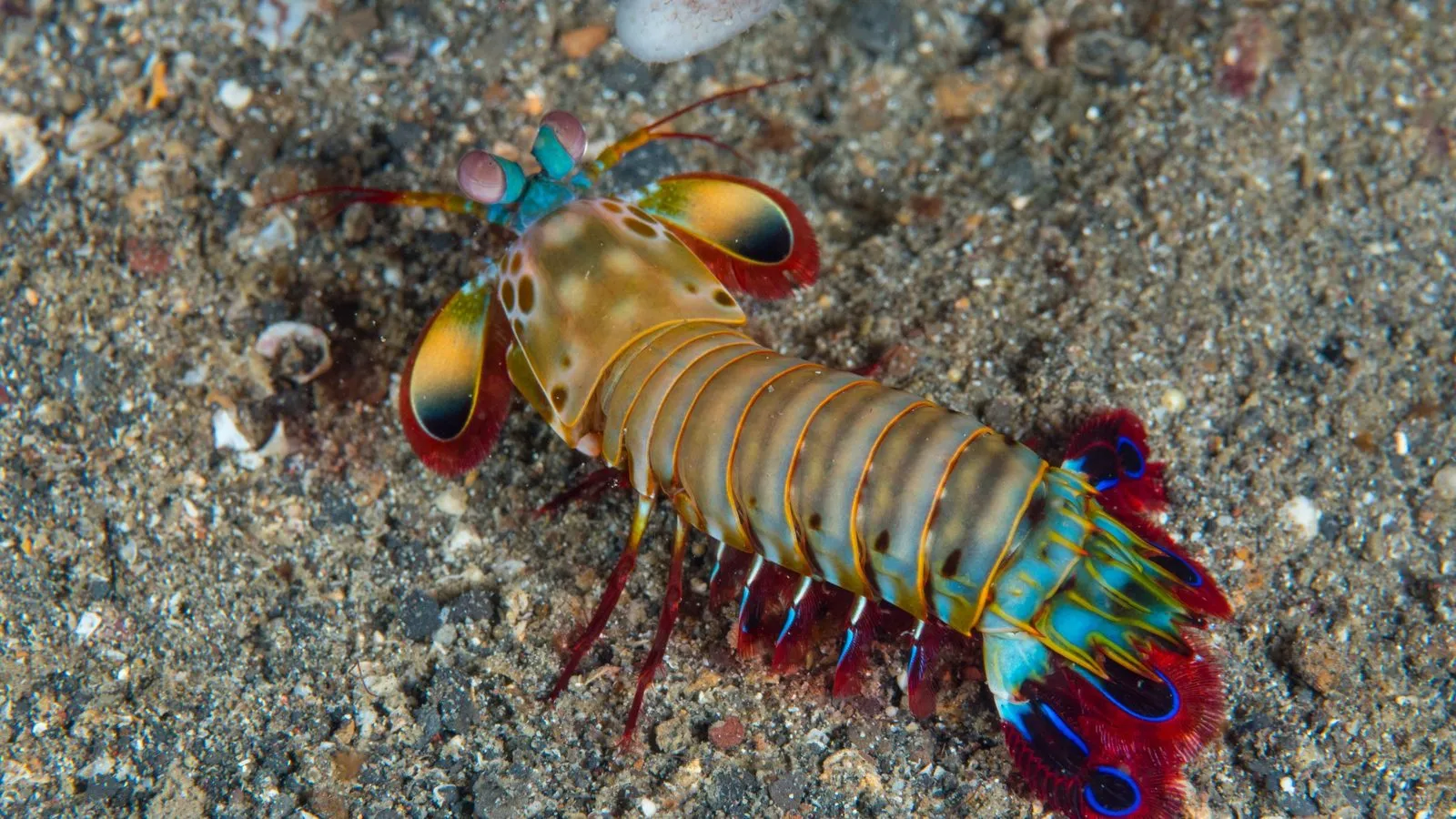
A mantis shrimp’s punch is one of the fastest strikes in the animal kingdom. When researchers at the University of California, Berkeley, filmed a peacock mantis shrimp smashing snails, they clocked its club at peak speeds of 14 to 23 meters per second, reached in a burst of acceleration thousands of times stronger than gravity.
Not a mantis and not a shrimp
Mantis shrimp are stomatopods, a group of marine crustaceans that are distant relatives of shrimp and lobsters. There are around 450 known species. They range from about 2 to 30 centimeters long and live in burrows, often around coral reefs, where they are major predators.
Scientists sort them by the shape of their front limbs. “Spearers” have limbs tipped with barbed spikes for stabbing soft prey such as fish. “Smashers” have heavy, hammer-like clubs, called dactyl clubs, which they use to break open crabs, clams and snails. The peacock mantis shrimp, a colorful smasher from the Indo-Pacific, is the star of most punch research.
Clocking the strike
For years the strike was simply too fast to study. Biologist Sheila Patek and her colleagues found their video equipment could not keep up. Then a BBC crew filming a series called Animal Camera rented the team a high-speed camera. Shooting at 5,000 frames per second, they finally caught the blow on film, slowed down by a factor of 330.
The results, reported in the journal Nature in 2004, showed peak club speeds of 14 to 23 meters per second, with peak accelerations of 6,300 to 8,000 times the force of gravity. An earlier estimate for another mantis shrimp species had put the strike at 10 meters per second, far lower than what the camera revealed.
The California Academy of Sciences puts the striking speed at more than 50 miles per hour, with up to 160 pounds of instant force. The whole strike is over in under three thousandths of a second, even though the shrimp is punching through water, which is far denser than air. The Aquarium of Western Australia describes it as 50 times faster than the blink of a human eye.
A spring shaped like a potato chip
Muscle alone cannot move a limb that fast. Scientists knew the shrimp cocks its club and holds it with a latch while its muscles tighten, then releases the latch to fire the strike. But that click mechanism could not explain the extreme acceleration seen on video.
The answer turned out to be a small, saddle-shaped piece of the exoskeleton in the striking limb. It has the shape of a Pringles chip. When the limb is cocked, this saddle is squeezed and stores elastic energy like a spring. When the latch lets go, the stored energy is released and the club whips forward. Patek said she knew of no other living thing that uses this saddle shape as a spring.
Hitting prey twice
The high-speed video showed something else: bubbles forming at the point of impact. The club moves so fast that it lowers the water pressure in front of it, causing small bubbles to form. When they collapse, they release a burst of energy, along with sound and small flashes of light. This process is called cavitation, and it is destructive enough to pit the steel of boat propellers.
The researchers suggest the shrimp uses cavitation to help break snail shells. Prey is battered by the club and by the collapsing bubbles. The battering wears away the shrimp’s own club too, sometimes leaving holes through to the flesh beneath. The damage is fixed when the animal molts and grows a fresh, hard surface.
A club that does not shatter
How does the club survive blow after blow? Studies of its structure found that its outer layer is made of hydroxyapatite, a very hard mineral also found in human teeth and bones. Beneath that coating lie many layers of chitin, a tougher, more elastic material. Each layer is rotated slightly from the one above, forming a spiral staircase. When cracks form, they twist along the spiral instead of running straight through the club.
Engineers at UC Riverside and Purdue University worked for more than seven years to understand this design. They found that each twist makes a crack harder to push further, until it runs out of energy. The work is now helping to develop lighter, tougher materials for cars, aircraft and sports gear.
Breaking out of tanks
All that power causes trouble in captivity. Club-equipped mantis shrimp have been known to break the glass walls of their tanks. In 1998, a mantis shrimp nicknamed Tyson, just four inches long, smashed through the quarter-inch-thick glass wall of his tank and had to be moved to a more secure facility in Great Yarmouth. The California Academy of Sciences keeps its peacock mantis shrimp in a shatter-proof acrylic tank.
Their eyes are remarkable too. A peacock mantis shrimp has twelve kinds of photoreceptors, compared with three in human eyes. Oddly, it does not seem to tell colors apart better than people do, but it can see ultraviolet and polarized light. Peacock mantis shrimp mate and raise their eggs in U-shaped burrows at the base of coral reefs, and pairs can stay together for life, which lasts four to six years.
Article Sources
- Mantis shrimp may have swiftest kick in the animal kingdom | UC Berkeley News
- Mantis Shrimp May Have Swiftest Kick In The Animal Kingdom | ScienceDaily
- The Mantis Shrimp Has the World's Fastest Punch | National Geographic
- Peacock Mantis Shrimp | California Academy of Sciences
- Why mantis shrimp don't crack under pressure | UC Riverside News
- AQWA Facts: Peacock mantis shrimp | AQWA