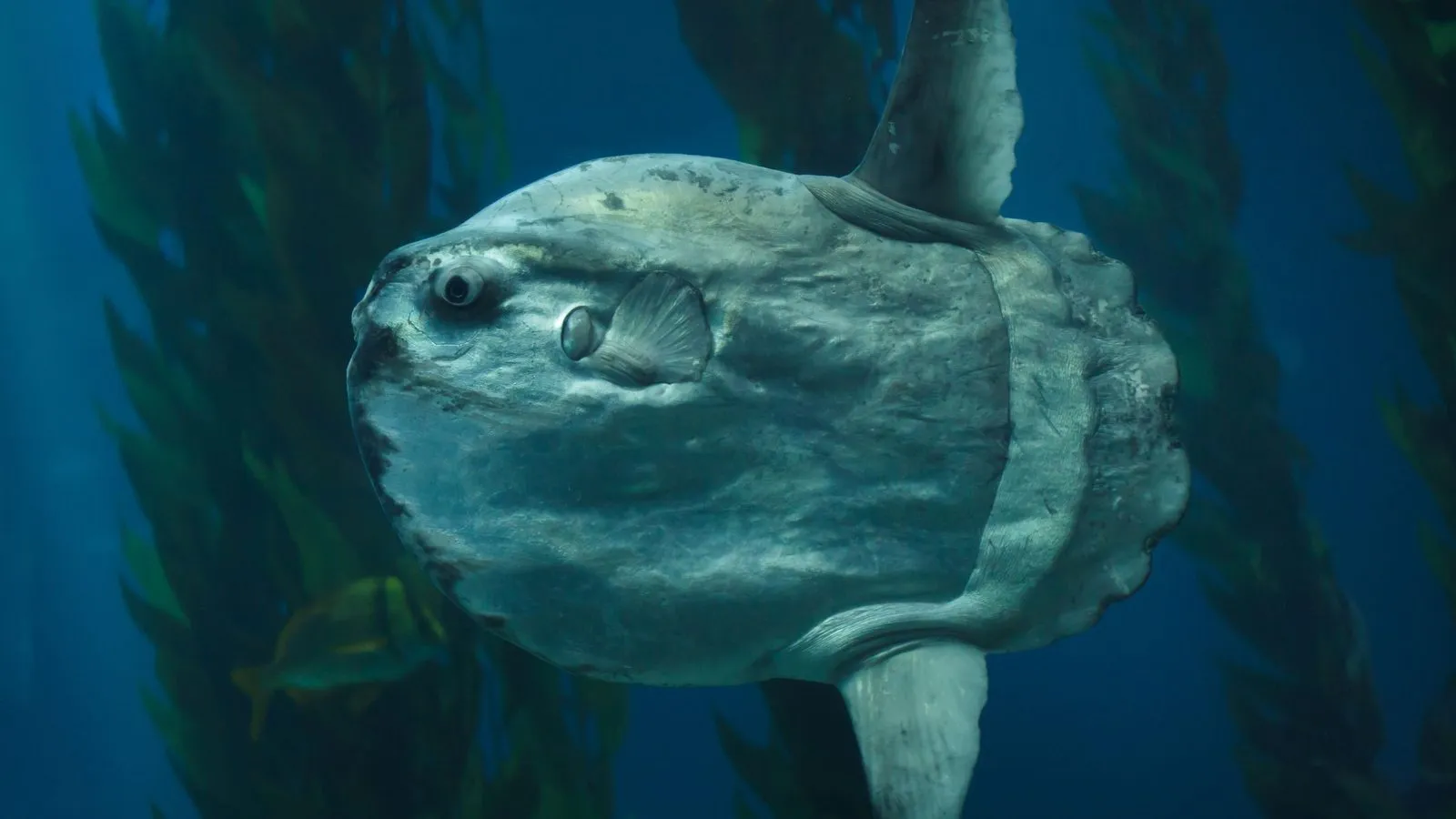
The heaviest bony fish in the world is a sunfish. The record holder, a bump-head sunfish found floating dead off the Azores in 2021, weighed 2,744 kilograms (6,049 pounds), and it may have been heavier still when it was alive.
A fish that looks like a head
Sunfish are some of the oddest-looking fish in the sea. The ocean sunfish, also called the mola, is silvery-gray and flattened from side to side, as if it had been squashed. It has a tiny mouth, big eyes and a tall fin sticking up from its back and another pointing down from its belly. Where a tail should be, there is only a short, scalloped fringe called the clavus, which the fish uses as a rudder.
The name Mola comes from the Latin word for millstone, a nod to the fish’s round shape. Inside that tiny mouth are hard tooth plates that look a little like a bird’s beak. Sunfish do not chew. They suck food in and spit it out again until it breaks into pieces small enough to swallow.
The mola is related to pufferfish, and a newly hatched sunfish shows it: the baby is puffy, round and covered in spines.
Just how heavy
Sunfish of the genus Mola hold the record for bony fish. Sharks and rays have skeletons of cartilage, so they are left out of the contest, and a whale shark can grow bigger still. Guinness World Records says adult sunfish average 1.8 meters (6 feet) long and weigh around 1,000 kilograms (2,200 pounds).
The record breaker was found off Faial Island in the Azores, Portugal, on December 9, 2021. It measured 3.25 meters long and 3.6 meters from fin tip to fin tip. It was towed ashore, and scientists needed a forklift and a crane to weigh it. It had a bruise from a boat strike near its head, but nobody knows whether that killed it. Because fish lose water after death, it may have weighed even more in life.
It beat a sunfish caught off Japan in 1996 that weighed 2,300 kilograms. That fish was long counted as an ocean sunfish, Mola mola, until a 2017 study showed it was a bump-head sunfish too.
There are three species in the genus: the ocean sunfish (Mola mola), Mola tecta and the bump-head sunfish (Mola alexandrini). They can be hard to tell apart without a DNA test. As bump-heads get big, they often grow lumps on the head and chin, and the Azores giant had them. A DNA test confirmed which species it was.
The ocean sunfish in California’s Monterey Bay can reach 1,000 pounds, but the Monterey Bay Aquarium gives the heaviest title to the bump-head, which it calls the giant sunfish.
From a speck to a giant
Sunfish start life tiny. The smallest larva ever weighed was just 3.7 milligrams. Marine biologist Tierney Thys worked out that going from that tiny larva to the record-breaking adult is an increase in weight of about 700 million times. Young ocean sunfish can put on up to 0.82 kilograms (1.8 pounds) every day.
Bigger fish can also lay more eggs, and a female releases tens of millions of eggs at a time. As adults, their size and skin several centimeters thick help protect them, though sea lions, sharks and killer whales still hunt them.
Jellyfish for dinner
Small sunfish eat crustaceans, squid, fish and algae. Once a sunfish reaches about 70 cm tall, it switches to a diet made mostly of jelly-like animals, from large moon jellies to tiny comb jellies and siphonophores. Scientists think a mucus-like lining in its gut keeps it from being stung.
Sunfish also carry a lot of hitchhikers. Nearly 40 kinds of parasites have been found in or on them, including gooseneck barnacles living in one sunfish’s throat.
Sunbathing at sea
Sunfish were once thought to simply drift with the currents. Tagging has shown they are strong divers that travel long distances at depth. Sunfish tracked in Southern California swam 16 miles (26 km) in a day, at up to two miles per hour.
Their prey often lives in deep, cold water, so after a dive a sunfish warms up by lying on its side at the surface. That basking habit is how it got its name. While it lies there, seabirds sometimes land on it, and researchers from the University of Washington have watched albatross picking parasites off sunfish at the surface.
Trouble near the surface
That time spent at the surface puts sunfish at risk. The IUCN lists the ocean sunfish as Vulnerable. Drift gillnets set for other fish catch many of them, and the nets cut their skin and scrape away their protective mucus. A 2004 study found that ocean sunfish made up 29% of the catch in drift gillnet fisheries targeting swordfish in Southern California. Estimates suggest their numbers are falling by at least 30% every 24-30 years.
Plastic bags are another danger. Floating at the surface, a bag looks a lot like a jelly, and a sunfish that swallows one can choke or slowly starve.