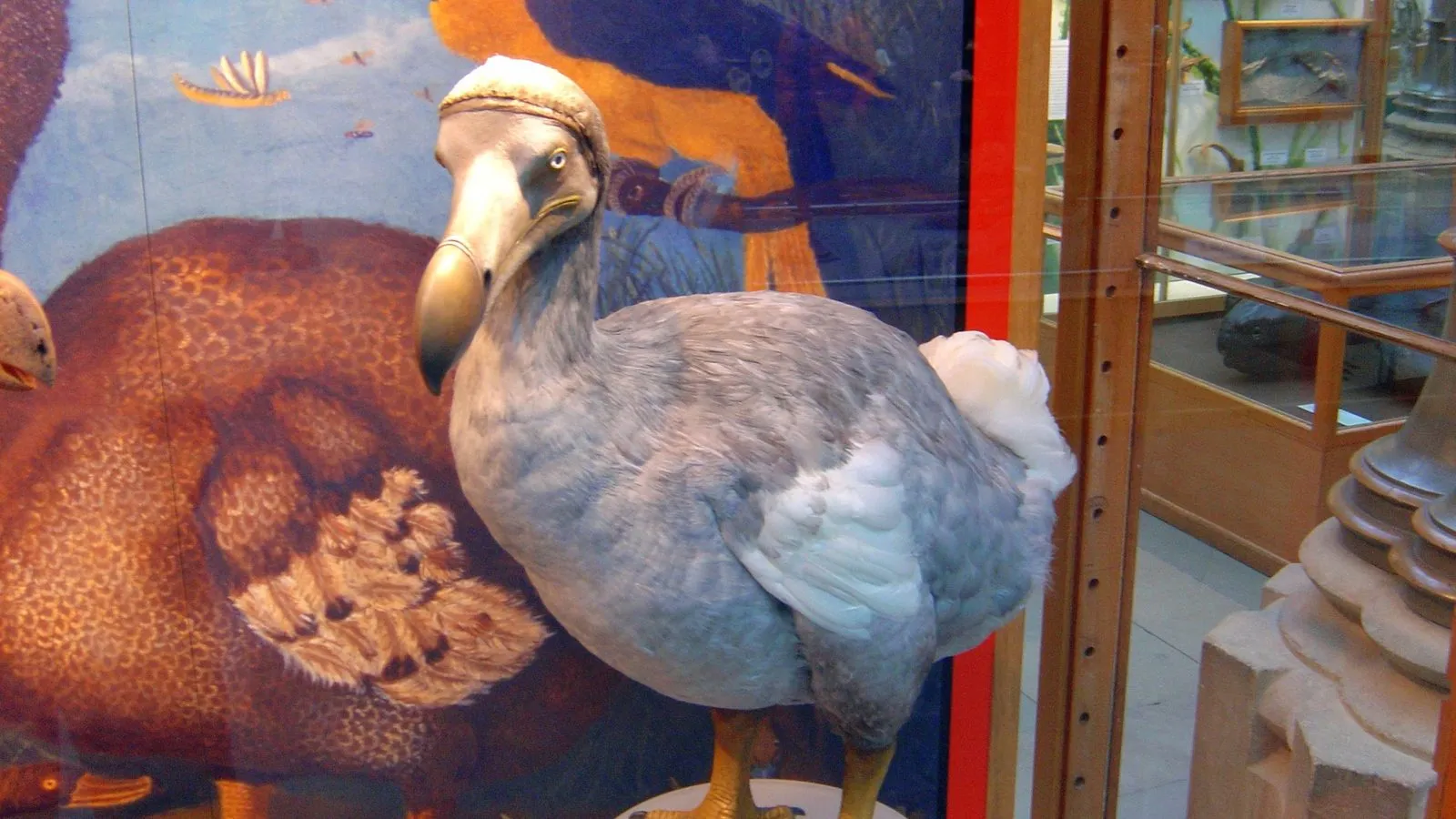
The dodo was not wiped out because it was too slow or too stupid to survive. It was a large, flightless pigeon that had thrived on the island of Mauritius, and it vanished in less than a hundred years after Dutch sailors landed there in 1598.
A giant pigeon on a quiet island
The dodo lived only on Mauritius, in the Indian Ocean. Its close relative, the Rodrigues solitaire, was another big flightless bird, found on the island of Rodrigues. In 2002, scientists at the University of Oxford used DNA to show that both birds belong to the pigeon and dove family. The closest living relative of the pair is the Nicobar pigeon.
Scientists think a flying ancestor reached Mauritius and Rodrigues some time after the volcanic islands formed, roughly 10 million years ago. With no land predators to escape, the birds spent more and more time on the ground. They grew bigger and, over time, lost the ability to fly altogether.
What a dodo really looked like
Old paintings show a fat, waddling bird, and that image has stuck for centuries. Newer studies of dodo bones tell a different story. The Natural History Museum in London describes the dodo as relatively slender and quite agile, with an upright stance and feathers that probably ranged from light gray to darker brown.
Size estimates differ. The Natural History Museum gives a height of about 70 centimeters and a weight of around 12 kilograms. The Oxford University Museum of Natural History says the birds stood about a meter tall and weighed about 20 kilograms. Weight may have changed through the year. Dodos are thought to have been leaner in the hot, rainy season from October to March and fatter in the cool, dry breeding season from April to September, which might explain why some early visitors called them plump.
Dodos lived on fruit and nested on the ground. A large gizzard stone helped them grind up fallen fruits and seeds. Each female laid a single egg, and the birds defended their territories fiercely, with males probably fighting each other using their big beaks. Scans of dodo braincases suggest the bird was about as intelligent as a modern pigeon and found its food by smell more than by sight.
What really happened
Arab and Portuguese ships had visited Mauritius before, but the Dutch were the first to settle. Having lived without predators, the dodos were unafraid of people and were easy to catch. Sailors hunted them, and their numbers fell sharply.
Hunting was only part of the story. The ships also brought dogs, cats, pigs and rats. These animals spread across the island, destroyed dodo habitat and ate their eggs. Both the Natural History Museum and the Oxford museum point to these introduced animals as the main reason the dodo disappeared so fast.
The last confirmed sighting was in 1662. The Natural History Museum notes that the dodo may have hung on until as late as 1680. By the 1700s, it was considered extinct, and many other animals from the island’s old wetlands had gone too.
The loss still matters on Mauritius. A 2023 study found that 400 years of extinctions have left 28% of the island’s native fruits too big for the surviving fruit-eating animals to swallow, so those plants struggle to spread their seeds.
The bird with no stuffed specimen
No stuffed dodo survives. At least 11 live dodos are thought to have reached Europe, yet every dodo shown in a museum today is a reconstruction. Most dodo skeletons are built from bones of many different birds, dug from a marsh on Mauritius called Mare aux Songes, which was discovered in 1865. Only two almost complete skeletons from single birds are known, and both are kept at the Mauritius Natural History Museum in Port Louis.
The most famous remains are in England. The Oxford Dodo, a head and a foot, holds the only dodo soft tissue left anywhere in the world. It was first listed in 1656 in a catalogue of the Tradescant collection, which later went to the University of Oxford. For a long time it was thought to be a bird kept alive in a London townhouse. Then in 2018, CT scans by WMG at the University of Warwick found lead shot pellets in its neck and the back of its head, of a type used to hunt wildfowl in the 1600s. Who fired the gun is still a mystery.
How the dodo got its name and its fame
Nobody is sure where the name came from. One idea links it to the Dutch word dodaars, first recorded in a ship’s journal in 1602, which refers to the knot of feathers on the bird’s rear end. Another links it to a Dutch word for a sluggard.
The dodo became a household name in 1865, when it appeared as a character in Lewis Carroll’s Alice’s Adventures in Wonderland. Carroll, whose real surname was Dodgson, is thought to have used Dodo as a nickname for himself, and he and Alice Liddell enjoyed visiting the Oxford museum to see the dodo remains there. The book turned the dodo into the best-known symbol of extinction, and the clumsy cartoon version of the bird grew from there.
Today, a company called Colossal says it hopes to edit the genes of the Nicobar pigeon to make a dodo-like bird. Even if that works, the real dodo, the agile island pigeon that sailors met in 1598, is gone for good.
Article Sources
- The dodo bird: The real facts about this icon of extinction | Natural History Museum
- The Oxford Dodo | Oxford University Museum of Natural History
- How did the Dodo evolve? | Oxford University Museum of Natural History
- Who shot the Dodo? | More Than A Dodo (Oxford University Museum of Natural History blog)
- Extinctions on the island of the dodo are pushing plants towards extinction | Natural History Museum
- Dodo | Wikipedia