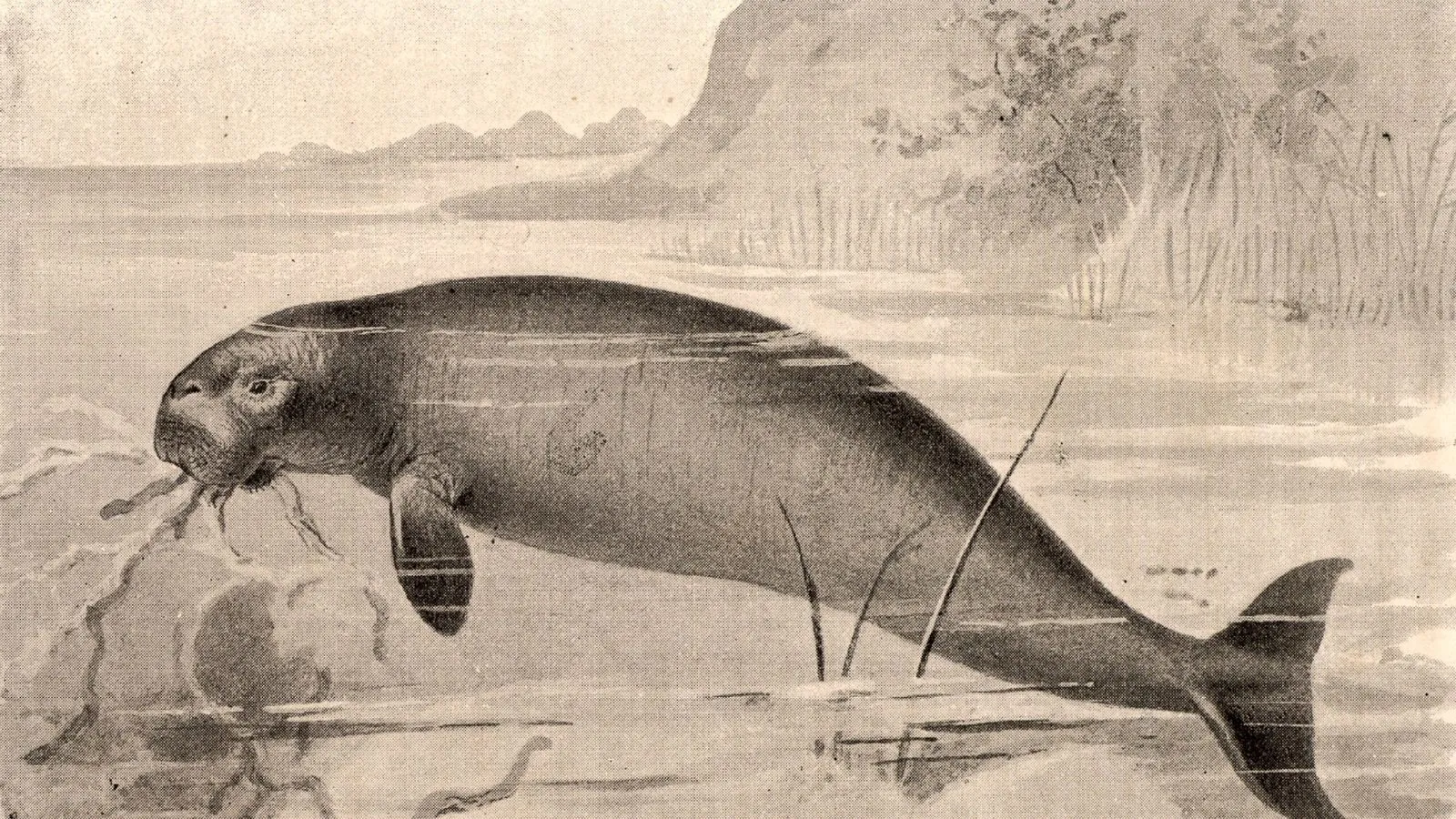
Steller’s sea cow was first described by a scientist in 1741, and by 1768 it was gone. In just 27 years, fur hunters crossing the Bering Sea killed off a giant, gentle relative of the manatee that no one alive has seen since.
A giant built for cold water
Steller’s sea cow belonged to the sirenians, the group that includes today’s manatees and the dugong, its closest living relative. All four surviving sirenian species live in warm, tropical waters. Steller’s sea cow was the exception. It lived in the cold sub-Arctic waters of the northern Pacific.
It was enormous, but sizes vary between sources. A study reported in Smithsonian Magazine describes it as more than seven meters long and around 5,000 kilograms, roughly 10 times heavier than living sirenians. The Natural History Museum in London says it could reach up to 10 meters and weigh up to 11 tonnes, heavier than a big male killer whale, which can reach eight meters and six tonnes. Georg Steller himself wrote down two very different weights, 4 and 24.3 tonnes, and the true figure is thought to lie somewhere between, at around 8 to 10 tonnes.
Its body was made for the cold. It had blubber up to 10 centimeters thick, which kept it warm but also made it so buoyant it struggled to dive. Its bones were extremely dense, which helped counter all that floating fat. It had no teeth. Instead, it chewed with large horny pads, ideal for kelp and not much else. It even had a see-through third eyelid to protect its eyes underwater.
The shipwreck that revealed it
The sea cow was discovered during a Russian expedition led by Vitus Bering, whose name now marks the Bering Sea. In 1741, the ship was wrecked on what is now called Bering Island, one of the Commander Islands between Russia and Alaska. On board was the German naturalist Georg Wilhelm Steller, who spent about a year stranded there.
Steller was the first scientist known to have seen the animals alive. Almost everything known about how they behaved comes from his notes, many of them written as the animals were being killed and butchered for food. His account was published in 1751 in a work called De bestiis marinis, or On the Beasts of the Sea.
He described sea cows gathering in large groups to graze on kelp in shallow water around the islands. He also wrote that when sailors harpooned a female, a male swam after the boat and tried to ram it, then followed it all the way to shore, even after the female had died.
How hunters wiped it out
The sea cows were not the main target. The real prize was sea otter fur, in hot demand at the time. Russian fur traders found huge numbers of sea otters in the islands, and the sea cows lived in exactly the same waters along the traders’ route between Russia and North America.
For crews on a long, cold voyage, a slow animal that floated near the surface was a supply of fresh meat that was too tempting to pass up. Steller recorded that the blubber tasted good, with a hint of almond. According to the Natural History Museum, a single sea cow could feed 33 men for an entire month.
Almost everything about the sea cow worked against it. Feeding on kelp kept it in shallow water within easy reach. Its blubber made it buoyant and hard to escape by diving. Its close social life put the survivors in further danger.
There may never have been many to begin with. One estimate suggests there were only around 2,000 left when Europeans arrived. In 1887, the naturalist Leonhard Stejneger estimated fewer than 1,500. Hunters recorded killing sea cows in 1754 and 1762, but a visitor in 1772 saw none. The last known sea cow is thought to have been killed and eaten by fur traders in 1768.
It once lived far more widely
The animals Steller met were survivors of a much larger range. Fossils show that the sea cow was still living in the Aleutian Islands and central California less than 20,000 years ago. A 2014 study used DNA to identify sea cow bones from St. Lawrence Island in Alaska, far north of the Commander Islands, dated to around 800 to 920 CE. That suggests a second population that disappeared centuries before Steller’s voyage, perhaps through climate change, hunting or both.
A genome sequenced from sea cow bones in 2021 showed that the species was already losing genetic diversity, and declining, before Europeans ever found it.
A forest without its gardener
Steller’s sea cow may have shaped the kelp forests of the North Pacific. One study from the University of British Columbia suggests that by grazing the kelp canopy at the surface, sea cows let more sunlight reach the plants growing below, making the forests more productive. Their loss some 250 years ago likely had wide effects on the ecosystem they left behind.
The Natural History Museum calls it the first marine mammal of modern times to be wiped out by people. It is a reminder of how quickly a large animal can vanish once humans find it.
Article Sources
- Steller's sea cow: the first historical extinction of a marine mammal at human hands | Natural History Museum
- How Steller's Sea Cows Impacted the Environment They Left Behind | Smithsonian Magazine (from Hakai Magazine)
- Rewriting the history of an extinction: was a population of Steller's sea cows at St Lawrence Island also driven to extinction? | Biology Letters (PMC)
- Steller's sea cow | Wikipedia