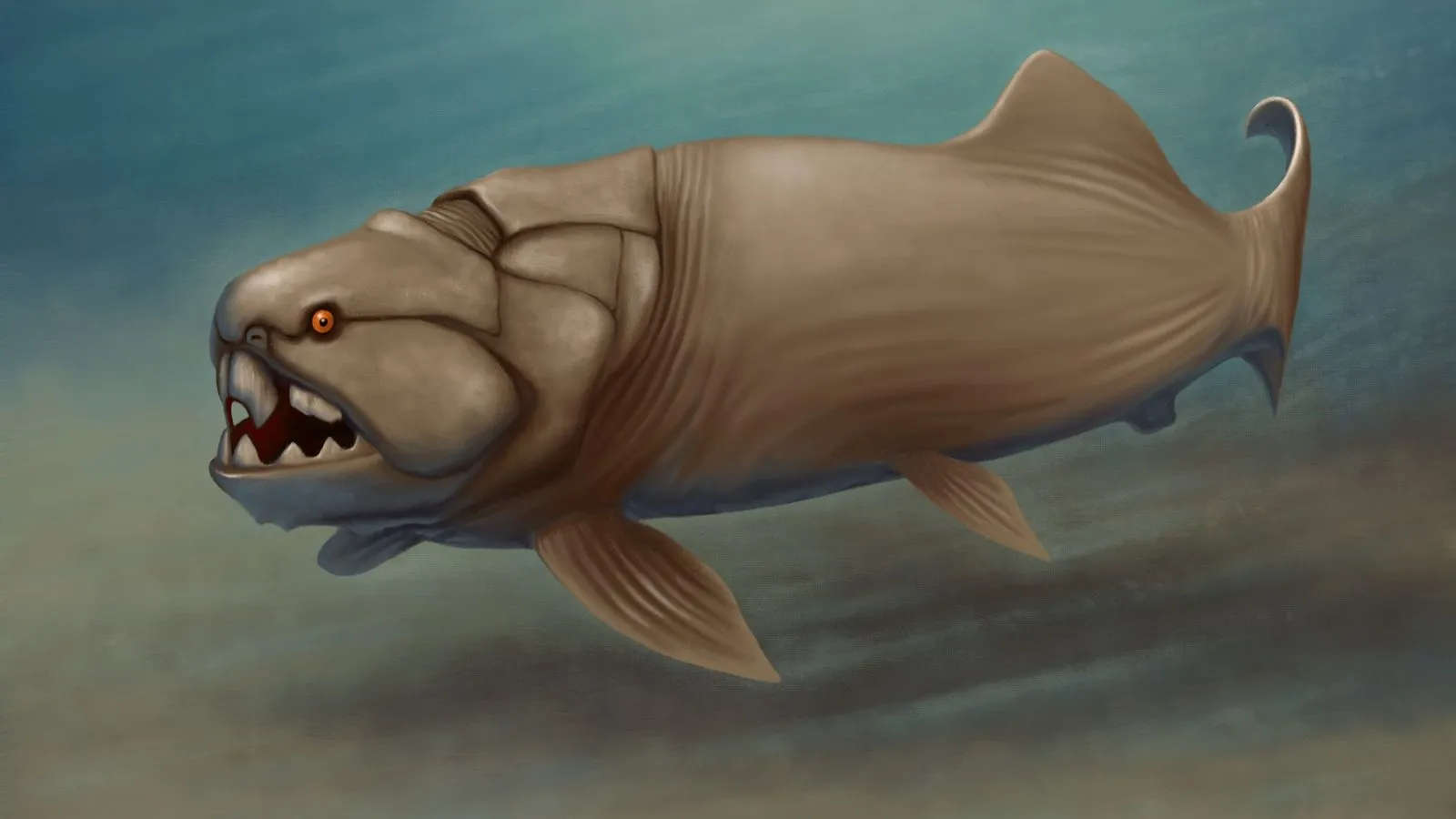
Around 360 million years ago, the top predator in the tropical sea that covered what is now Ohio was an armored fish called Dunkleosteus. It had no teeth at all. Instead, its jaws carried bony blades that sharpened themselves as they snapped shut, and one study found its bite was the strongest of any fish, living or extinct.
A fish in armor
Dunkleosteus lived in the Late Devonian Period, often called the Age of Fishes, about 130 million years before the first dinosaurs. It belonged to the placoderms, a name that means “plate skin.” These fish wore thick bony plates like a suit of armor. In Dunkleosteus, the plates covered its head and the front part of its body.
The rest of its body was made of cartilage, like a shark’s, and cartilage rarely turns into fossils. That is why, after about 150 years of searching, no one has ever found a Dunkleosteus body. All scientists have are the armored heads and chests, usually broken into pieces that must be fitted back together.
At the time, Ohio sat about 30 degrees south of the equator under a warm, shallow sea. When Dunkleosteus died, it sank into the soft, black mud on the seafloor. Over millions of years that mud hardened into a rock called the Cleveland Shale, which still holds Dunkleosteus fossils today. Fossils of the fish have also been found in Europe and northern Africa.
Jaws like scissors
Modern sharks have rows of teeth. Dunkleosteus had something stranger. Bare bone on its upper and lower jaws came together like a pair of self-sharpening scissors, slicing through the bones and shells of its prey.
The head itself was built to open wide. A hinge at the top of the skull let both the upper and lower jaws move, so Dunkleosteus could open its mouth to an angle of 45 degrees. People can only drop the lower jaw. Dunkleosteus may have eaten early sharks, bony fish, smaller placoderms and ammonoids, which were relatives of squid with coiled shells.
Measuring the bite
In 2006, Philip Anderson of the University of Chicago and Mark Westneat of the Field Museum used a Dunkleosteus fossil to build a computer model of its skull, jaw muscles and bite. Their study, published in the journal Biology Letters, found a skull worked by a four-bar linkage, a set of linked parts that move together like levers.
For a large fish 6 m long, they estimated a bite force of over 4400 N at the tip of the jaw and more than 5300 N farther back. That, they wrote, is the greatest bite of any living or fossil fish and among the most powerful bites of any animal. The model also suggested Dunkleosteus could open its jaws in one-fiftieth of a second. Most fish have either a powerful bite or a fast one, the researchers said, but not both.
Smaller than we thought
For decades, Dunkleosteus was thought to be enormous. Lengths of 5-10 m were often quoted, and the Cleveland Museum of Natural History notes that estimates have ranged from 3 to 10 meters.
In 2023, Russell Engelman of Case Western Reserve University tried a new method. Instead of comparing Dunkleosteus to sharks, he measured the distance from the eye socket to the back of the gill cover, a measurement that tracks body length closely in fish. He tested it on a huge dataset of 3169 measurements from 972 species of fish. His answer: a typical adult Dunkleosteus was about 3.4 m long, and the biggest known fish reached about 4.1 m.
That makes Dunkleosteus a shorter, chunkier animal, with a deep, rounded body. A second study by Engelman the same year found that arthrodires, the group Dunkleosteus belonged to, had much bigger mouths for their size than sharks, closer to catfish. That may mean they swallowed larger prey for their size than today’s big sharks do. Engelman’s study also suggested that no animal with a backbone reached 5 m or more until the Carboniferous Period.
Still rewriting the skull
Research is still changing the picture. A 2025 study led by Engelman took a fresh look at the jaws. It found that the skull of Dunkleosteus held far more cartilage than anyone had assumed, and that many of the big jaw muscles were attached to that cartilage rather than to bone. A large groove on the cheek points to a big muscle that probably helped snap the jaws shut.
The team also questioned two famous ideas: that Dunkleosteus sucked prey into its mouth, and the earlier estimates of its bite force. With the jaw muscles rearranged, they wrote, those bite numbers need to be worked out again.
Ohio’s own sea monster
The first Dunkleosteus fossils were found in 1867 by an amateur collector named Jay Terrell, in the cliffs along Lake Erie. Many more came to light when Interstate 71 was built in the 1960s. Today the Cleveland Museum of Natural History holds the largest and best-preserved collection of the fish, including a rebuilt skull nicknamed “Dunk.”
In 2020, Ohio made Dunkleosteus terrelli its official state fossil fish. A twelve-year-old amateur paleontologist was among those who spoke up for the bill.
Dunkleosteus and the other arthrodires died out at the end of the Devonian Period, long before the first dinosaurs appeared.
Article Sources
- Meet Dunk: Ohio's Ancient Apex Predator | Cleveland Museum of Natural History
- Ohio's State Fossil Fish | Ohio Department of Natural Resources
- Governor DeWine Signs Bill Designating New State Fossil Fish | Ohio Department of Natural Resources
- A Devonian Fish Tale: A New Method of Body Length Estimation Suggests Much Smaller Sizes for Dunkleosteus terrelli | Diversity
- Giant, swimming mouths: oral dimensions of extant sharks do not accurately predict body size in Dunkleosteus terrelli | PeerJ
- Feeding mechanics and bite force modelling of the skull of Dunkleosteus terrelli | Biology Letters
- Prehistoric fish packed a mean bite | NBC News
- Functional anatomy, jaw mechanisms, and feeding behavior of Dunkleosteus terrelli | The Anatomical Record