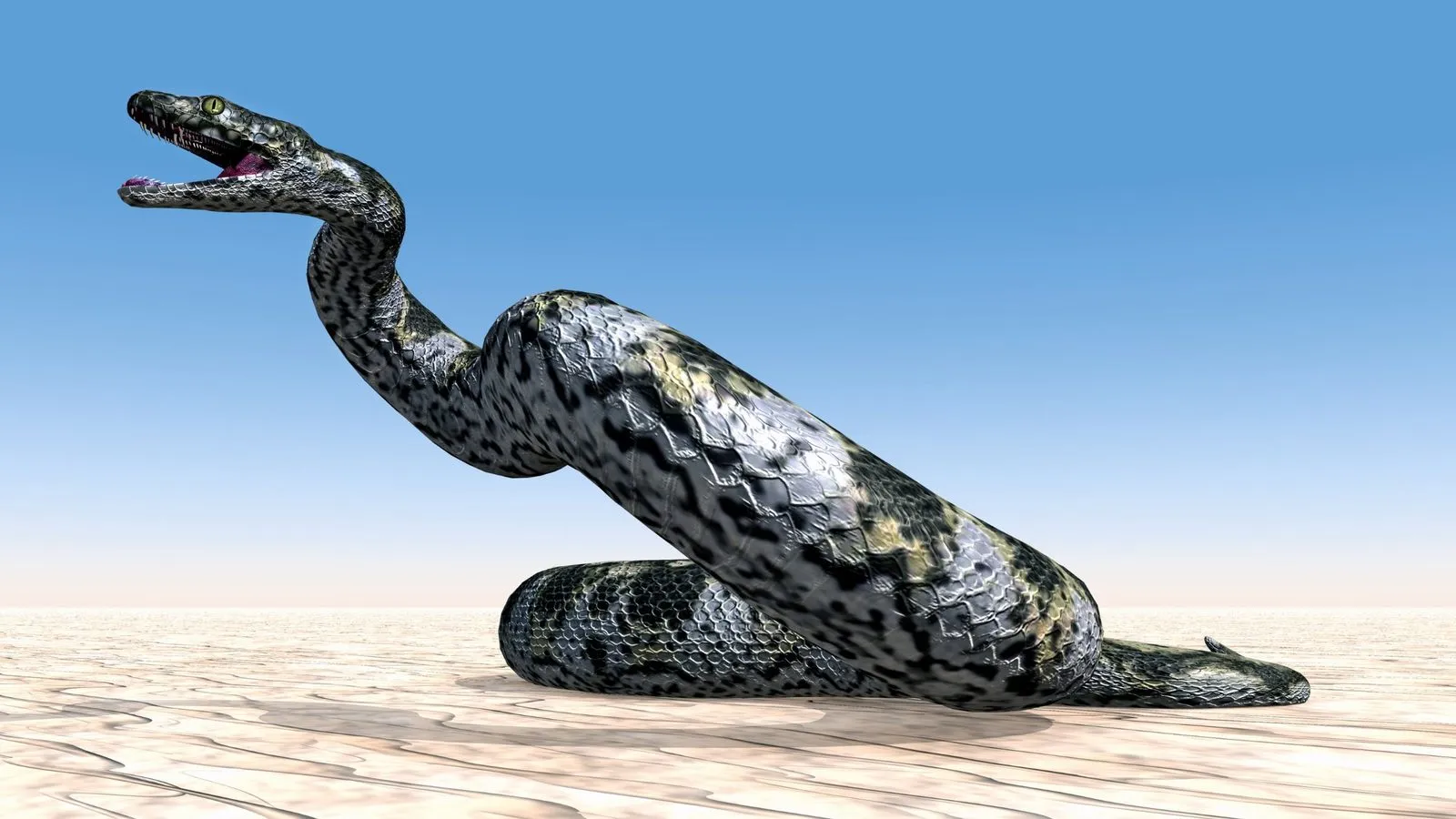
Titanoboa was the biggest snake known to science. It lived about 60 million years ago in the rainforests of what is now Colombia, stretched around 13 meters long, roughly the length of a bus, and weighed more than a ton.
Found in a coal mine
Titanoboa was discovered in the Cerrejón coal mine in northeastern Colombia, one of the world’s largest open-pit mines. Tropical fossils are rare, because thick forest hides the rocks, so a mine that strips away the ground is a rare window into the past.
Jonathan Bloch, a paleontologist at the Florida Museum of Natural History, has described seeing bones everywhere on the mine’s slopes. The team quickly recognized crocodiles, turtles and fish, but some bones puzzled them at first. Only months later, back in the lab, did they realize these were snake vertebrae. They had not recognized them because they were so large. Bloch compared it to finding the bones of a mouse the size of an elephant.
The find was described in the journal Nature in February 2009 by a team led by Jason Head, then at the University of Toronto. They named it Titanoboa cerrejonensis, after the mine.
How big was it?
Nobody has found a whole Titanoboa skeleton, so its size comes from its backbone. Living boas all have similar proportions, and the size of each vertebra tracks the length of the whole snake. By comparing Titanoboa’s vertebrae with those of modern boas, Head’s team estimated a length of about 13 meters, or 42 feet. Vertebrae from eight different specimens were all about the same size, so this was a normal size for the species, not a single freak.
Other estimates give a range. The Florida Museum puts it at 40 to 50 feet. Skull fossils found later suggest a length of up to 14.3 meters, using the head-to-body proportions of an anaconda.
Weight is harder to pin down. The original team estimated more than a ton, and some reports put it at over 1.3 tons. Later calculations give a range of about 730 to 1,135 kilograms. Even the lower end is enormous for a snake.
For comparison, the green anaconda can grow to around 7 meters and weigh as much as 45 kilograms. The longest verified living snake was a 10-meter reticulated python, an unusual case. Large surveys of reticulated pythons have not found any longer than 6 meters. The previous fossil record holder, Gigantophis from Egypt, was estimated at a maximum of 10.7 meters.
David Polly of Indiana University, one of the researchers, said that at its widest, Titanoboa would have come up to about your hips.
Life in a steaming rainforest
Titanoboa lived at a time when the area was a huge floodplain crossed by rivers and surrounded by tropical rainforest, much like the places where anacondas live today. It was a relative of today’s boas and anacondas, which kill by squeezing their prey.
At first, researchers thought it might have eaten crocodile relatives that lived in the same rivers. Later finds changed that picture. An expedition in 2011 recovered three Titanoboa skulls, and a 2013 study of them noted features of the palate and teeth that match modern fish-eating snakes. Fossil fish, including lungfish, have been found in the same rocks, so Titanoboa was probably mainly a fish-eater, though a snake that size could still have taken turtles or crocodile relatives.
National Geographic has called it the largest land-living animal with a backbone in the time after the dinosaurs died out. Bloch has said it was probably the largest predator on the planet for somewhere between 10 and 20 million years.
A thermometer made of bone
Titanoboa also says something about ancient climate. Snakes are cold-blooded, so their body temperature depends on their surroundings. Warmer conditions allow cold-blooded animals to grow larger, which is why the biggest reptiles today live in the tropics.
Working backward from Titanoboa’s size, the researchers estimated that its forest must have had an average yearly temperature of at least 30 to 34 degrees Celsius. National Geographic reported Head’s estimate as 32 to 33 degrees Celsius. Tropical forests today typically average 24 to 26 degrees Celsius. The finding suggests the tropics got hotter during the planet’s ancient greenhouse periods, and that rainforests could survive in that heat.
Still the champion?
For years Titanoboa held the record as the largest snake ever found. In 2024, scientists described Vasuki indicus, another giant fossil snake. Its vertebrae are smaller than Titanoboa’s, but some length estimates suggest it may have been about as long, or even longer. Either way, Titanoboa’s vertebrae are still the bigger bones, and it remains one of the largest snakes that ever lived.
Article Sources
- Titanoboa: thirteen metres, one tonne, largest snake ever | National Geographic
- Super Serpent: Bus-Size Snake Ruled Rainforest | Scientific American
- Titanoboa | Florida Museum of Natural History, Research News
- Monstrous prehistoric snake provides glimpse of warmer tropical forests | Mongabay
- Titanoboa | Wikipedia