Megalodon was the biggest shark that ever lived, but nobody can say exactly how big, because no complete skeleton has ever been found. Scientific estimates for the largest individuals range from 50 feet or less to an upper limit of 24.3 meters, or about 80 feet.
A shark known mostly from its teeth
Megalodon, known to scientists as Otodus megalodon, swam the world’s oceans for millions of years. Its earliest fossils date to about 23 million years ago, and it was extinct by at least 3.6 million years ago.
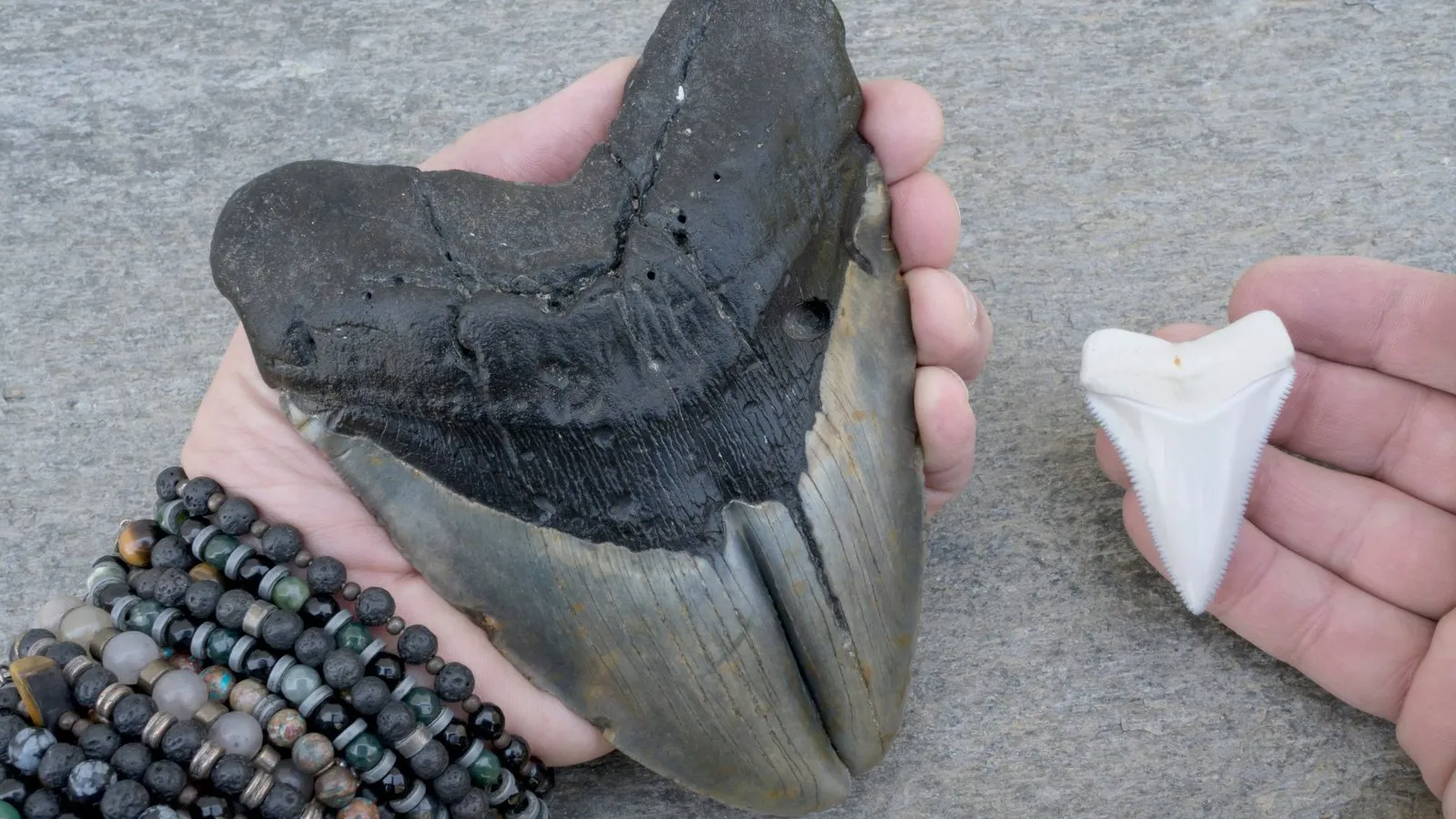
Sharks have skeletons made of cartilage, which rarely fossilizes. Their teeth are far tougher, and sharks shed and replace them throughout their lives, so teeth are by far the most common megalodon fossils. The name itself means “large tooth.” The biggest ones reach about 18 centimeters long. A great white shark’s teeth are usually about five centimeters.
That leaves scientists working backward: measure a tooth, then estimate how big a shark would need to be to carry it.
The tooth-based estimates
For years, researchers compared megalodon teeth with those of great white sharks and scaled up. That approach gave maximum lengths of between 60 and 66 feet. The Natural History Museum in London puts tooth-based estimates at a maximum of 15 to 18 meters.
Not everyone agreed. Kenshu Shimada, a fossil shark expert at DePaul University in Chicago, focused on large teeth from the front of the upper jaw, which seem to be more reliable guides to body size. His estimates for the biggest known teeth came out at between 46 and a little more than 50 feet. He concluded that sharks longer than about 50 feet were exceptionally rare.
Other researchers went the other way. A team at the Western Australian Museum and Flinders University estimated the largest possible jaw by scaling up sets of teeth found together from single sharks, matched with the widest megalodon tooth ever found. Using the jaw-to-body ratio of living white sharks, they reached a maximum of 19 to 20 meters.
Museums have had to pick a number to build. The Smithsonian’s National Museum of Natural History in Washington, DC, hangs a full-body megalodon model measuring 15 meters. It was so large it had to be built in sections to get it through the doors. The Western Australian Museum in Perth built a model of a megalodon head based on teeth from a single shark, which matches an animal roughly 14 meters long.
The backbone that changed the math
A 2025 study, led by Shimada with 28 other experts, used a different clue: a nearly complete section of megalodon backbone from Belgium, about 11 meters long. The team surveyed the body proportions of living and extinct sharks to estimate how long the missing head and tail would have been. That gave the Belgian shark a total length of about 16.4 meters.
The largest vertebra in the Belgian fossil is 15.5 centimeters across. But vertebrae up to 23 centimeters across have been reported from Denmark. If those came from the largest part of a megalodon’s spine, that shark could have been about 24.3 meters long. Shimada called this the largest possible reasonable estimate the current fossil record can support.
A shark that size may have weighed around 94 tonnes. The study also estimated a cruising speed of 2.1 to 3.5 kilometers per hour and suggested that newborn megalodons measured about 3.6 to 3.9 meters.
Bigger, but slimmer
The new work also changed megalodon’s shape. Most pictures show it as a giant great white shark, but the 2025 study suggests a slimmer body, more like a modern lemon shark. Stocky bodies are hard to move through water at huge sizes. That may be why great whites top out at no more than 7 meters, while slim giants can grow much larger. For comparison, the largest whale shark ever measured was 18.8 meters long.
The bite to match
Whatever its exact length, megalodon had a huge mouth. Its jaw is estimated to have spanned about 2.7 by 3.4 meters and held 276 teeth. Fossil whale bones carry cut marks from megalodon teeth, and some even have broken tooth tips stuck in them.
Studies of its bite put the force at between 108,514 and 182,201 newtons. A great white is estimated at 18,216 newtons.
Why it disappeared
Megalodon was gone by the end of the Pliocene, 2.6 million years ago, as the planet cooled. The Natural History Museum notes that grown megalodons depended on warm waters, so cooling seas probably cost them habitat and prey. The 2025 study adds that the rise of the great white shark, roughly 5 million years ago, may have played a part through competition.
So how big was megalodon? Tooth-based estimates put the largest at around 15 to 18 meters. The very biggest may have approached 24.3 meters, but until someone finds a complete skeleton, that number stays an upper limit rather than a measurement.
Article Sources
- Megalodon: The truth about the largest shark that ever lived | Natural History Museum
- Megalodon's body size and form uncover why certain aquatic vertebrates can achieve gigantism | DePaul University
- Making a megalodon: the evolving science behind estimating the size of the largest ever killer shark | The Conversation
- "Biggest Shark of All Time" Gets Downsized | Scientific American