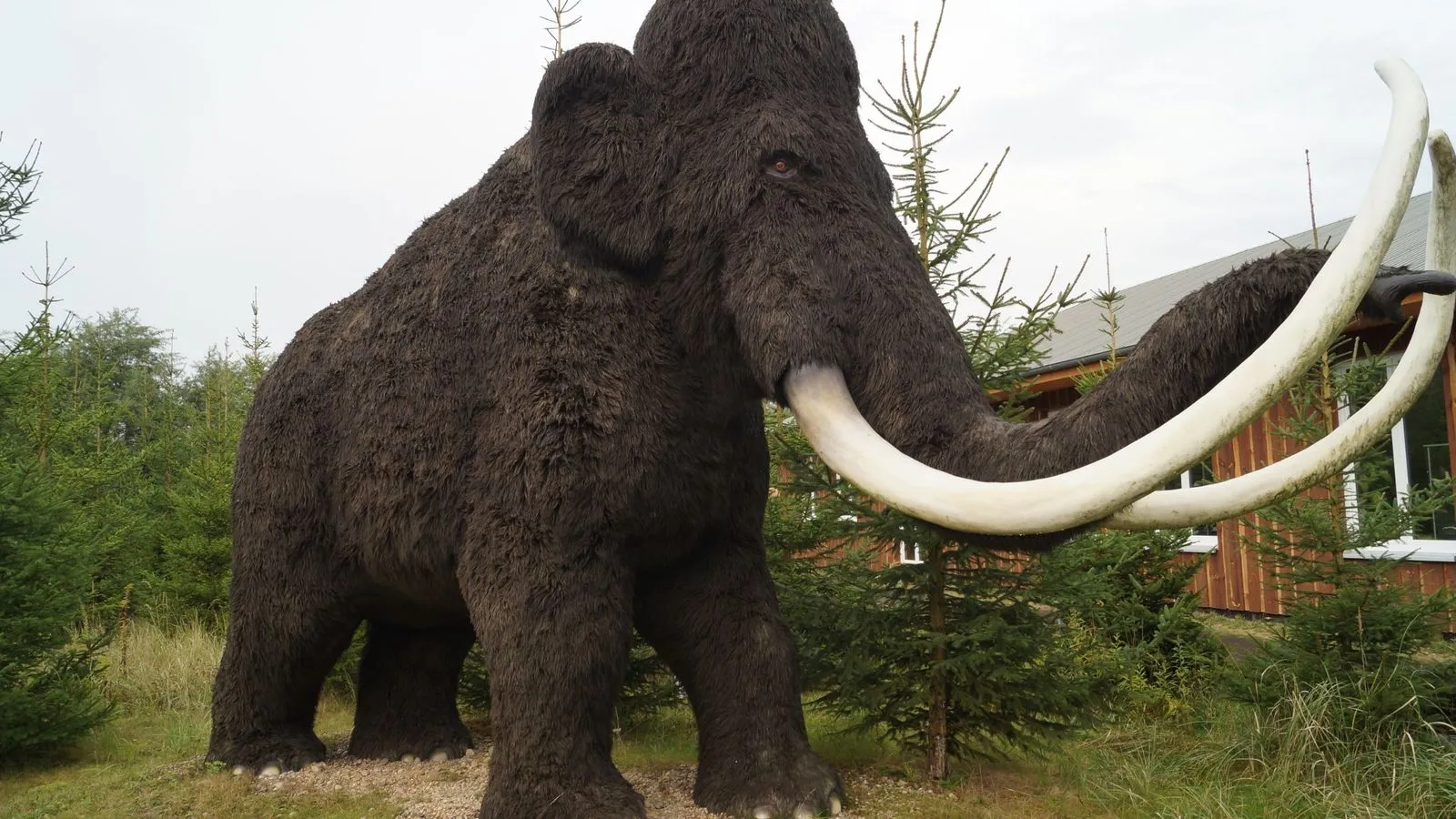
The last woolly mammoths died on Wrangel Island, a small island off Siberia, about 4,000 years ago. That is recent enough that a biotech company now says it can use their DNA to make a cold-adapted elephant that looks and lives like one.
An elephant cousin built for the cold
Mammoths were not the ancestors of today’s elephants. They were cousins. The elephant family arose in Africa about seven million years ago and soon split into three branches: one led to African elephants, one to Asian elephants and one to the mammoths. Asian elephants are the mammoths’ closest living relatives.
Woolly mammoths evolved in northeast Siberia between about 800,000 and 600,000 years ago, from steppe mammoths that were already adapted to the cold. From there they spread west across Europe and Asia and east into North America.
A woolly mammoth stood very high at the shoulder, with a back that sloped down toward the tail. Its tusks did more than curve. They twisted in a spiral, bending in two dimensions, while the tusks of living elephants curve gently in one. It had very small ears, a short tail and a thick coat of hair that scientists now think was a deep chocolate brown.
Not as big as you might think
The woolly mammoth was about halfway in size between an Asian elephant and an African elephant. According to Adrian Lister, a mammoth expert at the Natural History Museum in London, grown mammoths stood around 3 to 3.5 meters at the shoulder and weighed about four to six tonnes, depending on whether they were male or female. Its ancestors were larger. Southern and steppe mammoths weighed some 10 tonnes and stood up to four meters tall.
Pictures often put woolly mammoths in empty, snowy wastelands. In reality they lived in landscapes rich with plants, mostly away from deep snow. They needed a lot of food, after all.
Why did they disappear?
Scientists still argue about the main cause. As the last ice age ended, the open grasslands mammoths relied on shrank and were replaced by forest and tundra, and mammoth numbers shrank with them. At the same time, people with skilled hunting methods were spreading. Mammoths mattered to them for food, bones, ivory and skins. People painted 158 mammoths on the walls of Rouffignac Cave in southwest France around 13,000 years ago.
A few mammoth fossils have broken spear points in them, so they were sometimes hunted. Lister thinks the evidence fits climate change better as the main driver, but he does not rule out a part played by humans.
Woolly mammoths died out on the mainland around 10,500 years ago. Some survived on islands left behind when rising seas covered the land bridge between Asia and North America. On Alaska’s St. Paul Island they lasted until about 5,600 years ago, probably until drought and a lack of fresh water finished them. Wrangel Island was the final stronghold.
The last mammoths of Wrangel Island
A genetic study published in the journal Cell looked at the genomes of 21 woolly mammoths. It found that when Wrangel became an island, fewer than ten mammoths were left there. Their descendants then survived for another 6,000 years.
The population recovered to about 300 breeding animals, but inbreeding left them carrying harmful mutations for thousands of years. Even so, their numbers stayed steady until just a few generations before the end. Whatever finally killed them acted fast. People first show up on Wrangel only a few hundred years after the last mammoth fossils, yet there is no sign that they hunted mammoths there. The cause is still unknown.
The plan to bring it back
Colossal Biosciences, a company in the United States, says its goal is a cold-resistant elephant with the core traits of a woolly mammoth. The plan is to compare mammoth DNA with Asian elephant DNA, find the genes behind traits such as shaggy hair and fat stores, and edit those changes into elephant cells. An embryo made from those cells would then be carried by an elephant mother. Elephant pregnancies last about 22 months.
In March 2025, the company showed off a first step: “woolly mice.” Its researchers had modified seven mouse genes to give the mice long, thick coats similar in color and texture to a mammoth’s. To choose the edits, they compared 121 mammoth and elephant genomes, including mammoth DNA up to 1.2 million years old. The mice do not carry actual mammoth genes, and the work had not yet been checked by other scientists when it was announced.
Outside experts were divided. Some called it a real milestone in editing several genes at once, while warning that a “woolly elephant” could take years or even decades, since an elephant takes a further 10 to 14 years to reach breeding age after birth. Tori Herridge, an evolutionary biologist at the University of Sheffield, put the doubt simply: “A mammoth is much more than just an elephant in a fur coat.” Any animal made this way would be a new, mammoth-like elephant, not the woolly mammoth that walked Wrangel Island 4,000 years ago.
Article Sources
- Were all mammoths woolly? | Natural History Museum
- New genetic study reveals the woolly mammoths' journey towards extinction | Stockholm University
- Woolly Mammoth De-extinction Project & Process | Colossal
- Scientists 'bring back' the woolly mammoth... as this mouse | BBC Science Focus Magazine
- Biotech Firm Unveils 'Woolly Mice,' a Step Toward Recreating Woolly Mammoths | Yale E360