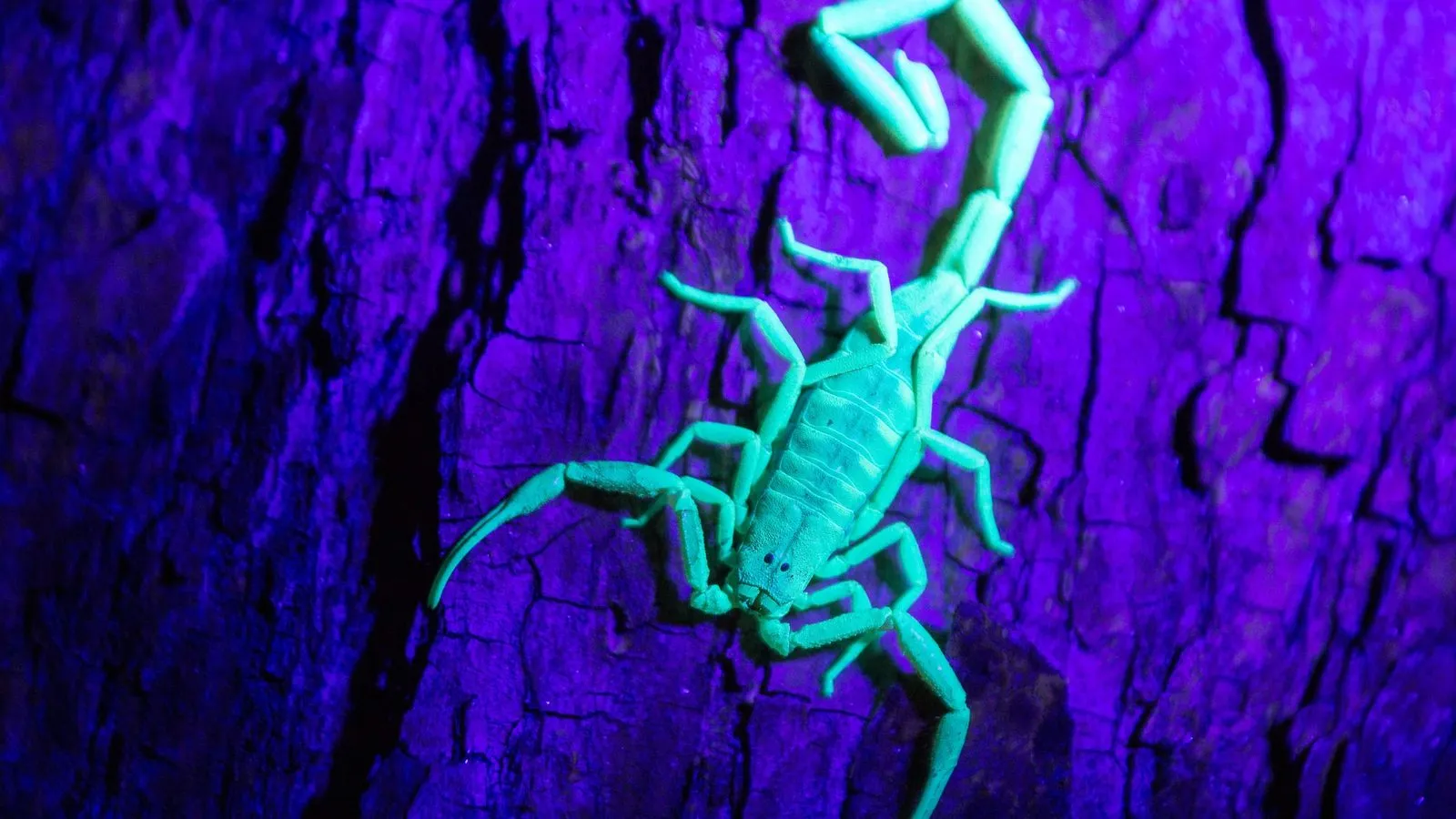
Shine an ultraviolet lamp, often called a blacklight, on certain animals and they light up in colors our eyes never normally see. The effect is called biofluorescence: chemicals in an animal’s shell, fur, skin or bone absorb ultraviolet light and give it back out as visible light. Scientists keep finding it in unexpected places, and for most of these animals nobody is yet sure what the glow is for.
Scorpions
Scorpions are the classic glowing animal. The Queensland Museum explains that chemicals in their exoskeleton, the hard outer shell, absorb and re-emit ultraviolet light, which makes the whole scorpion glow. The source is an unidentified substance in a very thin layer of the cuticle called the hyaline layer.
The glow takes time to develop. Newly molted and young scorpions do not fluoresce until their exoskeletons harden. Even some fossil scorpions have been known to glow.
Why scorpions do it remains a mystery. There are several suggestions, and some arachnologists argue that the glow is not adaptive at all, which would mean it does nothing useful for the animal.
Platypus
In 2020 a study in the journal Mammalia reported that platypus fur gives off a blue-green glow under ultraviolet light. The discovery came almost by chance. A team from Northland College in Ashland, Wisconsin, was shining ultraviolet lights on preserved squirrel pelts at the Field Museum in Chicago. Out of curiosity they did the same to a platypus specimen stored there, and saw it glow.
What the glow does is unclear. A member of the team told National Geographic it seems unlikely to help platypuses communicate, since they are nocturnal and keep their eyes closed when swimming. It might work as camouflage against predators that can see ultraviolet light. It is also possible it has no real function at all, and is simply an ancestral trait the platypus has kept, much like egg-laying.
Flying squirrels
The platypus find grew out of an earlier surprise. In 2019 the Northland College researchers, working with colleagues from Texas A&M, reported in the Journal of Mammalogy that New World flying squirrels glow pink under ultraviolet light, from the fur on their bellies. Of the museum specimens they tested, 108 of 109 glowed, along with all five wild squirrels.
Some marsupials, including the Virginia opossum, were already known to fluoresce, but the team knew of no other placental mammals that did. Flying squirrels are also the only New World squirrels active at night. The researchers suggested the pink glow might make the squirrels more visible to each other, help them mimic owls, or let them blend in with fluorescent lichens on tree bark. None of these ideas has been confirmed.
Chameleons
Some chameleons glow from their bones. A 2018 study in Scientific Reports found that many chameleons have small bony bumps, called tubercles, on the skull. Each tubercle pushes aside the other layers of skin until only a thin outer layer covers the bone, creating a window. Under ultraviolet light the bone shines through as a blue glow that peaks near 430 nm.
The effect is most widespread in chameleons from Madagascar and some African groups, especially those in humid forests, where ultraviolet light is relatively more abundant. In the genus Calumma, males and females often have different numbers of tubercles, which may act as a signal. The authors point out that fluorescence is widespread in marine life but uncommon in four-limbed land animals.
Hawksbill sea turtle
In 2015 National Geographic Emerging Explorer David Gruber was filming underwater off the coast of the Solomon Islands when a glowing hawksbill sea turtle swam past. National Geographic described it as the first biofluorescent reptile ever discovered. Gruber said he made the find mostly by accident.
He also said it was too early to say why the turtle would have developed biofluorescence. Finding out may not be easy. The hawksbill is critically endangered, and its worldwide numbers have declined by nearly 90 percent in recent decades.
Polka-dot tree frog
The South American polka-dot tree frog was hailed as the first fluorescent frog found. Researchers from the University of Buenos Aires collected the frogs near Santa Fe, Argentina, expecting a red glow from a pigment called biliverdin. Under ultraviolet light the frogs gave off a bright blue and green glow instead.
Three molecules, named hyloin-L1, hyloin-L2 and hyloin-G1, turned out to be responsible. They were found in the frogs’ lymph tissue, skin and gland secretions. Together they give off roughly 18% as much visible light as a full moon. The study appeared in the Proceedings of the National Academy of Sciences in 2017. Communication, camouflage and attracting mates have all been suggested as reasons for the glow, but its purpose is still unknown.
Article Sources
- Ask an expert: why do scorpions glow? | Queensland Museum
- We knew platypuses were incredible. Now we know they glow, too | National Geographic
- For Some Reason, New World Flying Squirrels Fluoresce Pink | Scientific American
- Widespread bone-based fluorescence in chameleons | Scientific Reports (VU Amsterdam research portal)
- First-ever biofluorescent sea turtle discovered in Solomon Islands | Mongabay
- First Fluorescent Frog Found | Scientific American