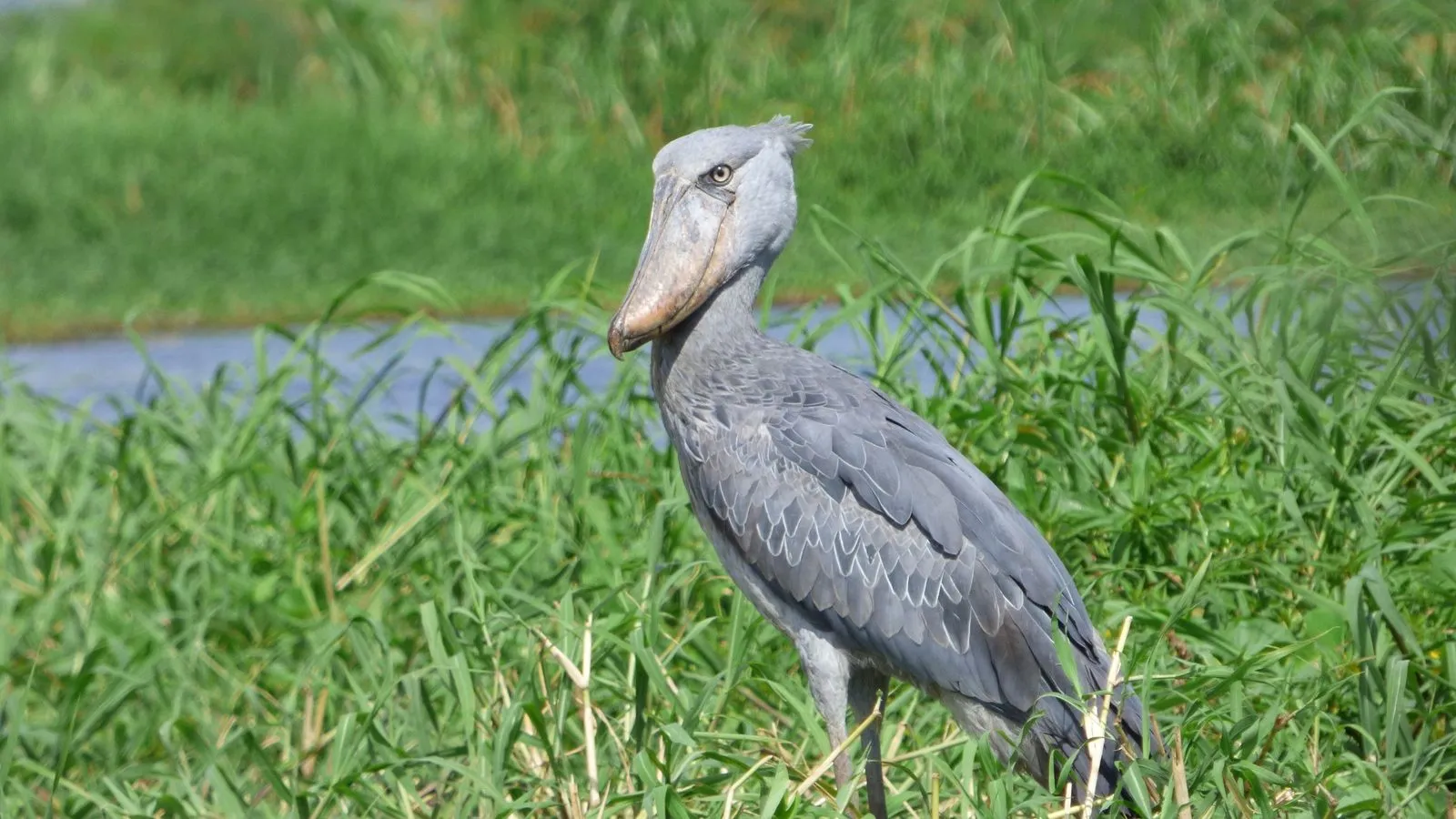
The shoebill is a huge wetland bird with a foot-long bill shaped like a Dutch clog, and it can stand motionless for hours waiting for a fish to swim within reach. With that heavy bill and its long, patient stare, it looks like a creature left over from a much older world.
A bill like a wooden shoe
Shoebills are big. National Geographic gives their height as 3.5 to five feet, and Discover Wildlife says they can grow up to 1.5 m tall with a wingspan of 2.6 m. Females weigh around 11 pounds and males around 12 pounds.
The most striking feature is the bill. It is huge and razor-sharp, and it resembles a Dutch clog, with a hook at the end that helps the bird hold on to slippery fish.
The shoebill’s family tree has puzzled scientists. It was once classified as a stork, and has also been placed with the herons and the pelicans. Today it sits in a family all its own, Balaenicipitidae, and National Geographic says its closest relatives are the pelicans.
Patience in the swamp
Shoebills live in large swamps from South Sudan to Zambia, in seasonally flooded marshes thick with papyrus, reeds, cattails and grasses. They usually forage in shallow water, using clear channels through the vegetation made by large mammals moving through the swamp. The IUCN notes they are reported to prefer poorly oxygenated water, where fish are forced to come to the surface to breathe and are easier to catch.
Hunting is a waiting game. A shoebill can stay motionless for hours. When prey comes within reach, it lunges or falls forward onto it, a technique known as collapsing. Lungfish are a favorite, but shoebills also take catfish, tilapia, eels and snakes. The IUCN adds amphibians, young crocodiles and, now and then, rodents and young waterfowl to the list.
Shoebills also have a signature sound. Bill-clattering, a rattle made with the bill, is used as a greeting and during nesting.
A loner, even in pairs
The shoebill is a very solitary bird. Even within a pair, the male and female often feed at opposite ends of their territory. The nest is a grassy platform up to 3 m wide, built on a mound of floating vegetation or on a small island. Females lay an average of two eggs at the end of the rainy season.
Usually only one chick survives to fledge. Discover Wildlife reports that siblicide, one chick killing another, is common, and that the second chick is believed to be an evolutionary back-up in case the first dies.
A study in Zambia’s Bangweulu Wetlands, published in the journal Waterbirds in 2015, used nest cameras to watch shoebill families. Parents were present constantly for the first 40 days of chick rearing and delivered prey about 1.2 times a day. By the time they fledged, chicks weighed about 5.7 kg.
Why the shoebill is Vulnerable
The IUCN Red List lists the shoebill as Vulnerable, in an assessment from 2018, with a decreasing population of an estimated 3,300 to 5,300 mature individuals. The largest population lives in the Sudd wetlands of South Sudan.
The threats include habitat destruction, disturbance, hunting and capture for the bird trade. Wetlands are being converted to farmland and pasture, and cattle have been known to trample nests. In some places shoebills are hunted for food or for cultural reasons, including the belief that they are a bad omen. Eggs and chicks are also taken, some probably sold to zoos or collectors.
That pressure shows up at the nest. In the Bangweulu study, breeding success in 2011 was only 20%, a low linked to human disturbance that included chicks being taken from nests. In the later years of the study, parents fledged 0.89 chicks per nest.