Wombats make cube-shaped droppings because of the way their intestines are built. Near the end of the gut, the intestine wall has bands that are stiffer than the rest, and as the gut squeezes, those stiff bands help press flat sides and sharp corners into each piece.
Meet the bare-nosed wombat
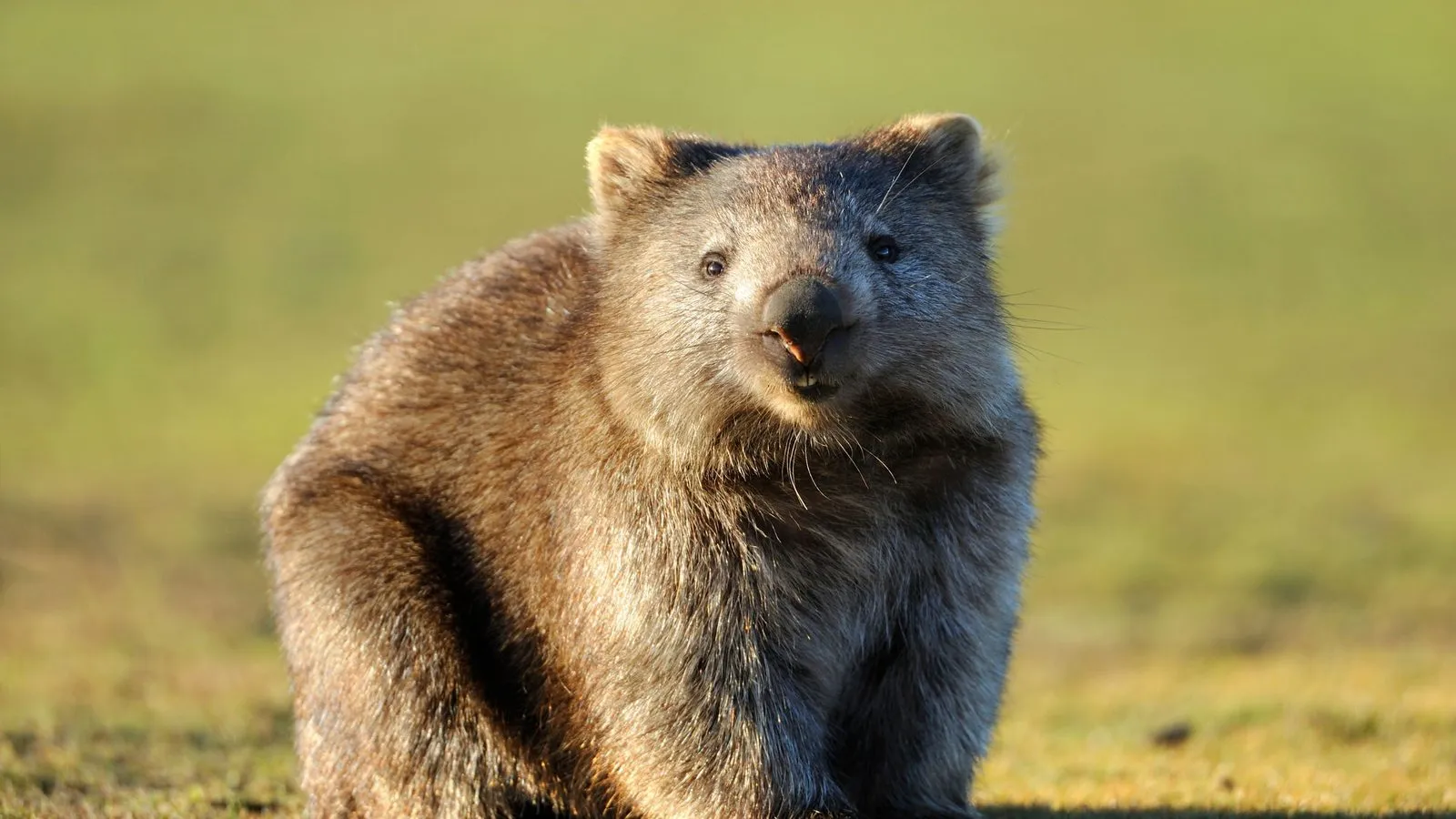
The bare-nosed wombat lives in south-eastern Australia, including Tasmania. The Australian Museum describes it as a short, stocky, barrel-shaped animal with a broad head, small eyes, powerful shoulders and a very small tail hidden by fur. On the mainland, it averages 985 mm in head and body length and weighs about 26 kg.
Wombats are among the world’s largest burrowing animals, and they spend about two thirds of their lives in their burrows. The IUCN Red List notes that a single wombat uses between one and six burrows in a night and up to 20 over several weeks. They are grazers, eating mostly grasses as well as sedges and rushes, and they are mainly active at night. Their front teeth keep growing throughout life and work as efficient cutters of grass.
Family life is slow. Usually a single young is born, and it develops in its mother’s pouch for 6 to 10 months. The young stays dependent on its mother for at least 17 months, and wombats become sexually mature at about two years old.
Droppings as signposts
The odd shape seems to have a purpose. The IUCN notes that wombats leave their cube-shaped scats on rocks, logs and other prominent spots to mark their territory. Wombats pile their droppings to communicate by scent, so it is important that the droppings do not roll away, and a cube-shaped dropping solves that problem.
Wombats are also unusual in another way. According to the researchers who studied them, they are currently the only species known to produce cubes naturally.
Following the poop
To find out how the cubes are made, a team including Patricia Yang, David Hu and Scott Carver examined the digestive tracts of wombats that had been euthanized after being hit by vehicles in Tasmania. They found that the poop changes shape late in its journey. Cubes are formed within the last 17 percent of the intestine.
The team concluded that the varying elastic properties of the intestinal wall were behind the cubes. Yang summed up why that is so surprising for engineers. “We currently have only two methods to manufacture cubes: We mold it, or we cut it,” she said. She also admitted, “I have never seen anything this weird in biology.”
Stiff and stretchy bands
In a follow-up study published in the journal Soft Matter in 2021, the researchers measured the intestine wall in detail. Around its circumference, some regions were two-fold thicker and four-fold stiffer than others.
They then built a computer model of a ring made of alternating stiff and soft sections that squeezes inward again and again. The corners formed because the stiff regions contracted faster, while the middle of each soft region moved more slowly. The bigger the difference in stiffness, the squarer the shapes became. The researchers suggest the work may one day help with manufacturing and with the study of digestive health.
A prize-winning puzzle
The first findings were presented in November 2018 at the American Physical Society’s Division of Fluid Dynamics meeting in Atlanta. In 2019 the team won the Ig Nobel Prize in physics “for studying how, and why, wombats make cube-shaped poo.” It was the second Ig Nobel for Hu and Yang, who had shared the 2015 physics prize for a study of how animals empty their bladders.
The wombats themselves are doing fine. The IUCN Red List lists the bare-nosed wombat as Least Concern, assessed in 2024, with a stable population, because it is common, widespread and tolerates a broad range of habitats.