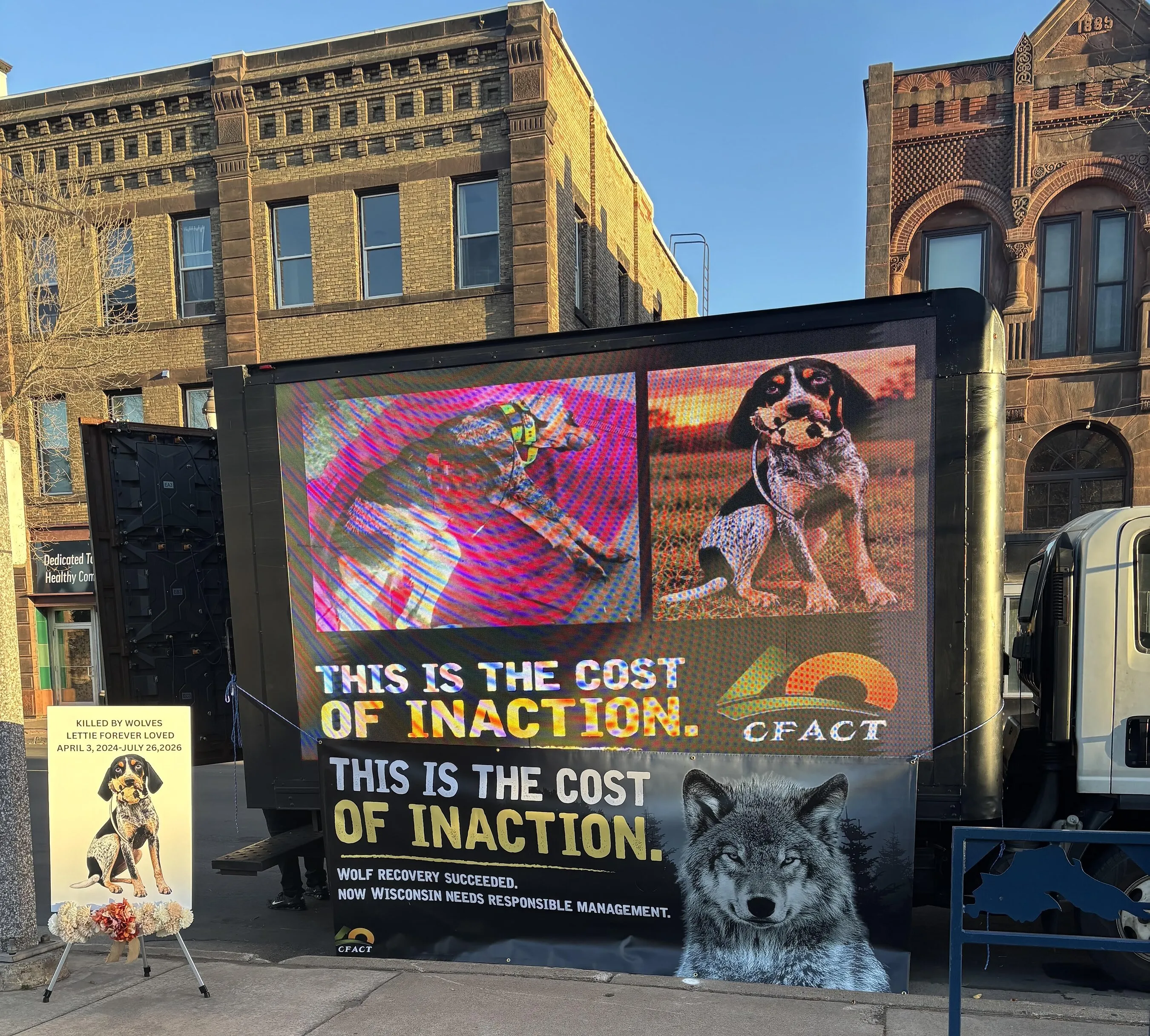
The Committee For A Constructive Tomorrow (CFACT) took its billboard truck tour approximately 800 miles through and near more than 30 Wisconsin communities, calling for responsible wolf management. Traveling from Madison north to Ashland and then south to Milwaukee, the campaign highlighted the consequences of wolf attacks on livestock, pets, and rural livelihoods. The route included Eau Claire, Hayward, Ashland, Wausau, Green Bay, Appleton, and Oshkosh, along with smaller communities across the state. CFACT representatives spoke with hundreds of people across northern Wisconsin, the majority of whom supported the campaign’s call to restore state authority over wolf management.
A Route Across Wisconsin
The truck carried a “Cost of Inaction” message beside a memorial to Lettie, a dog killed in a wolf attack. The organization’s campaign called for policies that recognize both wolf recovery and the needs of communities living alongside them.
Lettie’s Story
Erin Maluegge joined the truck along its route after her dog, Lettie, was killed in a wolf attack.
Erin Maluegge said:
“Lettie had her GPS collar on; she was 300 yards from us. We could hear the attack and could not get there in time to save her,”
Calls for State Authority
The campaign drew recognition from U.S. Secretary of Agriculture Brooke Rollins, who referenced CFACT’s efforts in a post on X. Rollins emphasized the threat wolf attacks pose to ranchers’ livelihoods and the lasting financial consequences of livestock losses.
The tour’s message also echoed concerns raised by U.S. Rep. Tom Tiffany (R-Wis.), who advocates returning wolf management authority to the states.
Tom Tiffany said:
“The gray wolf has recovered, and the impacts are being felt across rural communities in Wisconsin,”
Living Alongside Wolves
CFACT is urging policymakers to prioritize the protection of livestock, pets, and rural livelihoods in wildlife management.
Craig Rucker, president at CFACT, said:
“People across northern Wisconsin are asking for something straightforward: the ability to protect their livestock, their pets and their livelihoods. Wolf recovery is a conservation success story, but that success comes with a responsibility to manage the population. Washington needs to listen to the people living with the consequences.”