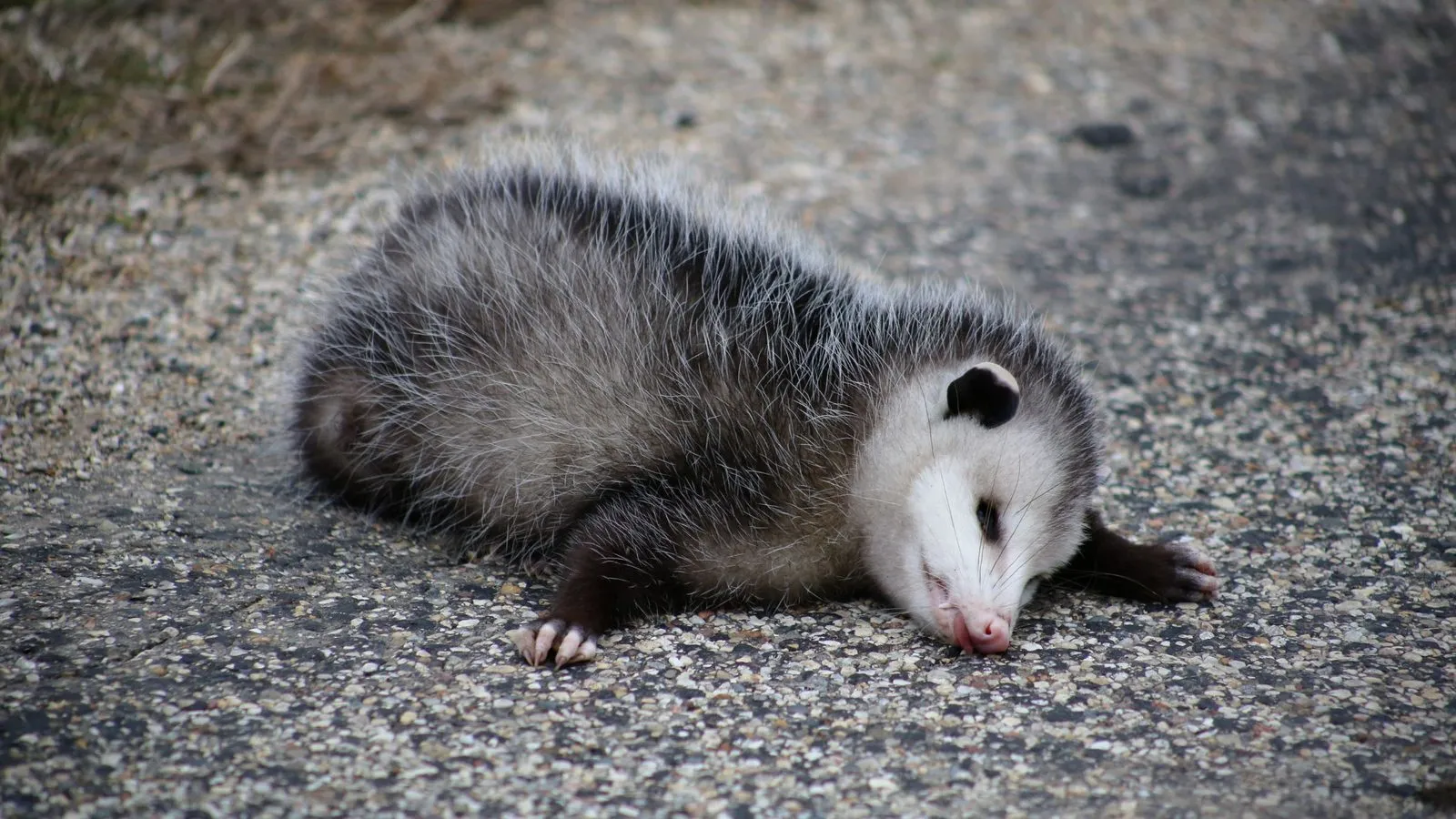
Some animals survive an attack by doing nothing at all. They go limp, stop moving and look dead, and that can be enough to stop the attack. Scientists call this thanatosis, or tonic immobility. It usually happens late in an attack, often after the predator has already touched or grabbed its prey, and it seems to make the hunter less keen to finish the job. Here are six animals that have turned playing dead into an art.
Virginia opossum
The opossum gave the act its nickname: “playing possum.” North America’s only native marsupial is not a fighter. When it cannot escape a predator such as a fox or coyote, it first bares its teeth and drools. If that fails, it rolls onto its side, goes limp, shuts its eyes and lets its tongue hang out of its open mouth.
The act is more than skin deep. In a study of four wild American opossums, a dog or researcher set off the response, and the animals’ heart rates dropped by 46%, from about 222 to 120 beats a minute. They did not react even when pinched. Yet they were fully aware of what was going on: when the dog came back, their heart rates dropped again.
Eastern hognose snake
The eastern hognose snake puts on two shows. First comes the bluff. It flattens its head and neck like a cobra, hisses loudly and strikes, but with its mouth closed. It is harmless to people.
If that does not work, the snake switches to the death act. It writhes and thrashes, rolls onto its back, opens its mouth and lets its tongue hang out. It may throw up its last meal and release feces. Flip it right side up and it rolls straight back over. Once the threat leaves, it turns over, checks the coast is clear with a flick of its tongue and slips away. Even newly hatched hognose snakes can do the full routine, and some have been seen playing dead in water.
Gift-giving spider
Playing dead is usually about avoiding predators, but the male of the spider Pisaura mirabilis uses it to avoid being eaten by his mate. A male courts a female by offering her a gift of food. She is usually interested in the gift, but sometimes she attacks him instead.
At that dangerous moment, the male can drop dead. He collapses and stays completely still, but he keeps hold of the gift, so both spiders are holding it at once. When the female starts eating, the male carefully comes back to life and mates with her. A 2006 study in the journal Biology Letters found that males that played dead were more successful at mating.
Red flour beetle
The red flour beetle plays dead when threatened, and researchers have tested whether the act really saves lives. In earlier tests, red flour beetles that played dead survived better than those that did not when a jumping spider was the hunter.
In a 2020 study, the team bred a related flour beetle for longer or shorter death-feigning. Beetles from the long-playing lines survived better against predatory bugs and took longer to be caught. They also collected wild red flour beetles and found that beetles from places with predatory bugs played dead longer than beetles from predator-free places.
Adzuki bean beetle
The adzuki bean beetle faces a choice when danger appears: fly away, or drop from its perch and play dead. Research on this beetle found that the two escape plans are linked in its genes.
When scientists bred beetles to play dead for longer, those beetles turned out to be worse fliers. When they bred beetles to fly better, those beetles played dead for less time. The same pattern held in the wild. Across 21 populations from different regions, beetles that played dead more strongly tended to fly worse. In other words, beetles tend to be either droppers or fliers.
Indian stick insect
For a long time, scientists doubted the classic explanation for playing dead: that predators avoid prey that look dead. A 2018 study using Indian stick insects tested it directly.
Birds that had never met these insects were first offered dead ones, which they quickly learned tasted bad. Afterward, the birds avoided live stick insects that played dead, but still attacked live ones that did not. Birds that had never seen dead stick insects were not fooled at all. The study showed that the trick works because predators mistake the motionless insect for a dead one they have already learned not to eat.
Scientists think playing dead probably happens in many more animals than have been described so far.
Article Sources
- Virginia Opossum | Missouri Department of Conservation
- Physiological responses associated with feigned death in the American opossum | Acta Physiologica Scandinavica
- Eastern Hog-Nosed Snake | Missouri Department of Conservation
- A review of thanatosis (death feigning) as an anti-predator behaviour | Behavioral Ecology and Sociobiology
- Death feigning in the face of sexual cannibalism | Biology Letters
- Death feigning as an adaptive anti-predator behaviour | Journal of Evolutionary Biology
- Drop or fly? Negative genetic correlation between death-feigning intensity and flying ability | Proceedings of the Royal Society B
- Avoiding death by feigning death | Current Biology