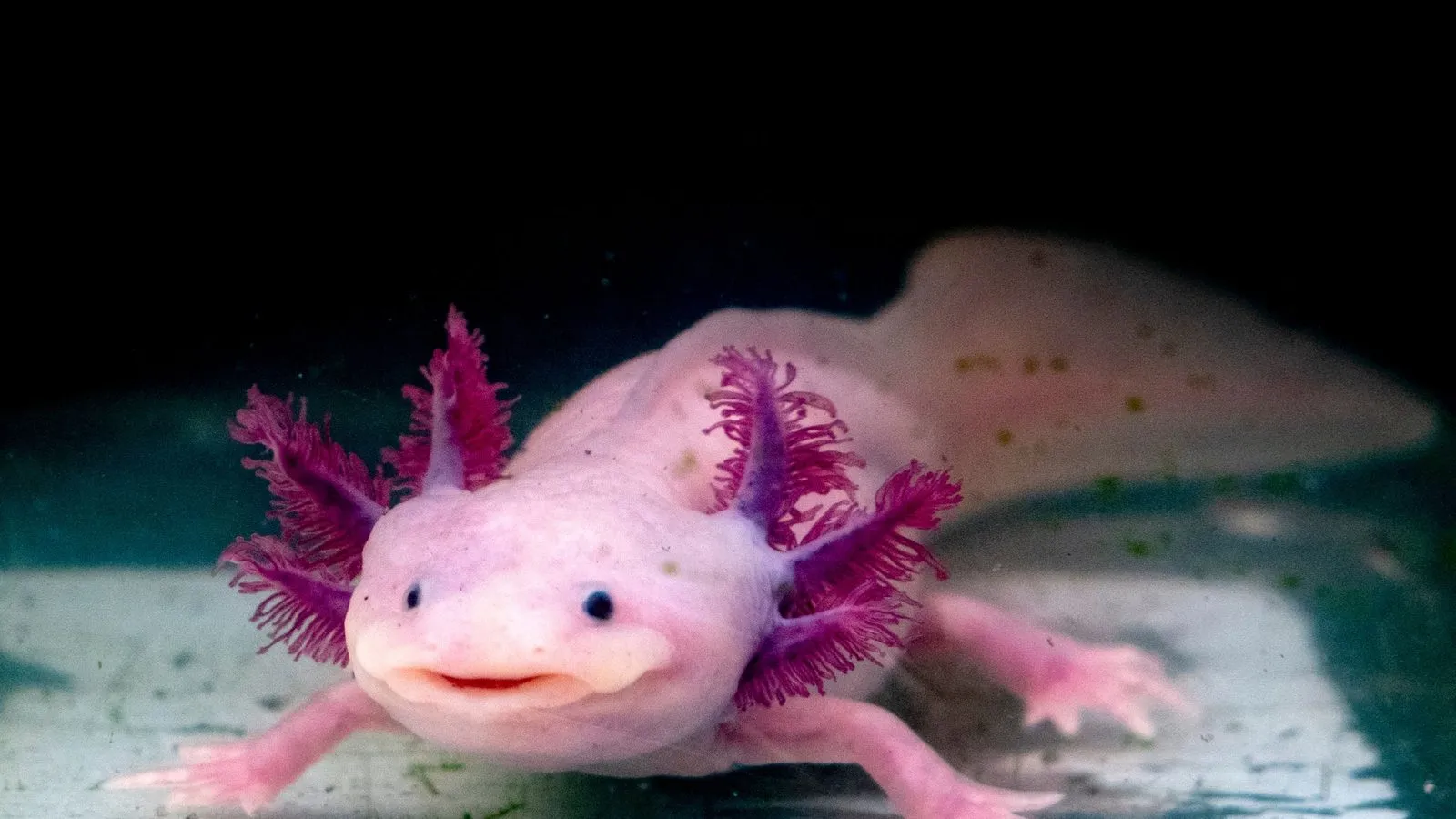
The axolotl spends its whole life looking like a baby. This Mexican salamander keeps the feathery external gills and tail fin of a larva even after it is old enough to breed, and it never leaves the water.
A grown-up with a baby’s face
Most salamanders go through metamorphosis, a change of body form as they mature. The axolotl usually skips it. Scientists call this neoteny: the animal reaches breeding age while keeping its larval body. The Ambystoma Genetic Stock Center at the University of Kentucky puts it simply. Axolotls keep their feathery external gills and tail fin their entire lives.
The skip is not absolute. Axolotls are thought to rarely change shape in the wild, but researchers can trigger metamorphosis in the lab by giving them the thyroid hormone thyroxine.
A full-grown axolotl can reach 30 cm (about 12 inches) or more from nose to tail tip. The San Diego Zoo Wildlife Alliance fact sheet gives males a weight of about 125 to 130 g and females about 170 to 180 g. Wild axolotls are black to dark brown with black spots, a color that helps them blend in with the silt of the lake bed. In zoos and labs they come in many colors, including white, golden and albino.
The water monster of the Aztecs
The name comes from Nahuatl, the language of the Aztecs. It has been translated as “water dog,” “water sprite” and “water monster,” among other meanings. Axolotls were seen as forms of the Aztec god Xolotl, who watched over the dead and took the shape of a dog, and they appear in Aztec art and mythology.
Home is a few canals in Mexico City
The axolotl once lived in a series of lakes and wetlands across Mexico’s Central Valley, including Lakes Xochimilco and Chalco. The IUCN Red List says it has disappeared from most of that range. It is now known from only three sites in the southern part of Mexico City: the canals at Xochimilco, Chalco lake and Chapultepec Lake, at about 2,240 m above sea level.
In the wild, axolotls eat small fish and invertebrates such as insects, worms and crustaceans. In human care a female can lay between 200 and 1,500 eggs every 3 to 6 months. The eggs hatch after about 2 weeks at 20°C (70°F), and the young reach maturity at around 1.5 years old.
Why it is Critically Endangered
The IUCN lists the axolotl as Critically Endangered, with a decreasing population, in an assessment from 2019. It estimates that only 50 to 1,000 mature individuals remain in the wild.
The threats pile up. Tilapia and carp, introduced in the 1970s and 1980s, prey on axolotls and compete with them. The canals carry high levels of bacteria, excess nutrients and heavy metals, and sewage can wash in after large storms. Continued urban growth in the Xochimilco district adds to the pressure.
Work is under way to help. Since 2014, biologists and local chinampa farmers, known as chinamperos, have been creating axolotl refuge areas, improving water quality and keeping the introduced fish out of canals. In the Chalco region, about 10,000 axolotls were released in 2012 to build a stable population.
A star of the laboratory
While wild axolotls are scarce, many thousands live in labs, zoos and private collections. Their scientific career began in 1863 or 1864, when about 35 live animals from Xochimilco were shipped to the Museum of Natural History in Paris. The zoologist Auguste Duméril began studying their anatomy and life history there, and the axolotl went on to become a prominent experimental animal.
The big draw is regeneration. Axolotls can regrow tissues and entire body parts, including limbs, tails and organs. The Marine Biological Laboratory sums up the feat: an axolotl can regrow a lost leg, a piece of its heart, parts of its spinal cord and even sections of its brain, with no scarring.
Staying young seems to help. In a 2014 study in the journal Regeneration, a University of Florida team made axolotls metamorphose with thyroxine and then watched how their limbs grew back. Metamorphosis caused a twofold drop in the rate of regeneration, so limbs regrew at about half the speed. Every one of the transformed animals regrew limbs with defects in the wrist bones and digits. Axolotls that kept their young form showed far milder problems.
Article Sources
- Ambystoma mexicanum (Axolotl) | IUCN Red List
- Axolotl Fact Sheet | San Diego Zoo Wildlife Alliance Library
- Axolotl Fact Sheet: Taxonomy & History | San Diego Zoo Wildlife Alliance Library
- Axolotl Fact Sheet: Population & Conservation Status | San Diego Zoo Wildlife Alliance Library
- Axolotl Fact Sheet: Reproduction & Development | San Diego Zoo Wildlife Alliance Library
- What is an Axolotl? | Ambystoma Genetic Stock Center, University of Kentucky
- Experimentally induced metamorphosis in axolotls reduces regenerative rate and fidelity | Regeneration
- The axolotl can regrow a lost leg, a piece of its heart, parts of its spinal cord | Marine Biological Laboratory