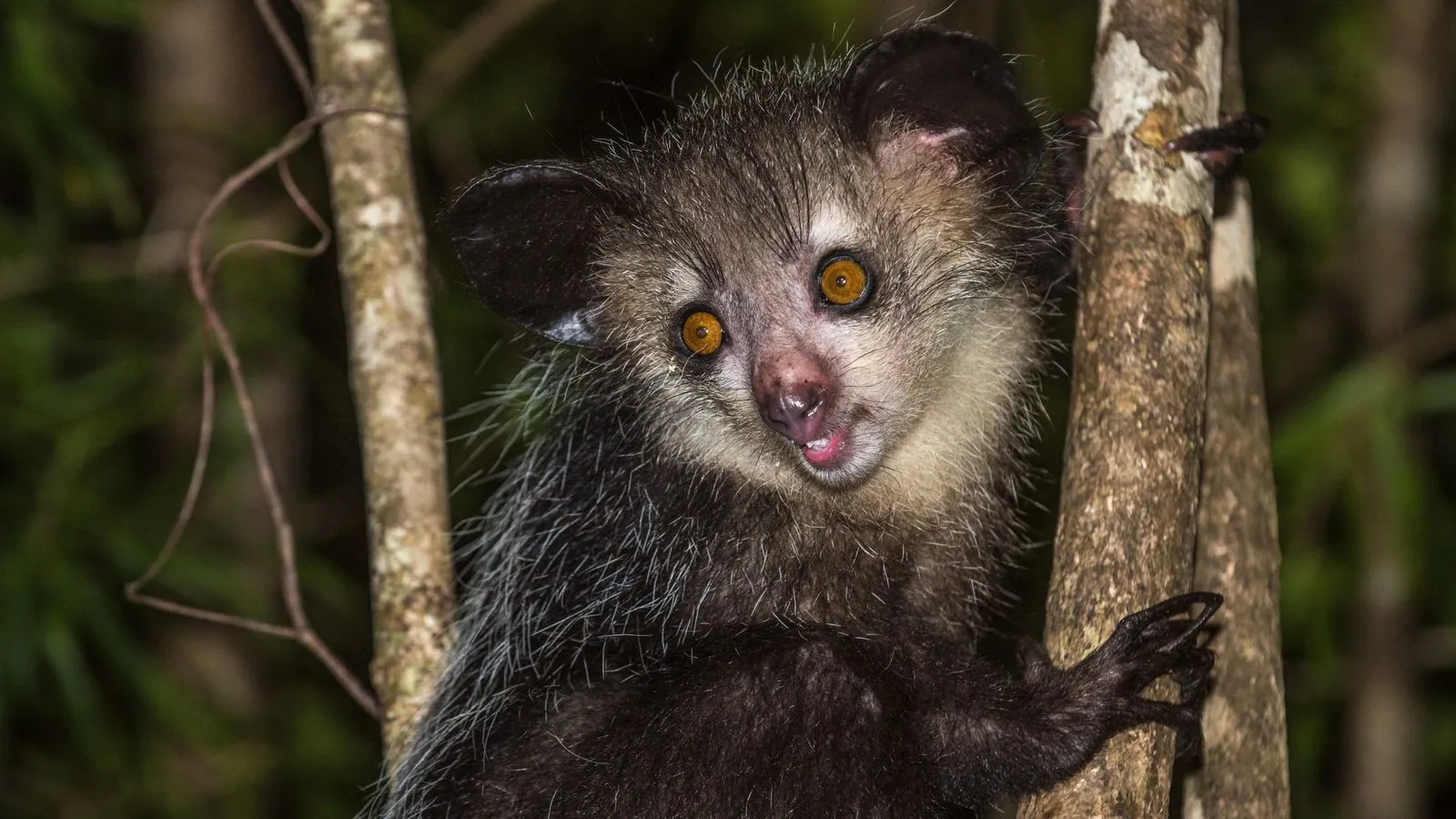
The aye-aye finds its dinner by knocking on wood. This lemur from Madagascar taps branches with a long, thin middle finger, listens for the hollow tunnels that insect larvae chew inside, then bites through the bark and hooks the grub out.
A lemur built from odd parts
At first glance the aye-aye looks as if it were assembled from spare pieces of other animals. Its body is covered in dark brown or black hair tipped with white, which gives it a shaggy, brindled look. Its large eyes are suited to seeing in dim light. Its big, black, oval ears are bare of hair and very mobile, and the San Diego Zoo Wildlife Alliance fact sheet notes they may help it locate hollows in decaying wood.
The head and body measure about 30 to 37 cm (12 to 15 inches), and the bushy tail is longer still, at 44 to 53 cm (17 to 21 inches). Fully grown aye-ayes weigh roughly 2.5 to 2.8 kg (5.5 to 6.2 pounds), according to the Duke Lemur Center. That makes the aye-aye the largest nocturnal primate in the world.
Its hands are large for its size, and the third and fourth fingers are especially long. The third, the middle finger, is extremely thin and looks almost like bare bone. The Duke Lemur Center describes it as the animal’s primary sensory organ.
Teeth that never stop growing
The aye-aye has 18 teeth, where a typical lemur has 30 to 36. Its front incisors are large, curved and chisel-like, and they keep growing throughout its life, wearing down with use. Duke notes that continually growing incisors are unique among primates. The aye-aye uses them to gouge seeds, scrape fungus and pry bark away from trees.
Teeth like these confused early scientists. When the naturalist Gmelin described the aye-aye in 1788, he classed it as a rodent, and for a time it was grouped with squirrels and jerboas. Today it is known to be a lemur, and the only living member of its own family, Daubentoniidae. A bigger relative, the giant aye-aye, is recently extinct. It was 2.5 to 5 times larger than the species that survives.
How it finds food
As an aye-aye walks along a branch, it taps the wood continuously and rapidly with its middle finger. When the sound suggests a cavity under the surface, it tears into the bark with its incisors and slides the slender finger in to pull the larva out. Scientists call this percussive or tap foraging.
Carl Erickson of Duke University studied the behavior in a paper published in 1991 in the journal Animal Behaviour. He found that sight and smell help a little but are not needed. The aye-aye gently taps on wood surfaces to find the cavities, and it opened significantly more cavities holding active larvae than cavities that were empty or held still prey. That suggested it can sense the grubs moving inside.
Insects are only part of the menu. Aye-ayes also eat sap, nectar, fungus, fruits and nuts. Where forest meets farmland they take cultivated foods such as coconut flesh and milk, banana, mango and lychee, tearing open tough fruits and nuts with those strong front teeth.
A night shift in the trees
Aye-ayes are active at night and rest alone during the day. Duke says they can spend up to 80% of the night feeding and moving through the forest canopy. By day they sleep in nests woven from small branches and vines, usually more than 9 m above the ground. A nest takes about an hour to build, and one animal may build many and move between them.
Most of the time aye-ayes live alone. Males roam larger home ranges that overlap one another, while each female keeps a range of her own. Males regularly visit the females’ areas.
A female gives birth to a single infant after a pregnancy of about 158 to 172 days, and in the wild she breeds only once every 2 to 3 years. The baby stays in or near the nest for its first 2 to 3 months, starts eating solid food at about 3 months, and is weaned at around 6 to 7 months.
Why it is endangered
The IUCN Red List lists the aye-aye as Endangered, with a decreasing population, in an assessment last updated in 2018. The main threats, according to the Duke Lemur Center, are loss of habitat and hunting.
Superstition plays a part too. In many villages the aye-aye is regarded as an evil omen, or fady, and some people believe one must be killed on sight to stop bad luck falling on the whole village.
The species lives along Madagascar’s east coast and in its northwestern forests, in nearly every type of forest except spiny forest. Because aye-ayes are so secretive and active only in the dark, nobody knows how many remain in the wild.
Zoos have learned to breed them. The first recorded aye-aye birth in human care came in 1992. In 2005 the Duke Lemur Center welcomed Angelique, the first aye-aye born to parents who had themselves been born in human care.
Article Sources
- Daubentonia madagascariensis (Aye-aye) | IUCN Red List
- Aye-aye | Duke Lemur Center
- Aye-aye Fact Sheet: Physical Characteristics | San Diego Zoo Wildlife Alliance Library
- Aye-aye Fact Sheet: Diet & Feeding | San Diego Zoo Wildlife Alliance Library
- Aye-aye Fact Sheet: Taxonomy & History | San Diego Zoo Wildlife Alliance Library
- Aye-aye Fact Sheet: Behavior & Ecology | San Diego Zoo Wildlife Alliance Library
- Aye-aye Fact Sheet: Reproduction & Development | San Diego Zoo Wildlife Alliance Library
- Percussive foraging in the aye-aye (Erickson, Animal Behaviour, 1991) | Duke Scholars