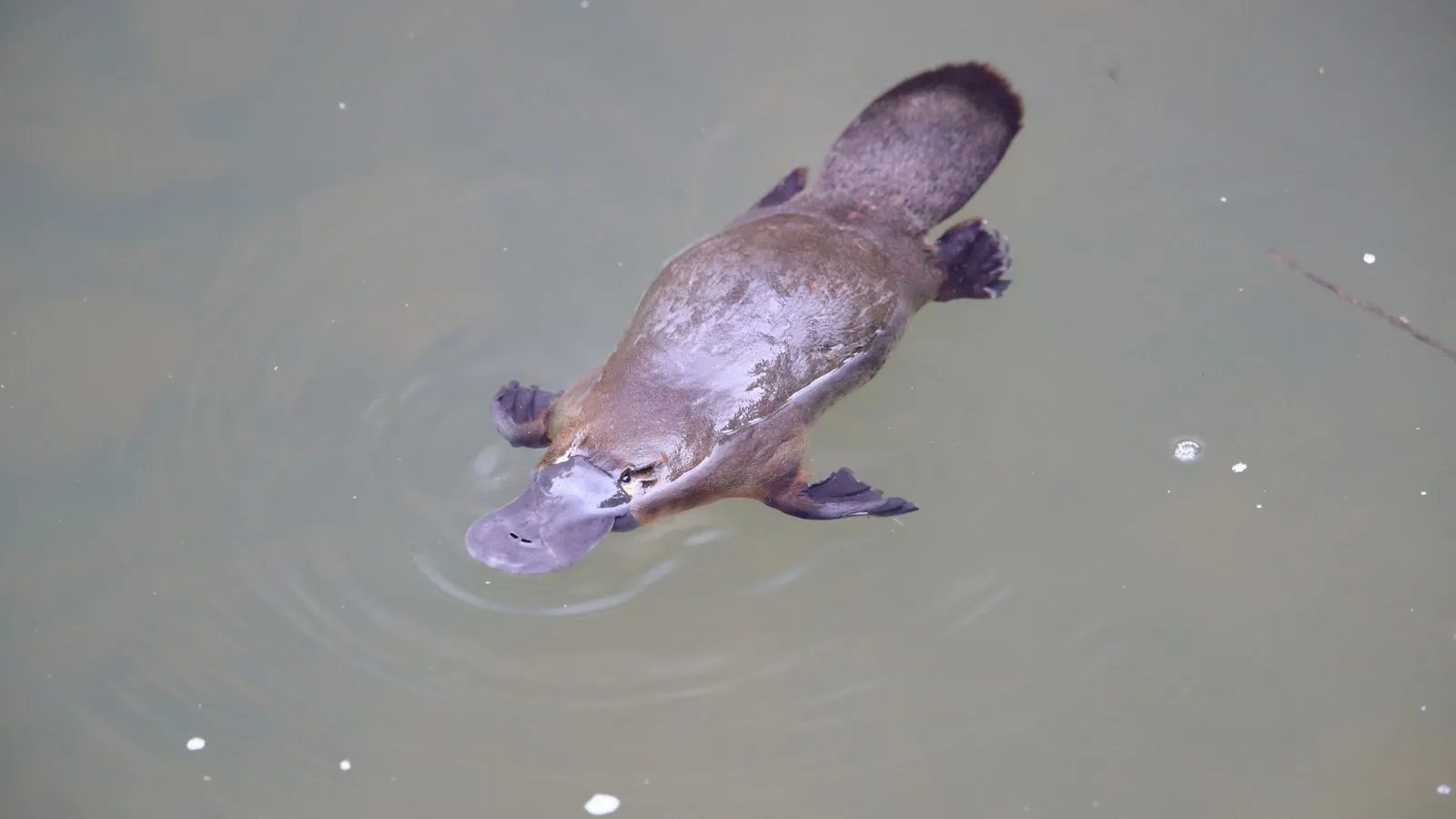
The platypus is a mammal that lays eggs, hunts with its eyes shut by sensing the electricity in its prey’s muscles and, if it is a male, carries a venomous spur on each hind ankle. Few animals break so many rules at once.
A mammal that baffled scientists
The platypus lives only in Australia. Along with the echidnas it belongs to a small group of mammals called monotremes, which the Australian Museum describes as different from all other mammals because they lay eggs and have no teats. When European naturalists first saw a platypus, its looks caused so much doubt that many of them believed the animal was a fake.
It has a streamlined body, dense waterproof fur, a broad flat tail and that famous bill. Unlike a duck’s bill, it is covered in smooth skin with a soft, suede-like texture, and it is pliable and fleshy around the edges.
Males are bigger than females. The Australian Platypus Conservancy gives males a length of 400 to 630 mm and a weight of 0.8 to 3.0 kg, while females measure 370 to 550 mm and weigh 0.6 to 1.7 kg. Animals in the cooler south tend to be larger than those in the warmer north, and life spans of up to 24 years have been recorded in the wild.
Hunting with its eyes closed
A platypus’s eyes normally close automatically as soon as it dives, and its ears sit in a muscular groove that pinches shut underwater. It feeds mainly at night, often in murky water. So it hunts by touch and by electricity.
The skin of the bill is thickly dotted with sensory receptors. More than 40,000 “push rods” respond to touch and water pressure, and they fire when their tip is moved by as little as 20 microns. That lets a platypus pick up the movement of a freshwater shrimp at least 15 to 20 cm away.
The bill also holds tens of thousands of electroreceptors, and the Australian Museum puts the figure at 40,000. They register the tiny electrical signals made when a prey animal’s muscles contract. Because electricity travels so quickly through water, the flick of a shrimp’s tail reaches the electroreceptors a fraction of an instant before the water movement reaches the push rods. That tiny delay is thought to give the platypus a way to judge how far away its prey is.
What it catches is mostly aquatic invertebrates, especially insect larvae, along with shrimps, tadpoles, worms and snails.
The venomous spur
The platypus is the only Australian mammal known to be venomous. A male has a spur on the inside of each hind ankle, typically 15 to 18 mm long and shaped like a dog’s canine tooth. The venom is made by paired glands in the upper thigh, called crural glands.
Only mature males make venom, and production peaks in the breeding season. That is why scientists believe the venom evolved mainly to help males compete for mates. Females lack obvious spurs altogether.
A spur wound is not known to be life-threatening to people, but the Australian Platypus Conservancy says it causes severe pain and swelling that can take several weeks to settle, and some swelling can linger for months.
Eggs, and milk without nipples
Courtship has been recorded in late July and August in southern Queensland, and as late as December in Tasmania. After mating, gestation takes an average of 16 days. The female then lays one to three eggs, most often two, each 16 to 18 mm long, in an underground nesting chamber. She holds them between her curled-up tail and her belly to keep them warm through an estimated 10-day incubation.
The young are tiny and very immature when they hatch. A female platypus has no nipples, so her milk is secreted from two special patches of skin onto her belly fur. The young develop in the burrow for about 3 months before entering the water for the first time, and both males and females become mature at two years old.
A Near Threatened species
The IUCN Red List lists the platypus as Near Threatened, with a decreasing population, in an assessment from 2014. It lives in eastern Queensland and New South Wales, much of Victoria, throughout Tasmania and on King Island, and an introduced population lives on Kangaroo Island. It appears to have vanished from its former range in the Adelaide Hills and Mount Lofty Ranges of South Australia.
On the mainland the main threat is shrinking stream and river flows, driven by drought, stream regulation and the extraction of water. Bank erosion, pollution, litter, accidental drowning in fishing nets and traps, and predation by introduced red foxes, dogs and cats add to the pressure.
Article Sources
- Ornithorhynchus anatinus (Platypus) | IUCN Red List
- Platypus | Australian Museum
- What is a monotreme? | Australian Museum
- The platypus bill: push rods and electroreception | Australian Platypus Conservancy
- Platypus venom and spurs | Australian Platypus Conservancy
- Platypus reproduction | Australian Platypus Conservancy
- Platypus vision and hearing | Australian Platypus Conservancy
- Platypus vital statistics | Australian Platypus Conservancy