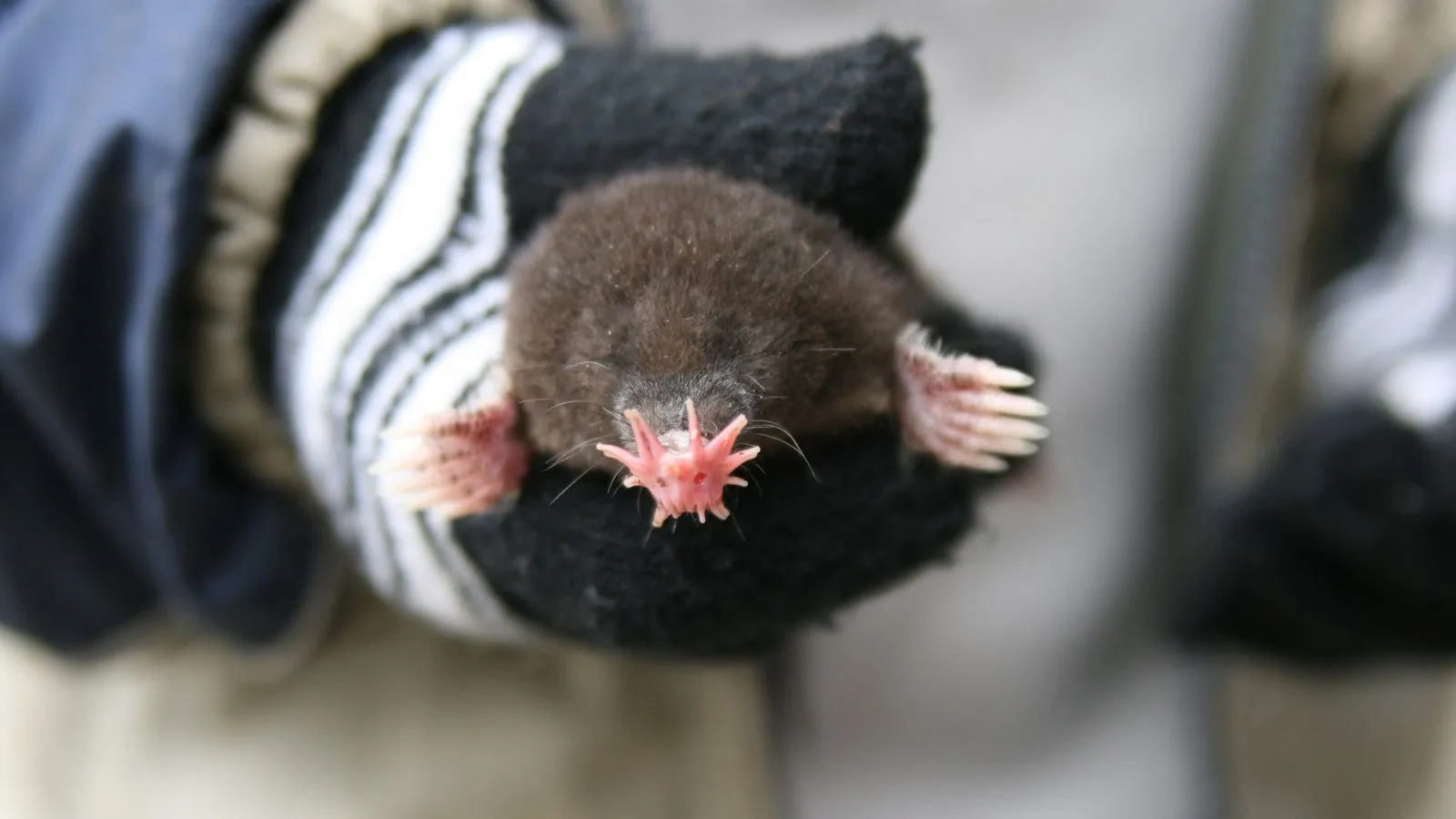
The star-nosed mole can identify and eat a small piece of prey in as little as 120 milliseconds, making it the fastest-eating mammal known. The tool behind that speed is one of the strangest noses on Earth: a pink star of 22 fleshy rays ringing its nostrils.
The star on its face
The star-nosed mole lives in the bogs and wetlands of the eastern United States and Canada, and Smithsonian magazine describes it as roughly the size of a rat when fully grown. It is functionally blind. Instead of seeing its world, it feels it.
The 22 rays form two rings of 11, one around each nostril. The whole star is only about a centimeter across, smaller than a human fingertip. Each ray is covered in tiny domes called Eimer’s organs, and the average star carries some 30,000 of them. Studies of these domes suggest they detect small shapes and textures.
The star is wired to the brain by more than 100,000 nerve fibers. Researchers writing in the journal PLOS ONE say that gives it the highest density of nerves of any mammal’s skin. A whole human hand, by comparison, has roughly 17,000 touch fibers. And the star is quick. The National Wildlife Federation reports that high-speed video shows it can touch ten objects in one second.
A fovea made for touch
Our eyes have a fovea, a small central spot that sees fine detail. The mole has a touch version. The central pair of rays, known as the 11th pair, acts as a tactile fovea. When something interesting turns up, the mole explores it with these central rays, much as we turn our eyes to look closely at something.
The mole’s brain gives the star special treatment. National Geographic describes a giant star pattern that mirrors the nose imprinted right into the brain’s anatomy. A 2011 study by Kenneth Catania and colleagues found that the 11th ray, the most important one for behavior, is over-represented in the brain, given more space than other rays.
The fastest eater among mammals
Guinness World Records lists the star-nosed mole as the fastest eater among mammals. In a 2005 study, Catania of Vanderbilt University filmed the moles with high-speed cameras and timed their handling time, from recognizing a morsel as food to eating it and moving on to search for the next. The average was 230 milliseconds, and the quickest was 120 milliseconds. Guinness points out that a human driver takes about 650 milliseconds just to respond to a red light.
The prey is small. The IUCN Red List notes that in some areas the mole eats mainly aquatic invertebrates, while in others earthworms make up much of its diet. Smithsonian magazine adds insects and small fish to the menu.
Sniffing underwater
The star-nosed mole is at home in water. The IUCN describes it as a good swimmer and diver that may stay active in water under the ice in winter, and its tunnels can even open underwater.
It has a special trick down there. National Geographic reports that it is one of only two animals in the world known to smell underwater. It blows air bubbles out of its nose and then sucks them back in, picking up scents from the water around it.
A common mole of wet places
Of the world’s 39 mole species, this is the only one that lives in swamps and marshes. It is seldom far from water and prefers wet soils in floodplains, swamps and meadows. Its range runs from Labrador, Quebec and Nova Scotia south along the Atlantic coast to southeastern Georgia and the northern edge of Florida, and it reaches farther north than any other native mole.
Females give birth in spring or early summer after a pregnancy of about 45 days, to litters of three to seven young.
The IUCN Red List lists the star-nosed mole as Least Concern, last assessed in 2016, with a stable population. It is common across a large range, and the IUCN finds no major threats to the species.
Article Sources
- Condylura cristata (Star-nosed Mole) | IUCN Red List
- Inside the Bizarre Life of the Star-Nosed Mole, World's Fastest Eater | National Geographic
- Fastest-eating mammal | Guinness World Records
- How the Star-Nosed Mole 'Sees' With Its Ultra-Sensitive Snout | Smithsonian Magazine
- Star of the Swamp | National Wildlife Federation
- The sense of touch in the star-nosed mole: from mechanoreceptors to the brain | Philosophical Transactions B (Europe PMC)
- The Star-Nosed Mole Reveals Clues to the Molecular Basis of Mammalian Touch | PLOS ONE (Europe PMC)
- A star in the brainstem reveals the first step of cortical magnification | PLOS ONE (Europe PMC)