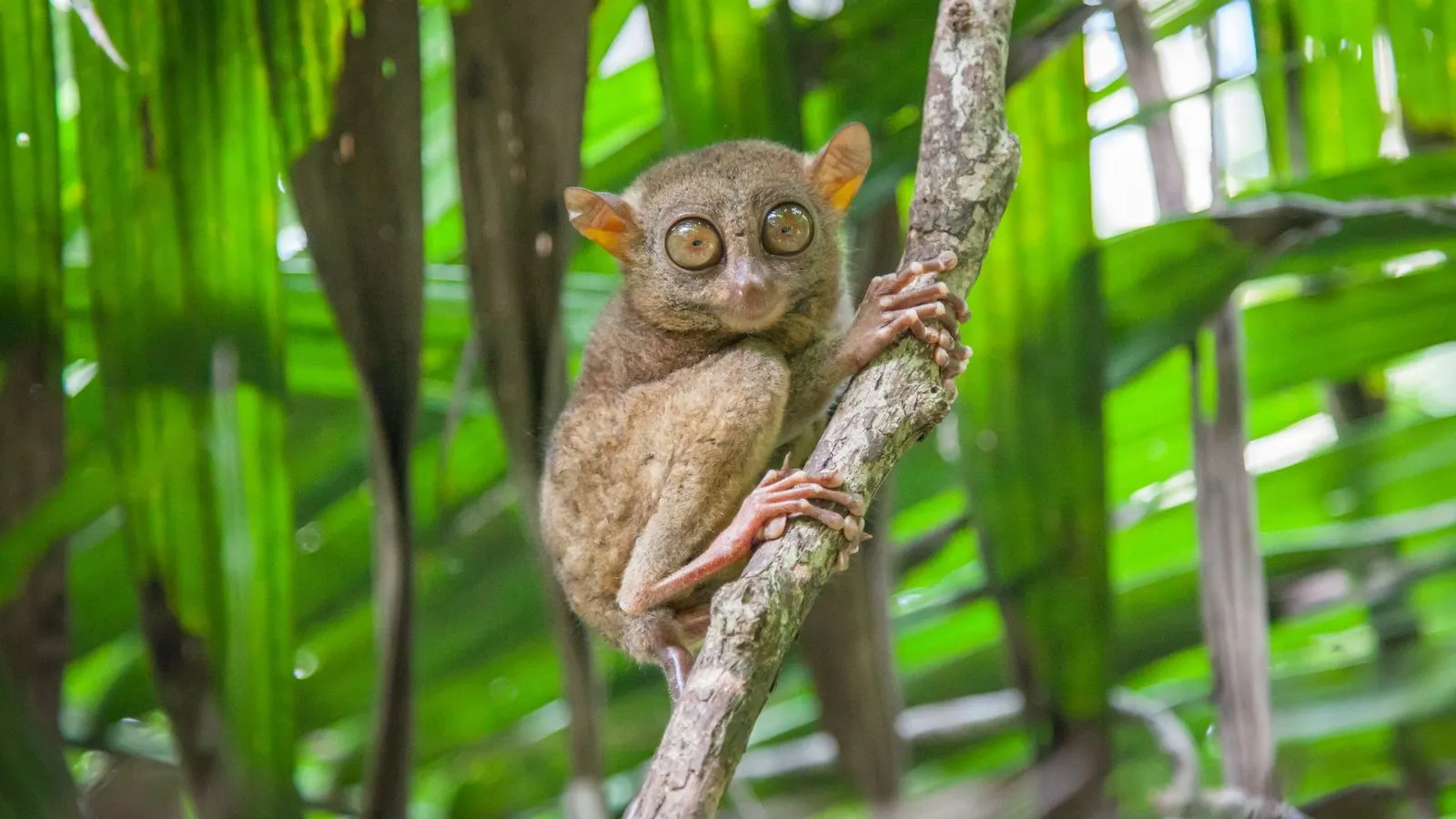
A tarsier’s eyes are so enormous that a single one weighs nearly as much as its whole brain. Relative to body size, no other mammal has bigger eyes, and this palm-sized primate uses them to hunt insects, lizards and even birds in the dark forests of Southeast Asia.
A primate the size of a hand
Tarsiers are small primates that weigh just 80 to 150 g, with bodies up to 10 cm long and a thin, mostly bare tail of 20 to 25 cm with a tuft at the tip. The Philippine tarsier is about the size of a young child’s hand. They live only on islands in Southeast Asia, including Sumatra, Borneo, Sulawesi and parts of the Philippines.
They have round heads, big, thin ears that look like a bat’s, and almost no neck. Their fingers are long, with soft pads at the tips for gripping bark. The spectral tarsier’s hands are thought to be the longest of any living primate for its body size.
Tarsiers are an old line. The oldest fossil of a tarsier-like primate is about 50 million years old and was found in China.
Eyes that cannot move
The spectral tarsier account on the University of Michigan’s Animal Diversity Web puts it simply: tarsiers’ eyes are larger than their brain. Each eye is so big that it is fixed in place in the skull and cannot roll from side to side.
To look around, a tarsier turns its whole head instead, more than 180 degrees. Tarsiers have a lot in common with owls. Scientists have counted over 30 ways in which tarsiers and owls have come to look and live alike, from their outward shape to their inner ears and their way of life.
Most night animals, such as cats, have a reflective layer behind the retina that helps them see in the dark. Tarsiers do not. Instead they rely on sheer size, which lets their eyes collect as much light as possible, plus a dense patch on the retina for pin-sharp vision. The result is the sharpest night vision of any primate.
Springs for legs
Tarsiers get their name from their tarsal bones, the long bones of the ankle and foot. Their hind legs are longer for their body than those of any other mammal, and their thigh muscles can make up 12% of their body weight. Two of the lower leg bones are fused together and work like a shock absorber when they land.
All that adds up to astonishing jumps. A tarsier can leap up to 45 times its own body length, and the Philippine tarsier can cover distances up to twenty feet. Tarsiers are especially good at leaping backward, pushing off backward, turning in midair and landing feet first.
A hunter that eats only meat
Tarsiers eat only animals. They use their huge eyes and sharp hearing to find prey at night, then grab it with a quick leap. Moths, butterflies, grasshoppers and crickets, ants and beetles make up most of the menu, but they also catch birds, lizards and snakes, sometimes as big as themselves.
They have enemies too. Tarsiers have been seen mobbing snakes and being caught by snakes and slow lorises.
Screaming in silence
For years, the Philippine tarsier was thought of as a quiet animal. Then, in a study published in the journal Biology Letters in 2012, researchers including Marissa Ramsier found it was calling all along in sounds too high for people to hear.
The highest-pitched sound a human can hear is about 20 kilohertz. The team tested the hearing of six tarsiers from the island of Mindanao and found they could hear up to 91 kilohertz, beating the bush baby’s 65 kHz, which had been the highest known for a primate. A colleague who saw tarsiers opening their mouths without making a sound borrowed a bat detector to record them. Of 35 wild tarsiers recorded, eight called in pure ultrasound, between 67 and 79 kHz, most often around 70 kHz.
“It’s actually screaming and we had no idea,” Ramsier said. The calls may work as a private line that predators cannot overhear. The tarsiers may also use their sharp hearing to listen for insects, some of which make ultrasonic sounds of their own.
Big babies and small numbers
Tarsier mothers have a single baby after a pregnancy of about 6 months. The newborn weighs 25 to 30% of its mother’s weight, the largest babies for their mother’s size of any mammal. Babies are born with fur and open eyes. A Philippine tarsier can climb after two days and jump after four, and it can catch its own prey at about 45 days old. Spectral tarsier mothers carry their young in their mouths for the first 3 weeks and park them on branches while they hunt.
At dawn, spectral tarsier families sing together as they head back to their sleeping trees, a way of telling neighbors that the territory is taken. Tarsiers can live up to 16 years.
The IUCN recognizes 8 species of tarsiers: two are listed as endangered, three as vulnerable, one as near threatened and two as data deficient. All of them are losing forest habitat.