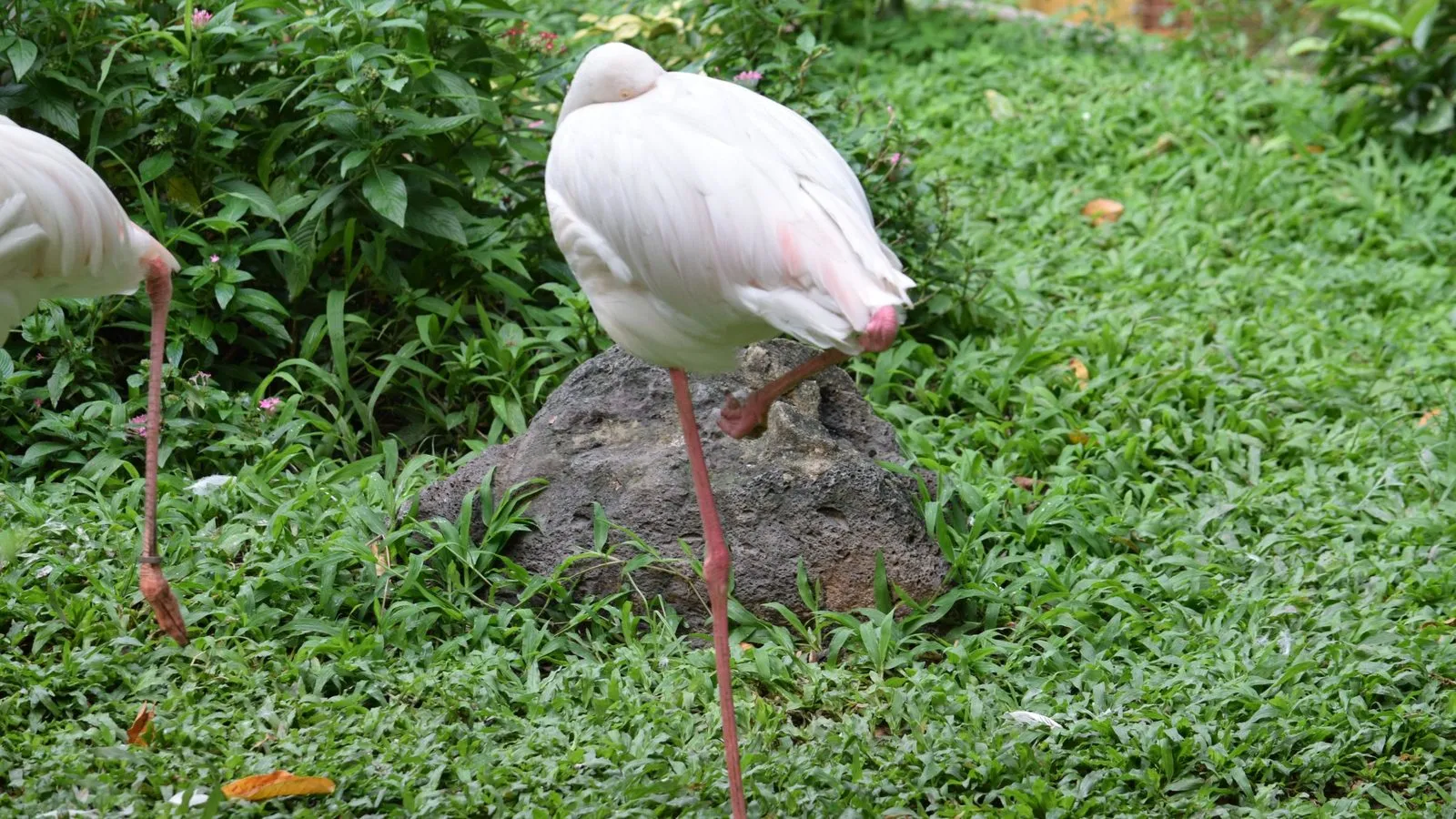
Flamingos stand on one leg because it takes them almost no effort, and because it probably helps them keep warm. Experiments with flamingo bodies have shown the pose can be held with no muscle activity at all, and a study of a zoo flock found the birds use it more in cooler weather.
A bird built for standing
American flamingos are tall birds. The Smithsonian’s National Zoo gives an average height of 5 feet (1.5 meters) and a weight of 4 to 8 pounds (1.8 to 3.6 kilograms). A pigment in their food gives their feathers that famous pink color.
They often stand on one leg, with the head resting on the body and the other leg tucked up under the belly. The scientific paper that finally explained how they do it opens by noting that flamingos often stand and sleep on one leg for long periods.
The leg is not quite what it seems, either. The joint halfway down that looks like a knee bending the wrong way is actually the bird’s ankle, as the Oklahoma City Zoo points out.
Idea one: resting tired muscles
One older explanation was that a flamingo stands on one leg to rest the muscles of the other, then swaps, so neither leg tires out. Matthew Anderson, a psychologist at Saint Joseph’s University in Philadelphia, put this to the test with a captive flock at the Philadelphia Zoo.
His team timed how long the birds took to start moving from a one-legged rest and from a two-legged rest. The birds were faster off the mark when they had been standing on both legs, which ruled out the fatigue idea.
Idea two: keeping warm
Anderson’s team also watched how the stance changed with the weather. When it was warmer, more birds stood on two feet. In cooler weather, more of them chose the one-legged stance, although most of the flock favored one leg overall.
That fits with how flamingos live. They spend most of their time in water, and water draws body heat away quickly. Tucking one leg up against the body reduces its exposure to cold air and especially to water. The study, reported in 2009 ahead of publication in the journal Zoo Biology, concluded that thermoregulation, meaning the control of body temperature, is a key reason for the stance. The team added that more research was needed, particularly on wild flocks, and that the pose might have other benefits too.
How the balance works
That still left a puzzle. How can a bird balance on one thin leg for so long, even while asleep? In 2017 Young-Hui Chang of the Georgia Institute of Technology and Lena Ting of Emory University published an answer in the journal Biology Letters.
They started with two flamingo cadavers from the Birmingham Zoo. When Chang lifted one leg of a dead bird, the body settled into a stable one-legged pose with no muscle activity. “Here we have a non-living animal able to stand on one leg,” he said. When the researchers tried to stand the dead birds on two legs, the pose would not hold.
The team then stood 8 live juvenile flamingos from Zoo Atlanta, home to one of the largest breeding flocks of Chilean flamingos in the U.S., on pressure plates and measured how much they swayed. The birds swayed seven times less while they slept than while they were awake. That suggested they were relaxing into a pose that holds itself up.
The researchers call the mechanism a “passively engaged gravitational stay apparatus.” In plain terms, the way the joints and ligaments line up under the bird’s weight locks the leg in place, so the flamingo does not have to keep working its muscles to stay upright.
Putting the answers together
The two findings fit together. The balance study shows that standing on one leg costs a flamingo very little effort, which makes it an easy way to rest. The Philadelphia Zoo observations suggest the birds lean on it most when keeping a leg out of the cold matters.
Flamingos are not alone. Many other birds adopt a one-legged pose, and the researchers suggest their findings could help explain why. The work could also inform better robots, orthopedic braces and artificial limbs.
Article Sources
- Mechanical evidence that flamingos can support their body on one leg with little active muscular force | Biology Letters (Europe PMC)
- How do flamingos stand on one leg? | Emory News Center
- Why flamingos do have one leg to stand on | The Naked Scientists
- How flamingos stand on one leg | Inside Science
- Why flamingos stand on one leg | NBC News
- American flamingo | Smithsonian's National Zoo
- American Flamingo | Oklahoma City Zoo