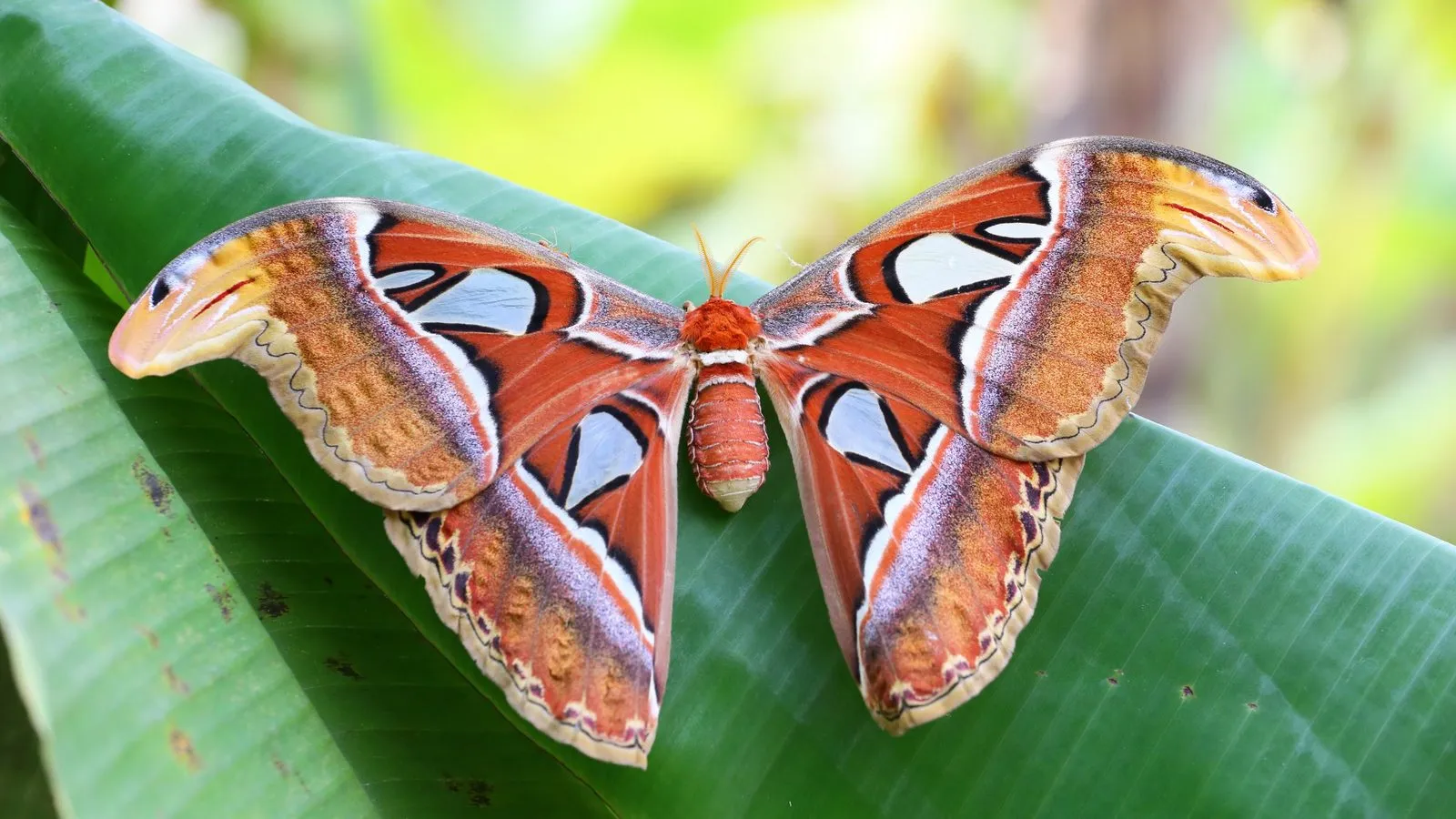
The Atlas moth carries a startling surprise on its wings. The upper tip of each forewing curls into a shape that looks remarkably like the head of a cobra seen from the side.
A giant among moths
The Atlas moth, Attacus atlas, lives in the tropical and subtropical rainforests of Asia, from India to the Philippines and south to Indonesia. It belongs to the family Saturniidae, the giant silkworm moths.
It is one of the largest moths in the world by wingspan and wing area. The California Academy of Sciences puts its maximum wingspan at about 10 inches, just behind the white witch moth of Central and South America, at about 14 inches. In one study of moths raised in a lab, females had wingspans of 240 to 250 mm and males 210 to 230 mm.
Its wings are a mix of deep orange, soft brown and reddish brown, patterned with white, black and pink. In the middle of each wing sits a large, see-through triangular patch.
Nobody is quite sure where the name comes from. It may honor Atlas, the Titan of Greek myth, or it may refer to the map-like patterns on the wings.
The snake-head wingtips
The Atlas moth’s Cantonese name means snake’s head moth. The California Academy of Sciences describes the wingtip markings as an uncanny match for a cobra’s head in profile.
Is it really snake mimicry? Not every entomologist is convinced, but there is some good evidence. Cobras live in the same part of the world as the moth. The moth’s main predators, birds and lizards, hunt by sight. And moths related to the Atlas moth have similar but less sharp snake-head shapes, a pattern natural selection could have refined over time.
When threatened, the moth is reported to drop to the ground and move its wings so that the tips imitate the head and neck of a moving snake. The see-through patches on the wings may also work as false eyes. These could startle a predator, or draw an attack toward the wings and away from the moth’s soft body, where the damage would matter much more.
A second trick for bats
The wingtips may fool more than eyes. In 2021, researchers at the University of Bristol reported that some silk moths have rippled and folded forewing tips that strongly reflect sound. They measured echoes from moths at over 10,000 angles. For a bat hunting by echolocation, those folded tips send back stronger echoes than the moth’s body, so the bat is more likely to strike the wingtip instead.
A photo caption released with the study describes the Atlas moth as having the strongest known wingtip decoy of this kind. The team planned further experiments with live bats to measure how much protection it really gives.
A life without eating
The longest stages of an Atlas moth’s life are the caterpillar and the pupa. The caterpillars, which can reach about five inches long, are covered in white, waxy spines. That wax may help them look like bird droppings to predators. If handled roughly, they can also spray irritating chemicals from small openings on their bodies.
When it is ready, the caterpillar spins a silk cocoon and stays inside as a pupa for about one to one and a half months. Atlas moth silk is similar to that of the domesticated silkworm but coarser, browner and more durable. In some Asian countries, empty cocoons have been used as coin purses.
The adult moth comes out in the morning and hangs from its cocoon for 8 to 10 hours while its wings expand and harden. From then on, it never eats. Its mouthparts do not work, and some parts are missing entirely. It lives off fat stored when it was a caterpillar, and it survives only one to two weeks.
Finding a mate in time
With so little time, an adult Atlas moth has one main job: to breed. Females stay put and release a scent signal called a pheromone. Males pick up the scent with their large, feathery antennae and follow it to find a female.
To save energy, the moths spend much of the day resting. Many of them spend almost their entire lives on a single tree, from egg, to leaf-munching caterpillar, to cocoon, to a female waiting for a mate.
Article Sources
- Atlas Moth | California Academy of Sciences
- Attacus atlas | Animal Diversity Web
- How the atlas moth imitates snakes to ward off threats | One Earth
- Taipei Zoo welcomes rare Atlas moth hatchings | Taiwan News
- Moth wingtips an 'acoustic decoy' to thwart bat attack | ScienceDaily
- Atlas moth image caption | EurekAlert