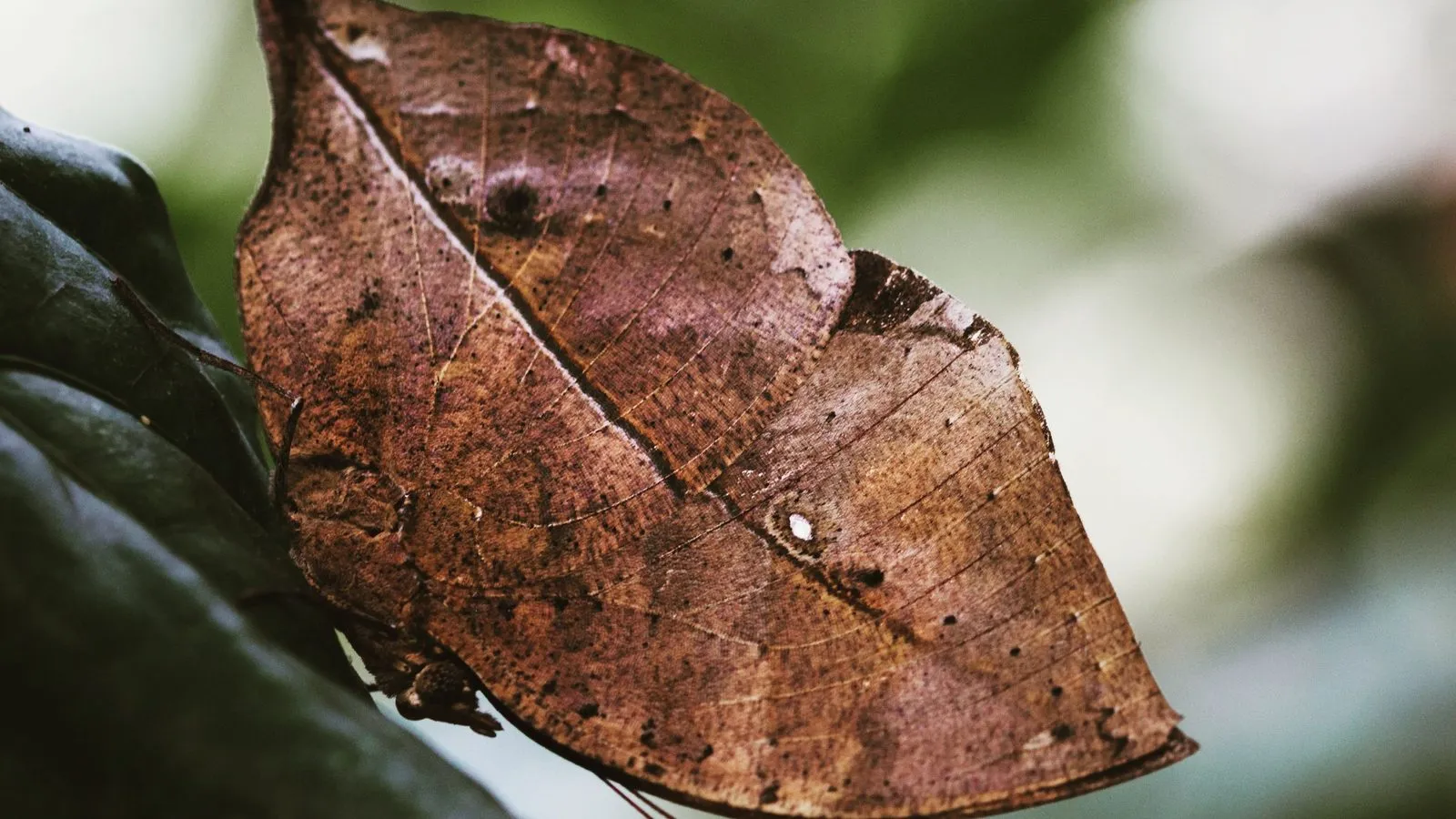
Many insects stay alive by being overlooked. Some blend into bark or soot, and others take on the exact shape of a leaf, a twig or a flower, a trick scientists call masquerade. Here are some of the best at it.
The dead leaf butterfly
With its wings closed, a Kallima butterfly looks like a dry brown leaf, right down to the veins and tiny spots that look like fungus. In the 1800s, the naturalist Alfred Russel Wallace collected these butterflies in Southeast Asia and used them to support Darwin’s theory of natural selection.
Not everyone agreed. In the 1940s, the geneticist Richard Goldschmidt argued that the leaf look must have appeared suddenly, in one big jump. In 2014, Japanese researchers led by Takao Suzuki mapped small changes in the markings under the wings of Kallima and their relatives. They concluded that the butterflies passed through at least four in-between forms on the way to looking like leaves. Other scientists said the methods were highly technical and would take time to check.
Chan’s megastick
Stick insects, also called phasmids, are among the best hiders in the animal world. Most simply take the shape of sticks or leaves and keep still. In 2008, scientists announced that one from Borneo, Phobaeticus chani, was the world’s longest insect. The specimen had been given to the Malaysian naturalist Datuk Chan Chew Lun by a local villager in 1989, and the species is named after him.
Its body measures 35.7 centimeters, or 14 inches, and with its thin, twig-like legs stretched out it reaches 56.7 centimeters. That is nearly the length of a human arm. Paul Brock, a scientific associate of the Natural History Museum in London, summed up its defense: it hangs around looking like a twig, and it will even sway in the wind.
Leaf insects
Leaf insects take the disguise a step further. Females have flat bodies and front wings with vein-like lines, so they look like the leaves of flowering plants. Their colors and patterns can even copy different stages of a leaf rotting. They live in the tropics of Asia, Australasia and the Pacific.
They mostly stay still by day, when predators that hunt by sight are busy, and move at night. Even then they move slowly, rocking like a leaf in the breeze. They hide so well from people too that in 2023, researchers described seven new species, some of which could only be told apart by their genes. Of about 3,500 known stick and leaf insects, just over 100 are leaf insects.
The peppered moth
The peppered moth is a textbook case of camouflage changing over time. The usual form has light-colored wings. During Britain’s Industrial Revolution, a dark form spread because it matched trees blackened by soot, and birds found it harder to spot. The first black peppered moth was recorded in Manchester in 1848.
In 2016, University of Liverpool scientists found the cause: a jumping gene, a piece of DNA that moves around the genome, inside a gene called cortex. They dated the change to around 1819, about 30 years before anyone noticed the dark moths.
The caterpillars look like twigs and slowly change color to match the twig they rest on. In 2019, the Liverpool team showed that blindfolded caterpillars still matched their background and still chose matching twigs. Genes used for vision were active in their skin, so they seem to sense color through it.
The orchid mantis
Not all camouflage is about hiding from hunters. The orchid mantis is white and pink, with flattened, petal-shaped legs. For a long time, people assumed it hid inside flowers to ambush insects.
Researchers found that it does not hide at all. It sits out in the open and looks like a flower itself, and insects approach it more often than they approach real flowers. It is the first animal shown to mimic an entire flower and attract prey on its own, a kind of disguise called aggressive mimicry. For an insect that comes to investigate, the mistake can be fatal.
Article Sources
- Mystery Solved? How Butterflies Came to Look Like Dead Leaves | National Geographic
- Bug from Borneo is the world's longest | NBC News
- Entomologists Discover Seven New Species of Leaf Insects | Sci.News
- 'Jumping gene' took peppered moths to the dark side | University of Liverpool
- Twig-mimicking caterpillars sense colour through their skin | University of Liverpool
- Secrets of the orchid mantis revealed | The Conversation