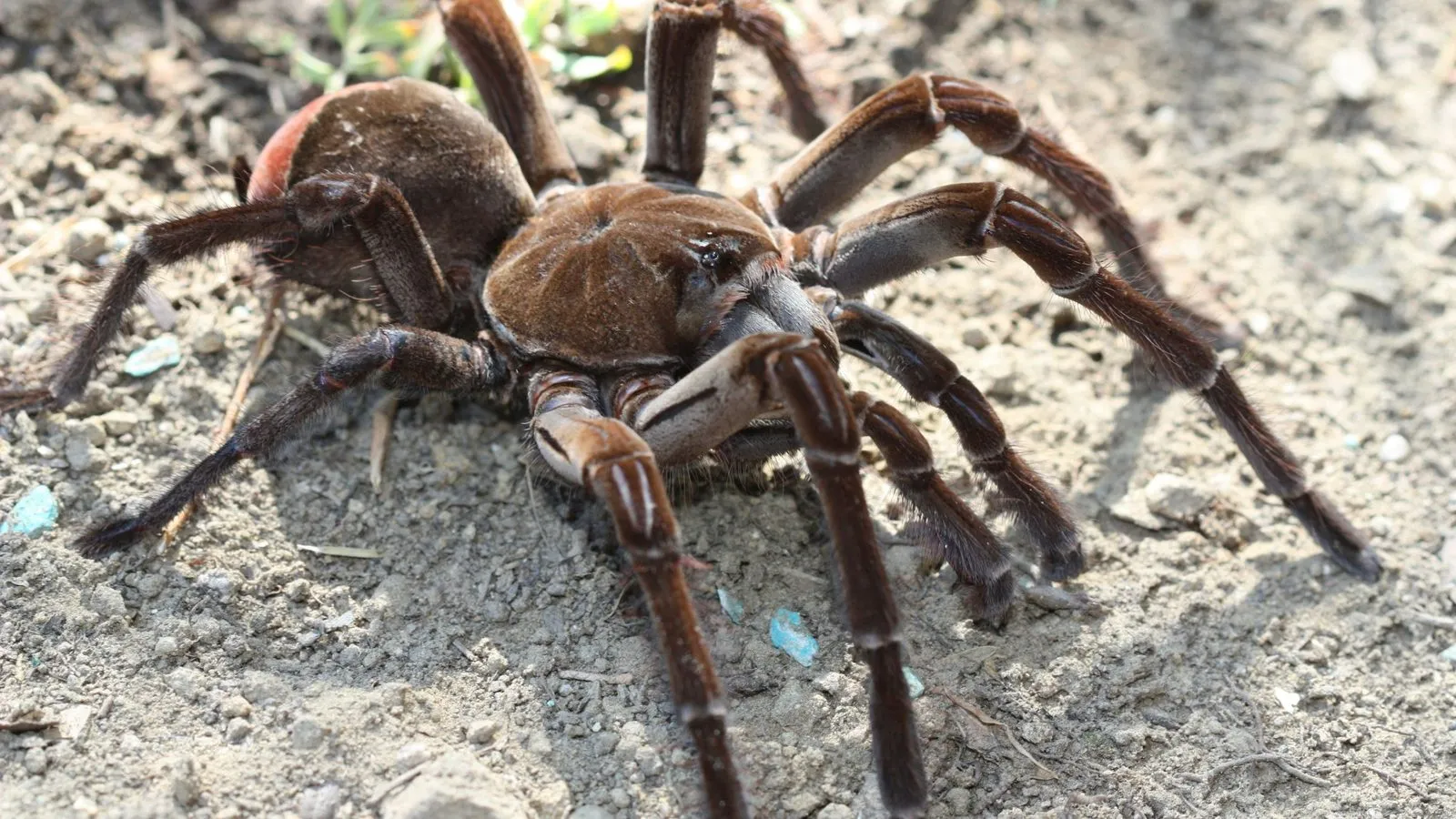
The Goliath birdeater is the heaviest spider known. Guinness World Records lists this South American tarantula at up to 175 grams, or about 6.2 ounces, and National Geographic gives its leg span as up to 12 inches.
How big it really gets
The Goliath birdeater, Theraphosa blondi, is a tarantula. Its color ranges from light tan to dark brown and black, and its body and legs are covered in short hairs.
Guinness gives it the record for the world’s largest spider by mass. One specimen collected by an expedition at Rio Cavro in Venezuela in April 1965 had a leg span of 28 centimeters, or 11 inches. There are reports of exceptional individuals with legs spanning 30 centimeters.
Harvard entomologist Piotr Naskrecki, who has met the spider in the wild, compared its legs to a child’s forearm and its body to a large fist.
On leg span alone, the Goliath has a rival. The giant huntsman spider of Laos is considered the widest spider in the world, with legs as long or longer. But the huntsman has a much smaller, lighter body. Naskrecki said comparing the two would be like comparing a giraffe to an elephant.
Where it lives
Goliath birdeaters live in the rainforests of northern South America. They are most common in the coastal rainforests of Suriname, Guyana and French Guiana, and have been seen now and then in Venezuela, Brazil and even Colombia.
They are hard to find. Naskrecki said that in 10 to 15 years of working in the tropics of South America, he had run across the spider only three times.
He described one of those meetings, at night in a Guyana rainforest. He heard rustling underfoot and switched on his flashlight, expecting to see a small mammal such as a possum or a rat. Instead, he found a giant spider. He also noticed that its feet have hard tips and claws that make a distinct clicking sound, a bit like a horse’s hooves, only quieter.
Does it really eat birds?
Not often. The name comes from an 18th-century engraving that showed a similar tarantula eating a hummingbird. Goliaths are big enough to kill a bird, and occasionally they do, but birds are a rare meal.
The spider hunts on the ground at night, in the leaf litter, so it seldom meets birds at all. Insects make up much of its diet, along with frogs, lizards and sometimes small rodents. Naskrecki says its main prey is actually earthworms, which come out on humid nights.
Like other tarantulas, the Goliath does not build a web to catch food. It prowls the forest floor, ambushes its prey and subdues it with venom. Then it drags the catch back to its burrow, which it lines with silk. Spiders cannot swallow solid food, so the Goliath turns its prey’s insides to liquid and sucks them up.
Hairs, hisses and clicks
Goliath birdeaters have poor eyesight. Instead, special hairs on their legs pick up vibrations and warn them of danger.
When a predator such as a coati comes too close, the spider has several tricks. It can rub hairs on its body together to make a hissing sound. Naskrecki compared the noise to pulling Velcro apart. If that does not work, it rubs its hind legs against its abdomen and flicks off a cloud of urticating hairs. These tiny hairs carry barbs that irritate the eyes and skin of an attacker.
Its venom is not deadly to people. National Geographic says a bite would sting about as much as a wasp’s, and Naskrecki described the spider as no real threat to humans.
Family life
Female Goliaths put their defensive hairs to another use. They cover their large egg sacs with them, and each sac holds between 50 and 150 eggs. The young stay close to their mother as they grow, reaching adulthood at two to three years old.
The sexes live very different lifespans. National Geographic gives an average life span of 20 years for females, but only 3 to 6 years for males.