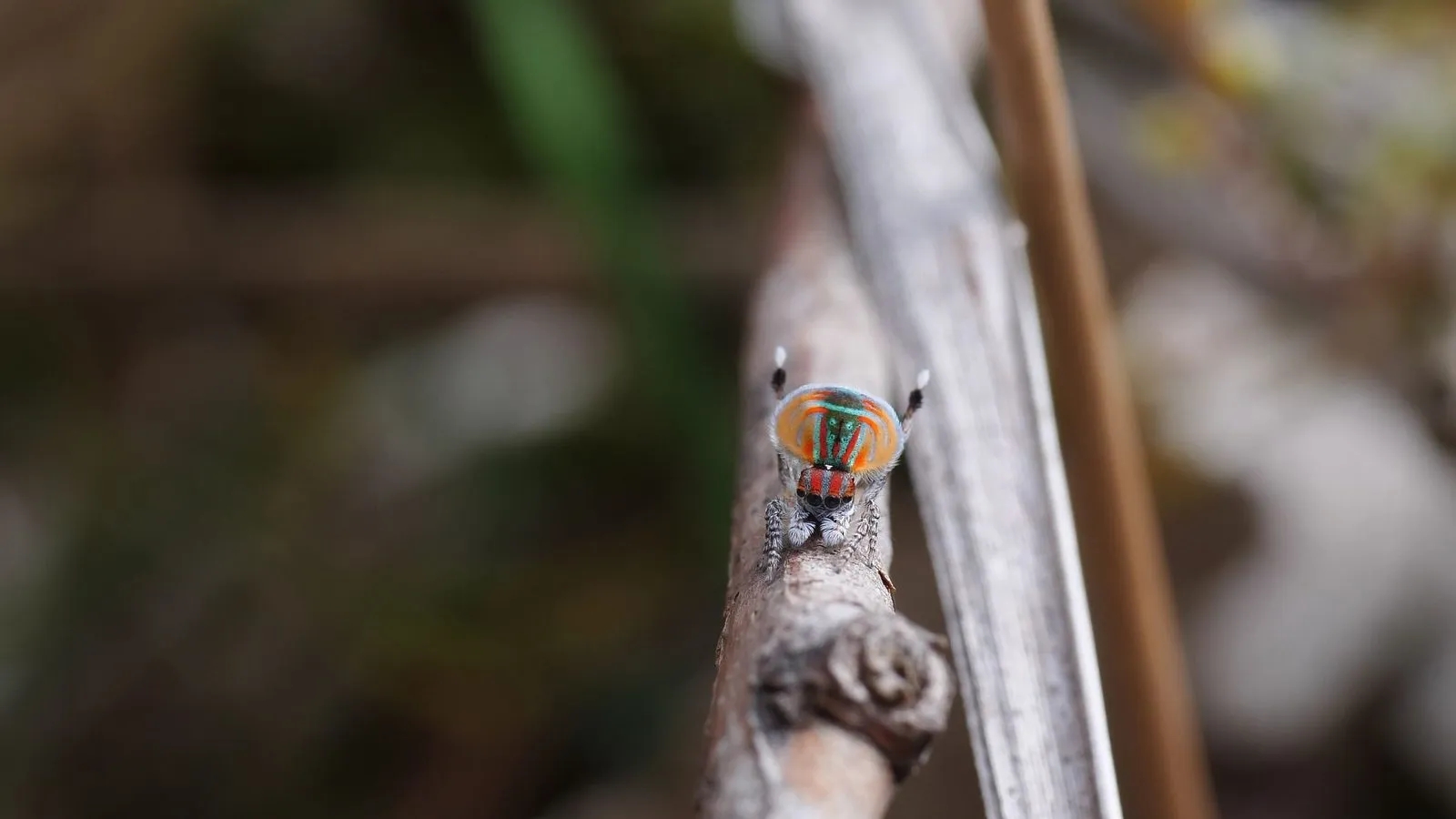
A male peacock spider courts a female by lifting a brightly colored fan on his back, raising a pair of legs high in the air and strutting back and forth. He is only a few millimeters long, and his performance can decide whether he mates or gets eaten.
Tiny jumping spiders from Australia
Peacock spiders are jumping spiders of the genus Maratus, and they live only in Australia. They are just 2 to 6 mm long depending on the species, and can weigh as little as 2 mg. The common peacock spider, Maratus pavonis, reaches about 5 mm for females and 4 mm for males.
They live in a range of places across southern and eastern Australia, from coastal forests to scrublands, grasslands and open woodlands. Some species are common in bushland and even gardens, but they are so small that they are hard to spot. Others have tiny ranges. Maratus yanchep lives only in a small patch of coastal sand dunes about 55 km north of Perth.
Peacock spiders have been known since the 1870s, yet for a long time few people noticed them. In 2011, just seven species were known to Western science. Today, more than 110 have been described, and more are almost certainly waiting to be found. Much of the public fame came from Jürgen Otto, an Australian biologist who studies mites for his day job and began filming the spiders’ courtship. Some species now carry nicknames like Sparklemuffin and Skeletorus.
Like other jumping spiders, they do not use webs to catch food. They have excellent eyesight for stalking and pouncing on small insects. A male splendid peacock spider can jump 15 times its own body length.
The fan and the legs
Females are mottled brown or gray, which helps them blend in. Males are the showpieces. Their abdomens carry brilliant colors made from iridescent scales and hairs, and their third pair of legs is extra long, often with a white tip.
In many species, the abdomen has side flaps that fold away when not in use. During courtship, the male unfolds them like a fan, which is how the spiders got their name. The colors, patterns and shapes of these fans differ from species to species. On the common peacock spider, the fan shows two red crescents around a red spot on a blue background.
How the dance works
A courting male does more than pose. Scientists studying the species Maratus volans found that males begin by sending vibrations through the ground to get a female’s attention, with moves the researchers nicknamed the rumble-rump and the grind-rev. Once a male is sure she is watching, he raises his fan, waves his legs and struts back and forth in front of her. If she starts to look away, he switches back to vibrating more.
To study all this, Madeline Girard of the University of California, Berkeley and colleagues built a courtship arena with a floor of nylon stretched over a frame, so they could film the dance and record the vibrations with a laser. They set up 64 pairs of males and virgin females collected near Sydney.
Tough judges
The females were hard to please. Only 16 of the 64 males succeeded in mating. The males that won were the ones that put the most effort into their visual display, keeping their fans in view while making sure the female kept watching. In these trials, looks mattered about twice as much as vibrations.
Females made their feelings clear. A female that was not interested would shake her abdomen back and forth, a sign that the male’s chances were low. Some attacked the male. Females that had already mated showed no interest in mating again. As study co-author Michael Kasumovic of the University of New South Wales put it, if females don’t like a male, they’ll eat them.
The researchers think this choosiness is what drove males to evolve such elaborate displays over time.
The smallest rainbows
One species takes the color show further. Males of the rainbow peacock spider, Maratus robinsoni, display a full rainbow of iridescent color, the first known case in nature of males using an entire rainbow to attract mates.
A team led by Bor-Kai Hsiung, working with researchers at the University of Akron, UC San Diego and other institutions, found how they do it. The color comes from special scales on the abdomen. Each scale has a curved, airfoil-like shape, and its surface carries rows of tiny ridges, far smaller than the scale itself, that split light into its separate colors. The researchers printed tiny copies of the scales to test their ideas. Even so, one engineer on the team said they could not replicate the exact structures. They hope the design could one day help make smaller instruments for measuring light, for example on space missions.
After the dance
When a male does succeed, the female lays her eggs in a silk cocoon and guards it closely until the spiderlings emerge some 4 to 5 weeks later. Peacock spiders typically live for up to a year.
Some species are at risk. Many have very small ranges, which leaves them exposed to habitat loss, climate change and changes in fire patterns. Sarah’s peacock spider, known only from the Stirling Range in Western Australia, was declared critically endangered in 2018.
Article Sources
- Meet the Common Peacock Spider | Western Australian Museum
- Fact File: Peacock spider | Australian Geographic
- Nature's Smallest Rainbows, Produced by Peacock Spiders | UC San Diego
- For male peacock spiders, the best dancers get the girl | Science News
- Female Peacock Spiders Underwhelmed By Disco-Dancing Suitors | National Geographic
- The spectacular peacock spider dance and its strange evolutionary roots | UNSW Sydney