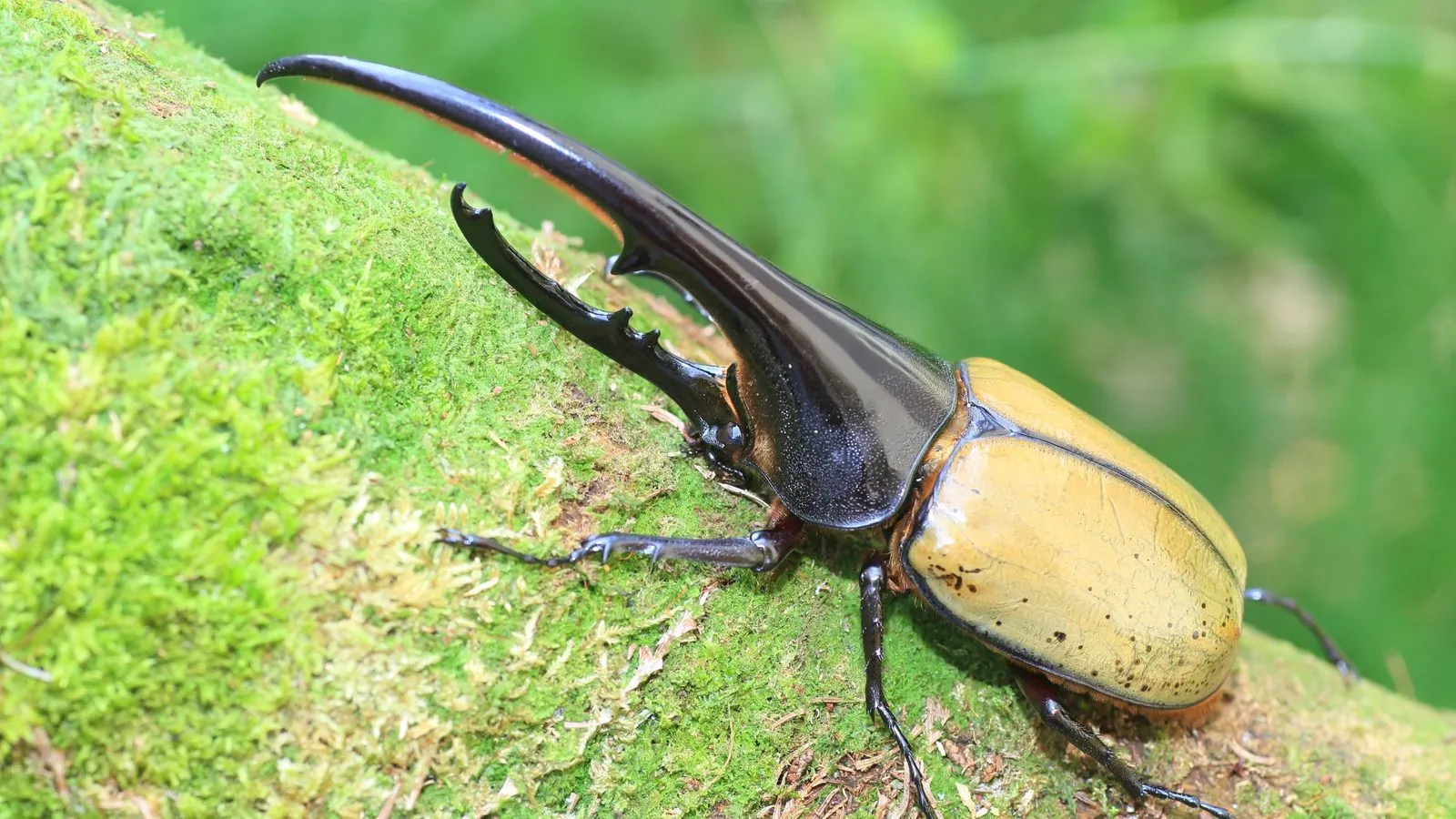
Measured from the tip of its horn to the end of its body, the Hercules beetle is the longest beetle in the world. A big male reaches up to 19 centimeters, and more than half of that is horn, which he uses like a pair of pliers to grab rival males, lift them up and throw them to the ground.
A giant of the rainforest
Hercules beetles live in rainforests from southern Mexico south to Bolivia, and on islands in the Lesser Antilles in the Caribbean. They are rhinoceros beetles, a group named for the horns the males carry.
The Natural History Museum in London says a large male is about the length of a new pencil and nearly 20 times the size of a seven-spot ladybird. Measured on body length alone, without the horns, the titan beetle of South America is longer, at 16.7 centimeters. Count the horns, and the Hercules beetle wins.
A male has two horns. A huge one curves forward and down from his back, and a second curves up from his head. Together they look like a pincer. Females have no horns at all and are dark in color.
Wing cases that change color
A male’s wing cases can be shades of olive, with scattered black spots. But they can change. When the air gets more humid, the wing cases turn black.
Hercules beetles are most active in the dark. They fly at dusk and through the night, and they are busiest just before dawn. Scientists catching them with light traps find most of them between 3:00 and 5:00 in the morning.
Pliers for fighting
The horns are not for show. Females do not seem to care about horn size when they choose a mate. The horns are weapons, used by males fighting each other for a chance to mate.
A fight is a wrestling match. One male grips his rival between his two horns in a full-body hold, pries him off his perch, and tosses him down. Battles go on until one beetle lands helplessly on its back, gets hurt or gives up and leaves.
In 2014, Erin McCullough of the University of Montana and her colleagues tested whether beetle horns are built for the way each species fights. They made computer models of the horns of three species and put them under virtual stress. The Hercules beetle mostly grabs and lifts, the calliper beetle lifts and shoves with a narrow, serrated horn, and the Japanese rhino beetle twists rivals with a horn shaped like a pitchfork. Each horn was stronger and stiffer when used in its own species’ style, and weaker when forced into another’s. The Hercules beetle’s horn, for example, has an oval cross-section that is tall and narrow, which suits gripping and lifting.
How strong is it really?
The Hercules beetle’s strength is famous. National Geographic has reported that it can lift 850 times its own weight, a figure that once earned it the title of the world’s strongest animal.
Careful lab tests on a smaller rhinoceros beetle, Xyloryctes thestalus, show what these insects can do. In a 1996 study in the Journal of Experimental Biology, eight of these beetles walked on a motorized treadmill. They could keep walking while carrying loads of more than 30 times their own body mass. Even more surprising, carrying the extra load was cheap. Moving a gram of load cost the beetles more than five times less energy than moving a gram of their own body.
A slow start in rotten wood
Most of a Hercules beetle’s life is spent as a grub. Females lay eggs that hatch after about 27.7 days. The larvae live inside rotting logs and dead tree trunks, eating the decaying wood. In the lab, they go through three stages lasting about 50, 56 and 450 days. Then they spend about 32 days as a pupa before emerging as adults.
From egg to adult takes 19-21 months, and the whole life can last up to two years. The adult stage is short by comparison: adults in captivity live three to six months. They feed on rotting fruit fallen to the forest floor and have been seen feeding for up to 24 hours without a break.
The grubs do useful work. By eating dead wood, they help break it down and recycle its nutrients.
Article Sources
- Hercules Beetle Dynastes hercules | UF/IFAS Extension, University of Florida
- How big can beetles get? | Natural History Museum, London
- Rhino Beetle Weapons Match Their Fighting Styles | National Geographic
- Structural adaptations to diverse fighting styles in sexually selected weapons | PNAS
- Inexpensive load carrying by rhinoceros beetles | Journal of Experimental Biology