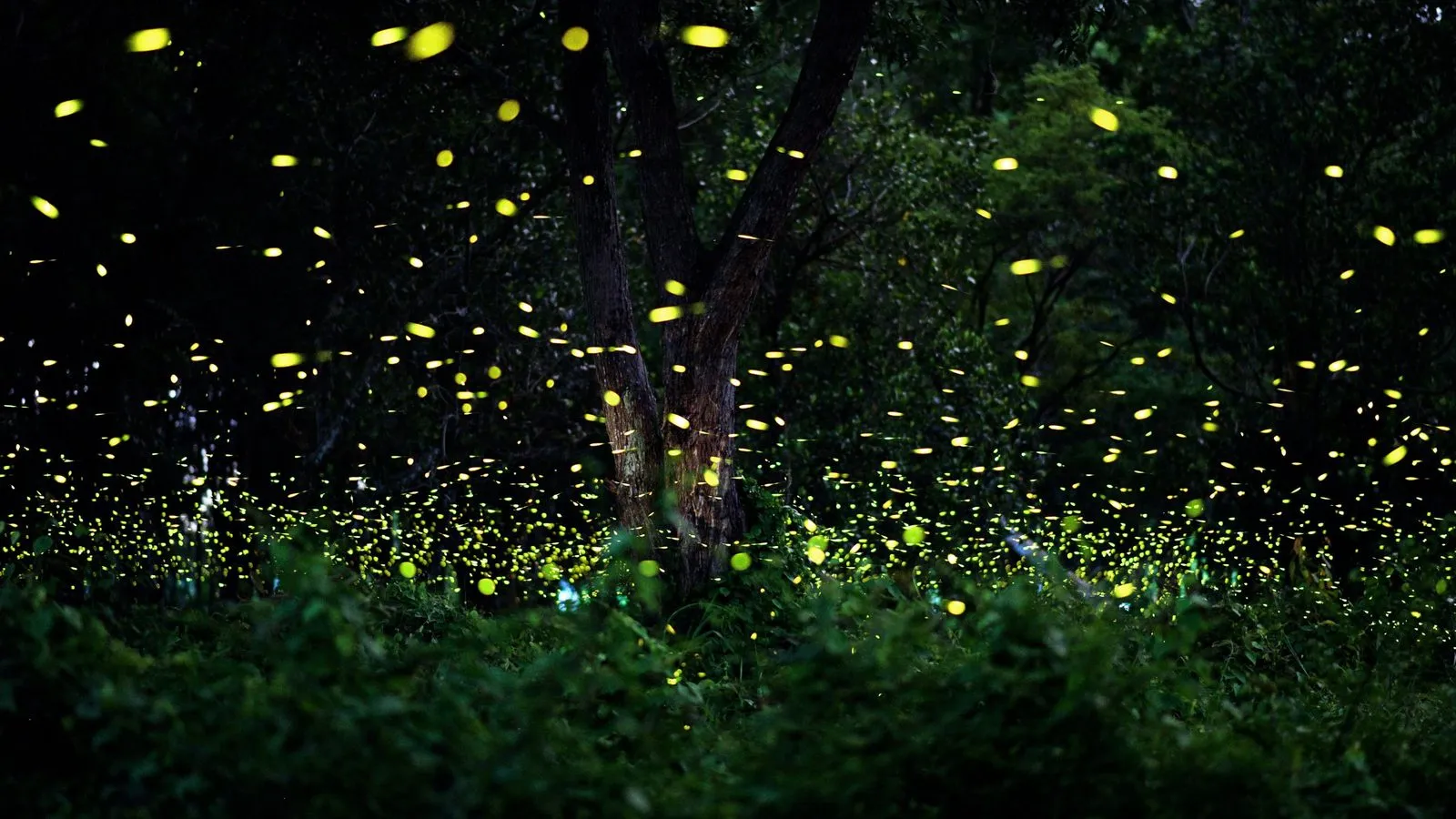
Fireflies light up by mixing chemicals in a special organ in the abdomen, and they turn the light on and off by controlling the oxygen that reaches it. Most of the time, the light is a message, sent to find a mate. Sometimes it is a warning, and sometimes it is a trap.
Beetles with lanterns
Fireflies, also called lightning bugs, are not flies at all. They are beetles. More than 2,000 species have been identified around the world, and Great Smoky Mountains National Park alone has 19.
Not every firefly glows as an adult. Some species find mates using scent signals called pheromones instead. Scientists think that pheromones were the original way fireflies found partners, and that flashing came later.
Fireflies spend most of their lives as larvae. According to the National Park Service, their life cycle lasts one to two years, mostly spent in the leaf litter eating snails, worms and smaller insects. The adult stage lasts just three to four weeks, and many adults do not eat at all.
The chemistry of cold light
Making light by a chemical reaction inside a living thing is called bioluminescence. In a firefly, the reaction happens in the light organ, often called the lantern. A chemical called luciferin combines with oxygen, helped along by an enzyme called luciferase. Calcium and ATP, the molecule that cells use to carry energy, are part of the mix too.
The result is cold light. Almost all of the energy comes out as light, not heat. The National Park Service compares this with an old incandescent bulb, which gives off only about 10 percent of its energy as light and 90 percent as heat. That matters for the insect: if a firefly’s lantern got as hot as a light bulb, the firefly would not survive.
The on and off switch
The key ingredient a firefly controls is oxygen. When oxygen reaches the light-making chemicals, the lantern glows. When it does not, the light goes out. Insects have no lungs. They carry air into their bodies through branching tubes that get smaller and smaller, called tracheoles.
For a long time, scientists puzzled over how some fireflies flash so quickly and precisely. In 2001, a team at Tufts University and Brigham and Women’s Hospital reported a key part of the answer: a gas called nitric oxide.
The lantern holds thousands of light-making cells called photocytes. The edges of these cells are packed with mitochondria, the tiny power plants of the cell, which normally use up incoming oxygen before it reaches the light-making chemicals. So the lantern stays dark. When a nerve signal arrives, cells make nitric oxide, which briefly stops the mitochondria from using oxygen. Oxygen floods through, and the lantern flashes. As the nitric oxide fades, the mitochondria start up again and the light goes off. All of this happens in a fraction of a second.
When the researchers exposed fireflies to nitric oxide gas, the insects glowed or flashed almost nonstop. When they turned the gas off, the flashing stopped. Lead researcher Barry Trimmer summed it up as a temporary cut in the power supply.
Why fireflies flash
The main reason is romance. Each species has its own flash pattern, a kind of code that helps males and females of the same species find each other. Typically, males flash while flying, and females answer from below, often perched on the ground. Studies in two firefly species found that females preferred males that flashed faster or brighter.
Most fireflies glow greenish-yellow, though some species give off a bluer or whiter light.
Larvae glow too. Their short glows are thought to be a warning. Fireflies carry defensive chemicals that make them taste bad, and the glow tells predators to stay away.
Flashing in time
A few species flash together. In Great Smoky Mountains National Park, the synchronous firefly, Photinus carolinus, gives a burst of five to eight flashes followed by an eight-second pause of darkness. As more males join in, their rhythms line up, and whole sections of forest pulse together.
Scientists do not fully understand why. One idea is that it helps the dim females answer. A study found that females of this species only respond when there is enough flashing around them, and they reply during the males’ dark pauses. The mating season lasts only about two to three weeks each year, and the park gives out viewing places by random draw to protect the insects.
The firefly femme fatale
Some fireflies use light to hunt. Females of the genus Photuris copy the answering flashes of females from another group, Photinus. When an eager Photinus male flies down, the Photuris female kills and eats him.
Cornell entomologist Thomas Eisner and his colleagues found a second reason for this trick, reported in 1997. Photinus fireflies carry defensive chemicals called lucibufagins, which Photuris cannot make for itself. By eating a male, a Photuris female gains his chemical protection. In the lab, jumping spiders ate Photuris females that had never eaten a Photinus, but quickly dropped ones that had. The meal is a big one, too: nearly two-thirds of the female’s own size.
Article Sources
- How and why do fireflies light up? | Scientific American
- How fireflies power up and power down | Tufts Journal
- Synchronous Fireflies | Great Smoky Mountains National Park (NPS)
- Femmes Fatales Fireflies | Discover Magazine
- Firefly femmes fatales acquire defensive steroids (lucibufagins) from their firefly prey | PNAS