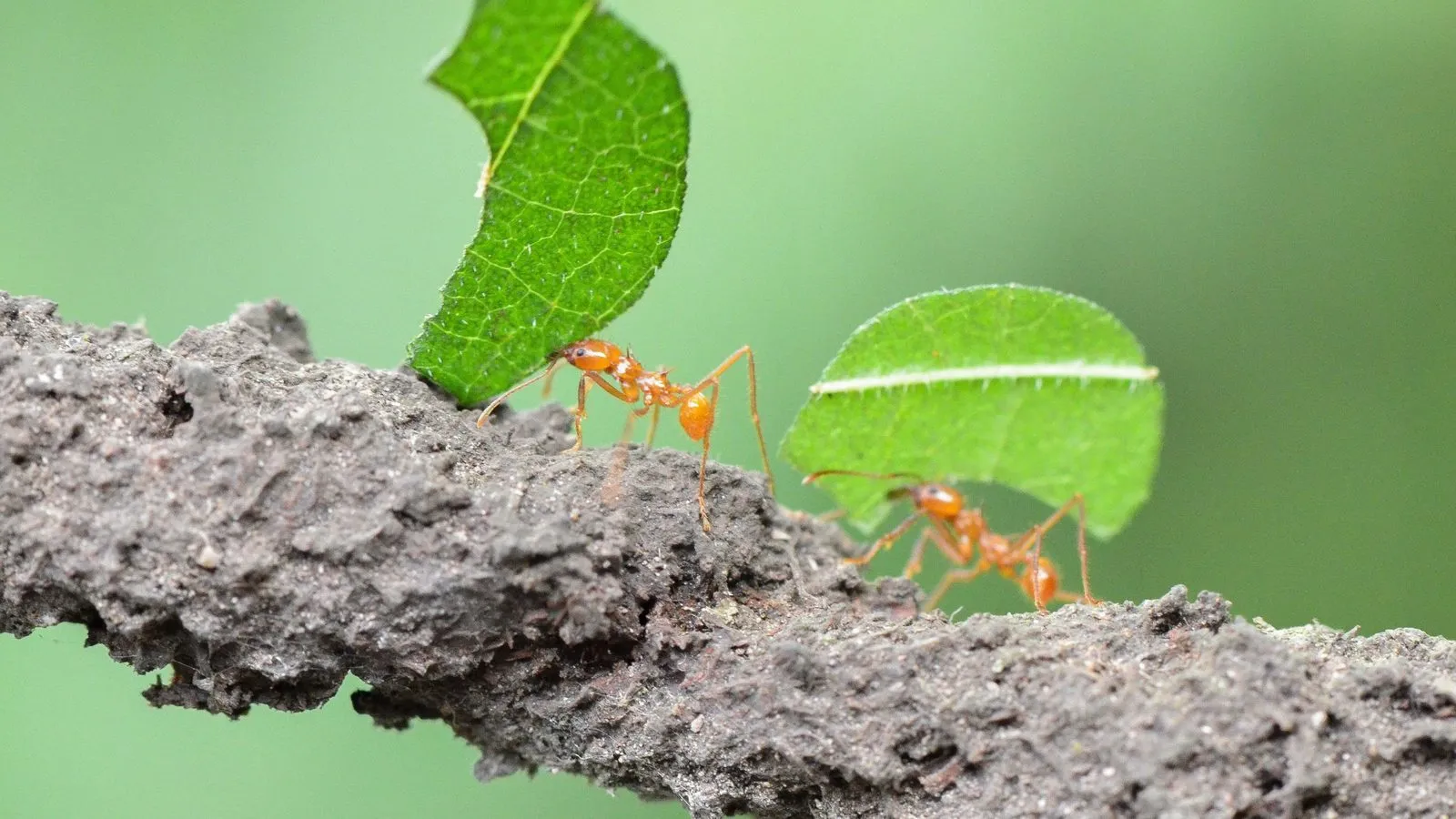
Leafcutter ants spend their days cutting and carrying pieces of leaves, but they never eat them. Instead, they feed the leaves to gardens of fungus that they grow inside their nests, and the fungus feeds the ants.
Farmers, not leaf-eaters
At least 55 species are known as leafcutter ants, in three main groups: Atta, Acromyrmex and Amoimyrmex. Atta leafcutters are dark red, and the back of the thorax carries three pairs of spines that help them handle loads such as leaf pieces.
The ants bring the leaf pieces home to their fungus. The fungus grows special swollen tips, called gongylidia, and the ants eat these. Scientists sort fungus-farming ants into four farming systems, and leafcutters practice the most advanced one, which researchers call higher agriculture.
The partnership works for both sides. The ants get food. The fungus gets shelter, constant care and a ride to new places. Some ant-grown fungi are now found only inside ant nests, a sign that the ants have domesticated them.
An assembly line by size
Leafcutter workers come in very different sizes, and a worker’s size largely decides its job. Researchers at the University of Kansas describe workers with heads ranging from just 0.7 mm wide in the smallest to 5 mm in the largest.
Ants with heads 1.6 to 5.0 mm wide work as foragers. They cut leaves and carry them back to the nest, often in a long line. Inside, larger gardener ants clip the leaf pieces into fragments 1 to 2 mm across. Smaller gardeners crush the fragments into moist pellets, add droplets of their own droppings and press them into the garden. Even smaller workers pluck strands of fungus from thick patches and plant them on the fresh material. The tiniest workers, with heads 0.7 to 1.0 mm wide, patrol the garden and pick out the spores and threads of unwanted molds.
Underground cities
A big leafcutter colony can hold millions of ants, all working for a single queen. In her large chamber, the queen lays hundreds of eggs a day. Workers carry the eggs to nurseries, where the young are raised.
The nests are huge. Because the ants are hard to measure while they are at home, researchers often study abandoned nests by pouring concrete into them and digging out the cast. According to Guinness World Records, the largest leafcutter nest ever recorded covered more than 67 square meters and contained 1,920 chambers, 238 of them holding fungus gardens. Nests can reach as deep as 9 meters.
Rooms are organized by job: fungus gardens, nurseries, storage and rubbish dumps, linked by tunnels and air shafts that help control temperature, humidity and airflow. The ants keep their waste well away from their crops. A 2017 study of one species found the waste chambers sat roughly 4 to 6 meters from the fungus gardens.
Fighting crop disease
Like any farmer, leafcutter ants face crop disease. Their gardens are often attacked by a parasitic fungus called Escovopsis. The ants fight back in several ways. They groom their crops, running their mouthparts over the fungus and licking up the parasite’s spores.
They also carry helpers. Cameron Currie, a biologist at the University of Wisconsin in Madison, noticed as a student that leafcutter ants carry bacteria that show up as fuzzy white patches on their bodies. In 2005, he and his colleagues identified them as Pseudonocardia, part of a group of bacteria that is also a source of human antibiotics. In tests, the parasite was more sensitive to the bacteria’s chemicals than other fungi were, which suggests the ants use the bacteria to protect their gardens.
Farming since the dinosaurs died
Ants have been farming for far longer than people. In a 2024 study, Ted Schultz of the Smithsonian National Museum of Natural History and his colleagues used DNA from 475 species of fungi and 276 species of ants to build family trees for both. They found that ants and their fungi have been linked for about 66 million years.
That is the same time an asteroid struck what is now the Yucatán Peninsula in Mexico, wiping out the dinosaurs other than birds. Dust from the impact blocked out the Sun and stopped photosynthesis for years. Plants died in huge numbers, and fungi feeding on all that dead material flourished. The researchers think this brought fungi into close contact with ants.
The most advanced form of ant farming, the kind leafcutters practice, came much later, around 27 million years ago. As drier grasslands and savannas broke up the wet forests of South America, ants carried their fungi into dry places, where the fungi came to depend on the ants to survive.
When a young queen leaves to start her own nest, Schultz says, she takes a little of her mother’s fungus with her in her mouth. As he put it, humans have been practicing agriculture for 12,000 years, and ants for 66 million.
Article Sources
- When a massive asteroid wiped out the dinosaurs, ants began farming fungi | CNN
- Dinosaur-Killing Asteroid Impact Turned Ants into Fungus Farmers, Study Says | Sci.News
- Leaf Cutter Ant | Center for Latin American and Caribbean Studies, University of Kansas
- Leafcutter ant nests | Discover Wildlife
- Fungus-Farming Ants First To Find Natural Pesticides | NBC News