A periodical cicada spends 17 years underground, then lives for only about a month in the open air. In that month, millions of them crawl out of the soil in the same few nights, sing, mate and die. The long wait is one of the strangest life stories in the insect world, and scientists are still working out exactly why it evolved.
What periodical cicadas are
Periodical cicadas live only in the eastern United States, from northeastern Texas to New England, and nowhere else on Earth. There are 7 species. Three have 17-year life cycles and four have 13-year cycles. The 17-year kinds mostly live farther north, and the 13-year kinds farther south.
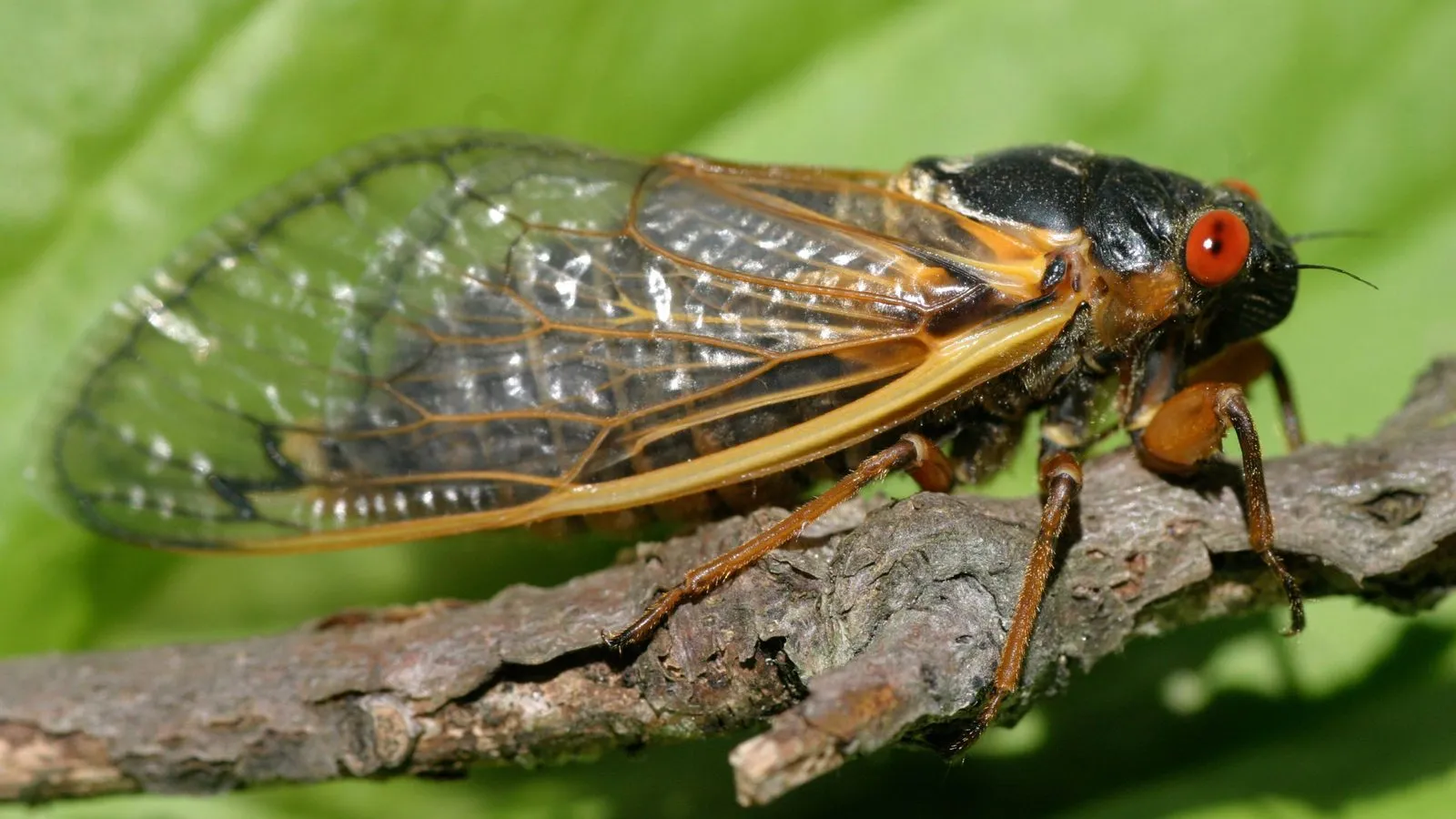
Adults are about 1-1/2 inches long, with black bodies, red eyes and orange in their wings and legs. They are not the same as the green-winged cicadas heard every summer. Those annual cicadas have shorter life cycles that overlap, so some appear every year. Periodical cicadas all come out together.
Seventeen years in the dark
The life cycle begins in a twig. About 10 days after coming out, a female cuts a small slit into a tree branch and lays 24-28 eggs inside, then moves along and does it again. Over her short life she can lay 400-600 eggs. The eggs hatch 6-7 weeks later. The tiny nymphs drop to the ground and dig in.
Underground, the nymphs live anywhere from 2 to 24 inches deep. They use their sucking mouthparts to drink sap from tree roots, and they barely move. Despite feeding on roots for so long, they do the trees very little harm. A long-term study that followed one group of 17-year cicadas from 1979 to 1996 found that most deaths happened in the first 2 years. After that, life underground was fairly safe.
Periodical cicadas take longer to grow up than any other insect that does not pause its development in a resting stage, according to a 2014 study in the journal Ecology.
The great emergence
In the spring of their final year, the nymphs dig up to about an inch below the surface. They wait for a signal: the soil 8 inches down must warm past 64°F (18°C), and enough moisture helps set them off. If the ground is too wet, they build small earthen towers, called turrets, over their holes. As many as 25 exit holes can appear in a single square foot.
Then they come out, often over just one or a few nights. Each nymph climbs a foot or more up a tree trunk or plant stem and splits out of its old skin in an hour or less. The new adult is soft and white and cannot fly at first. Within hours its body hardens and darkens.
In good spots, periodical cicadas can reach densities of hundreds of thousands or even millions per acre. One study counted 579 per square meter at a single site.
A deafening love song
Only males sing. They make the sound with drum-like membranes called tymbals on the sides of their bodies, and their mostly hollow abdomens help it carry. Females answer at close range with a quick flick of their wings. A chorus in nearby trees can reach about 80 decibels, and very close up it can get near 100. Cicadas do not bite or sting.
Why 17 years?
The most popular answer is safety in numbers. Adult periodical cicadas are clumsy fliers and easy to catch. Birds and other animals, wild turkeys among them, gorge on them. But when millions appear at once, predators quickly eat their fill, and most cicadas survive to breed. Any that come out early or late are too few to stand a chance.
There is also a payoff for waiting. Seventeen-year cicadas have heavier ovaries than 13-year cicadas, which suggests the longer wait can mean more eggs.
Then there is the curious fact that 13 and 17 are both prime numbers, divisible only by themselves and one. One idea is that a prime cycle keeps broods with different cycles from meeting and interbreeding very often. A 2009 computer model that let life cycles from 10 to 20 years compete found that the non-prime cycles died out quickly. A 2021 review of cicada research says newer studies have both supported and questioned the role of prime numbers, so the debate is not settled.
Broods and calendars
Cicadas that come out in the same year in the same region form a brood, numbered with Roman numerals using a system set up by Charles Marlatt in 1902. There are 12 living broods of 17-year cicadas and 3 of 13-year cicadas. Two other broods have gone extinct, and habitat loss is probably the biggest threat to the rest.
Brood X, the Great Eastern Brood, covers 15 states. It last came out in 2021 and is due again in 2038. Brood XIV appeared in 2025, and in 2024 a 17-year brood and a 13-year brood came out in the same year. Small numbers of cicadas sometimes come out off schedule, usually 4 years early or late. These are called stragglers. The next 17-year brood, Brood I in Tennessee, Virginia and West Virginia, is due in 2029.
Article Sources
- Resources & FAQs | Periodical Cicadas in Wisconsin, University of Wisconsin-Madison
- Broods | Periodical Cicada Information Pages, University of Connecticut
- Periodical Cicada | Cornell Cooperative Extension, Warren County
- Cicada FAQs | UGA Cooperative Extension
- Evolution of prolonged development: a life table analysis for periodical cicadas | The American Naturalist
- Transient habitats limit development time for periodical cicadas | Ecology
- Selection for prime-number intervals in a numerical model of periodical cicada evolution | Evolution
- Advances in the Evolution and Ecology of 13- and 17-Year Periodical Cicadas | Annual Review of Entomology