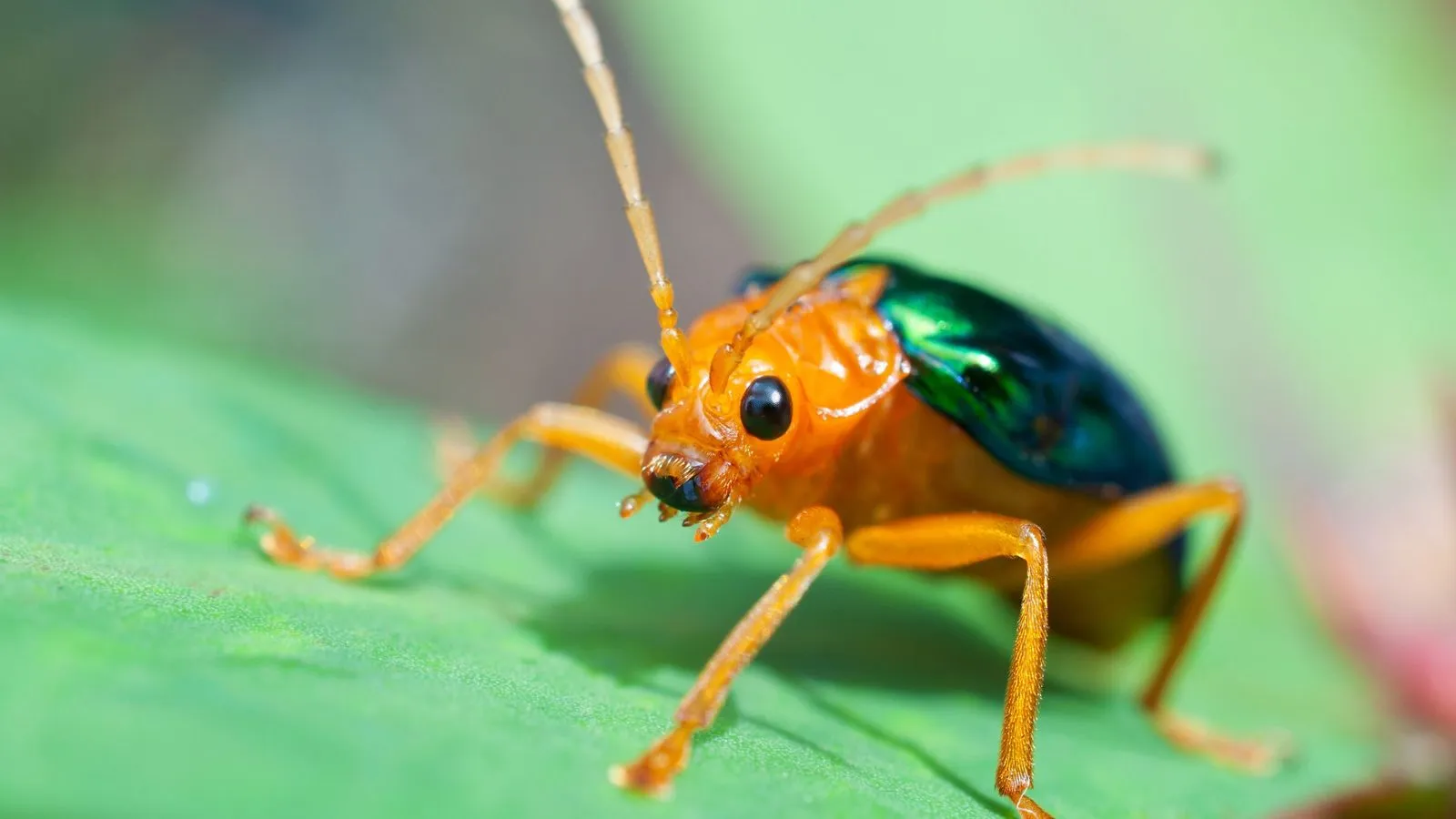
When a bombardier beetle is attacked, it sets off a chemical explosion inside its own body and fires the result at its enemy. The spray comes out at around 100 degrees Celsius, the boiling point of water, and it leaves the beetle in a rapid string of tiny blasts rather than one steady stream.
A beetle with a built-in reactor
Bombardier beetles are ground beetles, part of the large family Carabidae, and there are some 500 species of them. They live on every continent except Antarctica. Plenty of ground beetles defend themselves with chemicals, but the bombardiers are the only ones known to heat their spray to boiling as they fire it.
Each beetle carries a gland near the tip of its abdomen, and the gland has two chambers. The first, the reservoir, holds a solution of hydrogen peroxide and hydroquinones. On its own this mixture is quiet. The second chamber, the reaction chamber, holds enzymes called catalase and peroxidase. Enzymes are proteins that speed up chemical reactions, and these ones work very fast.
When the beetle feels threatened, it squeezes some of the reservoir liquid into the reaction chamber. The reaction throws off oxygen, water vapor, a great deal of heat and irritating chemicals called p-benzoquinones. The pressure from all that gas drives the hot liquid out of the beetle’s rear, often with an audible pop.
How hot and how fast
The boiling-point figure is not new. Scientists measured the temperature of the spray back in 1969, and later work kept confirming that the reaction brings the liquid close to boiling. National Geographic reports that the spray can travel at up to 22 miles per hour.
The bombardier’s spray is much hotter than the same irritant used by other insects, and it shoots out about 5 times faster. Speed and heat together make it a strong deterrent. It is painful to people, and it can be deadly to small predators such as ants.
The beetle does not just spray blindly behind it. Reflector plates and a turning tip on the end of its abdomen let it aim the jet in many directions.
Hundreds of explosions a second
For decades, scientists wondered how a small insect could set off explosions inside itself without cooking its own insides. A team led by Christine Ortiz at the Massachusetts Institute of Technology found an answer in 2015, using high-speed X-ray imaging to watch the gland working inside living beetles.
To film them, the researchers chilled each beetle until it went to sleep, then held it in the path of the X-ray beam. As it warmed up and realized it was stuck, it fired.
The videos showed that the spray is not one long squirt. The beetle fires between 368 and 735 pulses every second. The trick lies in the valve between the two chambers. A droplet of fuel slips through the valve and explodes. The blast pushes the spray out of the exit, and the same pressure presses on a thin membrane that shuts the valve. As the pressure drops, the membrane relaxes, the valve opens again and the next droplet goes in.
This means the pulsing runs by itself. The beetle needs no special fast muscles to open and close the valve, so it does not spend energy on it. The pauses between pulses also give the chamber a moment to cool. As Ortiz told National Geographic, a continuous spray would heat the beetle up a lot more. She thinks the design could help engineers make armor that protects against blasts.
Escaping from inside a toad
The spray works even after a predator has swallowed the beetle. In a study published in 2018, Shinji Sugiura and Takuya Sato of Kobe University in Japan fed a bombardier beetle called Pheropsophus jessoensis to two toad species in the lab.
Every toad swallowed its beetle. But 43 percent of the toads vomited the beetle back up, between 12 and 107 minutes later. In the first case the researchers saw, the toad gave up after 44 minutes. All the beetles that came back out were still alive and active. The researchers concluded that the beetles had fired their hot chemicals inside the toads, forcing them to throw up.
Size mattered. Larger beetles escaped more often than small ones, and small toads vomited more often than large toads. Beetles that had already used up their spray before being eaten had no such luck: they were all digested.
The bombardiers also seem unusually tough. When the team checked beetles after 20 minutes in a toad’s stomach, the bombardiers were much less harmed by digestive juices than other beetle species. The scientists are not yet sure whether the beetles resist those juices or whether their chemicals weaken them.
Why it works so well
For a small insect that lives on the ground, a boiling, stinging spray is a strong reason for a predator to look elsewhere. It deters animals with backbones as well as other insects. Wendy Moore, an entomologist at the University of Arizona, told National Geographic that the squeaky pop is shocking and gets your attention. For a toad that has had to bring one back up, that lesson may stick.
Article Sources
- How This Beetle Creates 500 Explosions Per Second In Its Bum | National Geographic
- Beetle's toxic, explosive vapor explained | Science News
- New Study Shows How Bombardier Beetles Produce Defensive Spray | Sci.News
- Boiling beetles | The Medical Journal of Australia
- Data from: Successful escape of bombardier beetles from predator digestive systems | Dryad
- See the Amazing Way a Beetle Survives Being Eaten | National Geographic
- BRIEF: The Bug That Can Survive A Toad's Stomach | AIP Inside Science