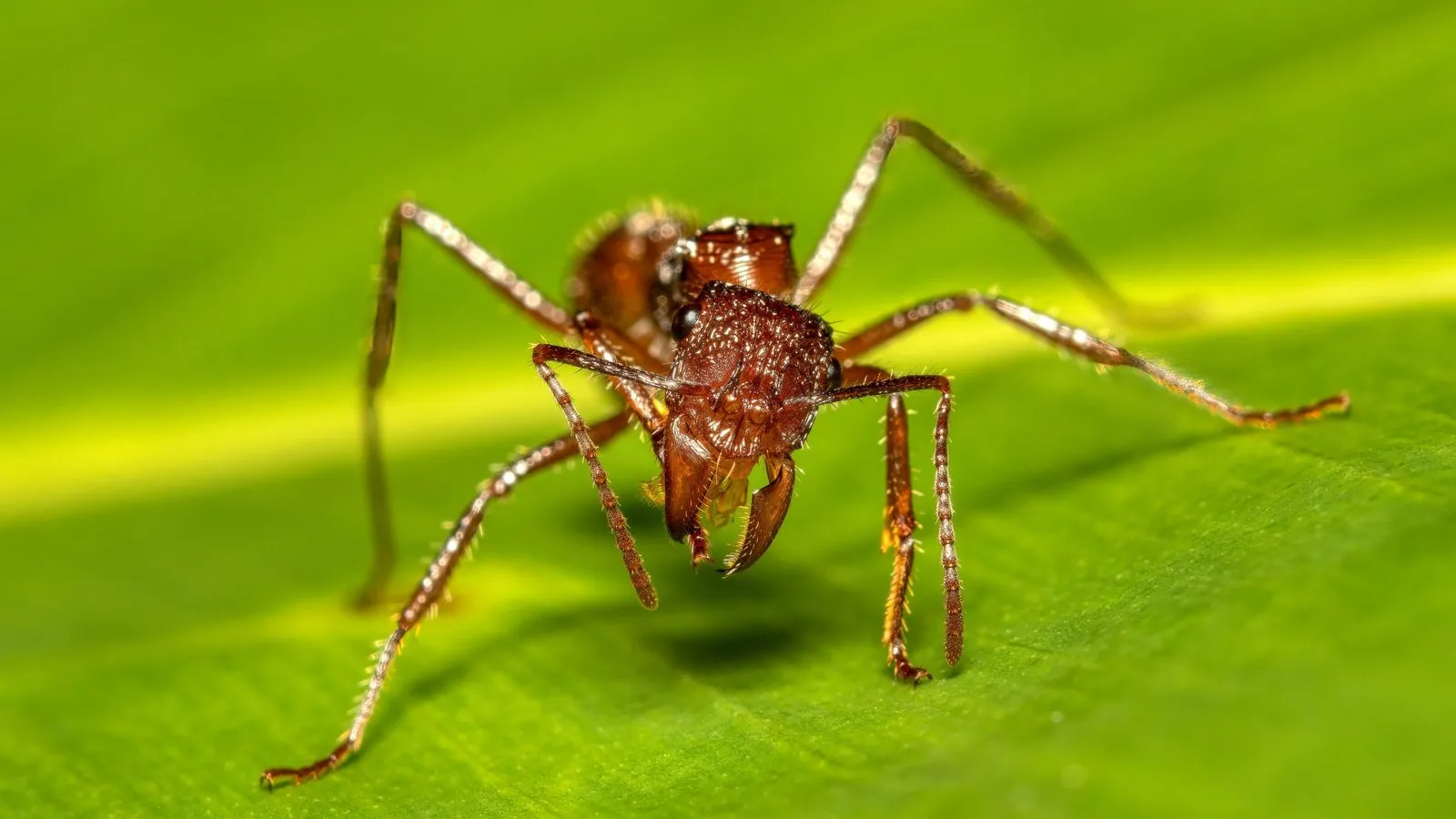
The bullet ant sits at the very top of the best-known scale of insect sting pain, sharing first place with a large wasp. Entomologist Justin Schmidt, who was stung by dozens of insects in the name of science, gave it the top score of 4 and called it “pure, intense, brilliant pain.”
What a bullet ant is
The bullet ant, Paraponera clavata, lives in the lowland rainforests of Central and South America, from Nicaragua down to about southern Brazil, including the Amazon. It is one of the largest ant species in the world. Schmidt described it as black and very stocky, a primitive-looking ant a bit like a dinosaur, but warned that it is a nimble climber, an acrobat rather than a plodder.
Bullet ants usually nest at the bottom of the forest, near the ground. To feed, workers climb high into the canopy, way up into the tops of the trees, to hunt. The species has one of the longest foraging ranges of any ant and is fiercely territorial.
Unlike many familiar ants in Europe and North America, which bite, the bullet ant delivers its venom through a stinger, much like a wasp.
Measuring pain with your own body
The Schmidt Sting Pain Index ranks the pain of insect stings from 1 to 4, with 4 the worst. Schmidt, an entomologist at the University of Arizona, built it from his own experience, collecting stings over three decades in many parts of the world. By the time of his 2016 book The Sting of the Wild, he had ranked 83 insect stings. His work focused on the stinging ants, wasps and bees.
At the bottom end sits the red fire ant, a 1. Schmidt described its sting as sharp, sudden and mildly alarming. At the top, sharing the 4 with a large wasp called the tarantula hawk, is the bullet ant.
His full description of the bullet ant reads like a dare: “Like walking over flaming charcoal with a 3-inch nail embedded in your heel.” Schmidt called it the holy grail of stinging insects. He also admitted he did not exactly want to be stung. He wanted the data, he told NPR, but not the sting.
Why it hurts so much, and so long
What sets the bullet ant apart is not just how much the sting hurts but how long the pain lasts. The tarantula hawk’s sting fades after two or three minutes. Schmidt said the bullet ant’s sting will hurt for anywhere from 12 to 24 hours. Sam Robinson, a researcher at the University of Queensland, describes the pain as lasting up to 12 hours: a deep, drilling pain felt in the bones, with sweating and goosebumps. People stung by these ants have compared the feeling to being shot, which is how the ant got its name.
The venom also causes trembling. Schmidt described a totally uncontrollable urge to shake the stung part of the body. He noted that the sting can even make the hairs around the sting site stand on end.
Researchers have long known that bullet ant venom contains a nerve-targeting substance called poneratoxin. A study led by Robinson, published in the journal Nature Communications, looked at how it works. The toxin acts on tiny gates in the walls of nerve cells, called voltage-gated sodium channels, which play a key part in sending pain signals. It makes these gates open more easily and stops them from closing again, so the pain signal keeps going and gets stronger. Venom from some scorpions targets the same channels. The team noted that other factors may also be involved.
The one bit of good news, Schmidt said, is that each ant carries very little venom.
Why an ant needs a sting like that
Schmidt’s main interest was why insects sting at all. He believed bullet ants need such a painful defense because of where they find food. To feed, they climb into the rainforest canopy, which he called probably the most dangerous place on Earth for small animals. A sting that hurts this much is a strong reason for any predator to leave them alone.
The bullet ant glove ceremony
In the Brazilian Amazon, the Sateré-Mawé people use bullet ants in initiation ceremonies for boys becoming men. The ants are collected and calmed with a mixture of chopped cashew leaves so they can be handled safely. Many ants are then woven into gloves made from natural fibers, with their stingers pointing inward.
Boys as young as 12 take turns putting on the gloves. The ceremony is repeated many times over a young man’s life, and showing the pain is frowned upon for anyone who wants to be seen as worthy of leadership.
Article Sources
- Stung By 83 Different Insects, Biologist Rates His Pain On A Scale Of 1 To OW! | NPR
- Ouch! Scientist endures thousands of insect stings to measure which hurts most | CBC
- In the Amazon, bullet ants deliver agonising pain to boys as young as 12 | Discover Wildlife
- World's most painful ant sting targets nerves in the same way scorpion venom does | Live Science