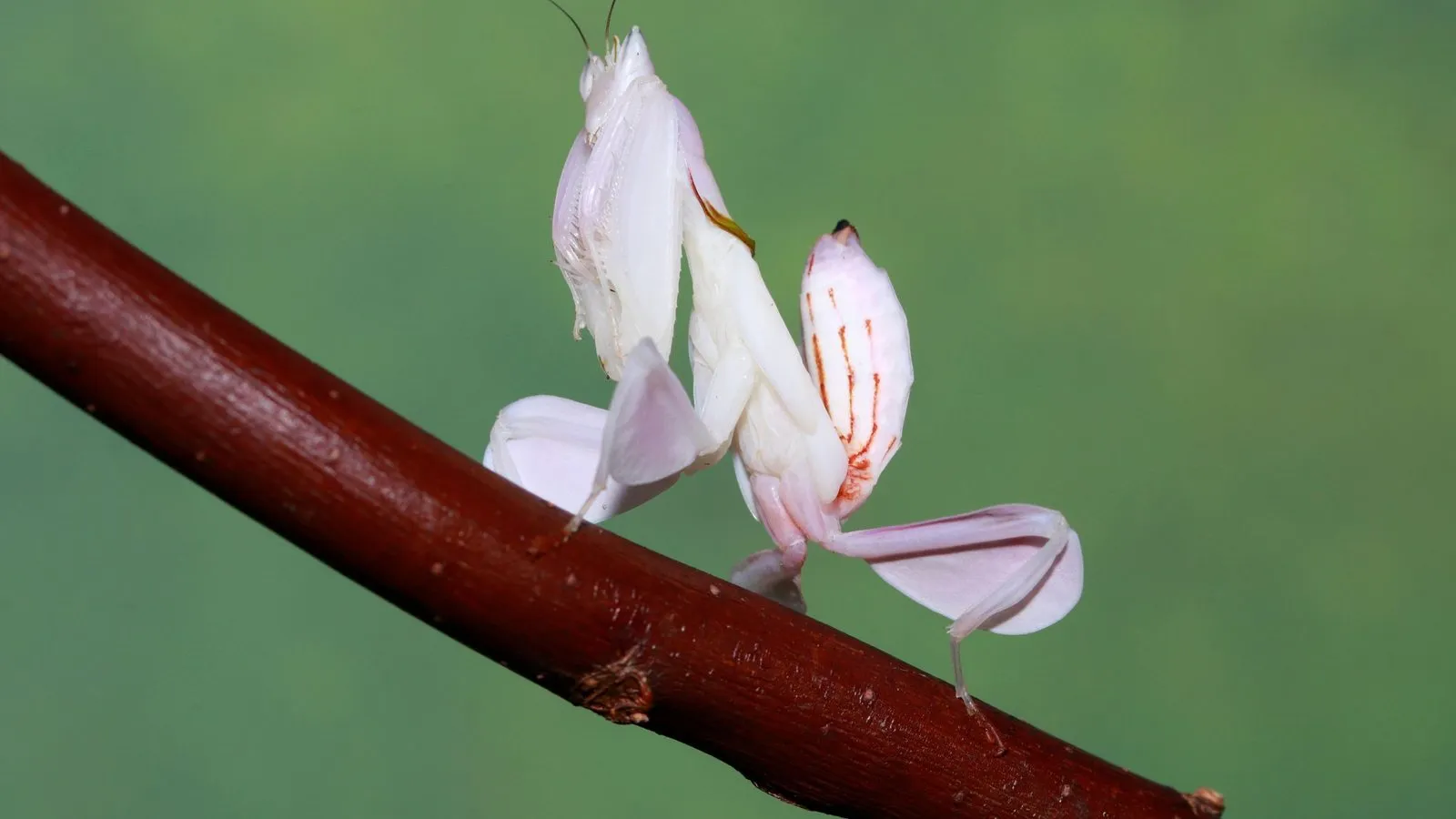
The orchid mantis is a predator that passes itself off as a flower. Bees and other pollinating insects fly up to it expecting nectar, and some of them are caught and eaten.
A flower with legs
Most mantises are green or brown. The orchid mantis, Hymenopus coronatus, is white and pink, with pink or yellow touches. The upper parts of its legs are flattened into heart-shaped lobes that look uncannily like petals. Its four hind legs carry these lobes. Young mantises look the most flower-like, because they hold their abdomens bent upward. As they grow up, their long wings cover the body and they look a little less like a bloom.
The species lives in the rainforests of Southeast Asia. It is a loner, and it is very rare in the field. When researchers from Macquarie University in Sydney went looking for it in Malaysia, they asked Indigenous people for help finding it, because the mantises live at very low density in the forest.
People have been fooled by this insect for a long time. In 1879, the travel writer James Hingston described being shown, in a garden in West Java, what he thought was a red orchid that caught and fed on live flies. He had seen an orchid mantis. The naturalist Alfred Russel Wallace was among those who wondered about its strange looks.
The old story was wrong
For more than a century, the accepted story went like this: the mantis sits inside an orchid, blends in with the petals, and ambushes insects that come to the real flower. It sounded so obvious that nobody tested it.
Then James O’Hanlon and his colleagues did. Their work, published from 2014 onward, found that the orchid mantis does not hide in orchids. In fact, it does not really hide at all. Given a choice, the mantises sat on leaves just as often as they sat near flowers.
The team also could not find any one flower the mantis copies. They compared its colors with more than a dozen flower species from its habitat on the Malaysian peninsula. To the eyes of bees and wasps, the mantis’s color could not be told apart from those flowers, yet it matched none of them exactly. It seems to look like a general idea of a flower rather than a particular one.
Better than the real thing
Here is the most surprising result. In field experiments, mantises sitting on their own drew in wild pollinators at a higher rate than real flowers did, and caught them as prey. O’Hanlon’s team measured how often pollinators flew up to the mantis each hour and compared it with real flowers. The mantis came out about 30 percent more effective at attracting them.
That makes the orchid mantis the first animal shown to mimic a whole flower and attract insects on its own. Before this, mimicking flowers had only been demonstrated in flowering plants. Graham Milledge of the Australian Museum told Australian Geographic that the finding shows the flower disguise is used to pull in prey, not just to hide.
Sitting near flowers still helps. Insects are drawn to patches of flowers in general, so a mantis in a flowery spot gets more visitors. As O’Hanlon put it, the more flowers near the mantis, the more bees it ends up trying to eat.
Color matters more than petals
Why does the trick work so well? Tests with plastic model mantises put out in the field showed that color mattered far more than shape. When O’Hanlon removed or moved the petal-like lobes on model mantises, pollinators still came to inspect them. He has suggested the lobes might instead help camouflage the mantis from its own predators.
A small insect flying past has little time to decide what it is looking at. It works by a quick rule: the right color means a flower with nectar. A big patch of that color looks like a big, rewarding flower. The mantis takes advantage of that shortcut.
A chemical trick for honeybees
Young orchid mantises may have a second trick. A Japanese team studied mantises in Thailand, Malaysia and Indonesia and found that juvenile females often succeeded in catching oriental honeybees, while adult females often failed.
The researchers found two chemicals in the young mantises’ mouthparts that honeybees also use in their own chemical signals. One of them was released into the air only when a young mantis was trying to catch prey. In a field test, honeybees mostly chose dummies soaked in a mix of the two chemicals. The team concluded that the juveniles use these scents to lure the bees in.
Big females, small males
Only the females play flower. Males are small and camouflaged, and spend their adult lives avoiding predators and looking for mates. A 2016 study led by the Cleveland Museum of Natural History suggests that females in this lineage grew larger and more colorful over time because it helped them catch large pollinating insects such as bees. The same researchers noted that, despite the name, orchid mantises do not sit on orchids.
Article Sources
- Secrets of the orchid mantis revealed - it doesn't mimic an orchid after all | The Conversation
- Pollinator deception in the orchid mantis | Macquarie University
- Mimicking mantis outperforms orchids | Australian Geographic
- Unraveling The Orchid Mantis Mystery | Science Friday
- Predation on pollinating insects shaped the evolution of the orchid mantis | ScienceDaily
- Double-Trick Visual and Chemical Mimicry by the Juvenile Orchid Mantis | Zoological Science