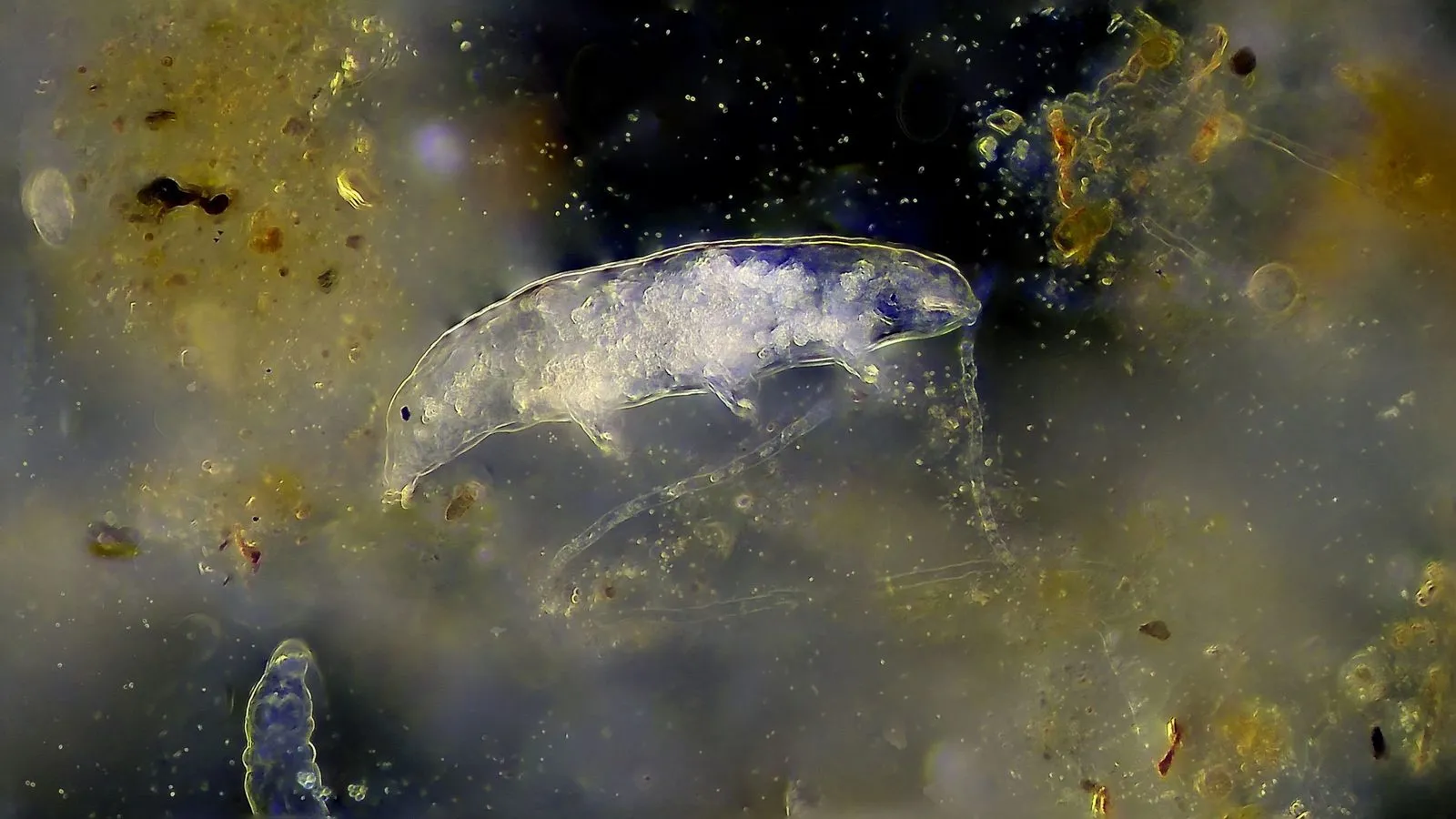
Tardigrades are microscopic animals that can survive being dried out, frozen for decades and even sent into space. Their nicknames, water bears and moss piglets, fit their looks: a plump, barrel-shaped body shuffling along on eight stubby legs.
Meet the water bear
Adult tardigrades are usually 0.3 to 0.5 mm long, and the largest known reach only about 1.2 mm. Their body has five segments including the head, and the last four segments each carry a pair of short, wide legs with no joints, ending in claws.
Johann Goeze first described them in 1773 and called them little water bears. Three years later, Lazzaro Spallanzani gave them the name Tardigrada, meaning slow stepper, because of their slow walk.
They are easiest to find in damp moss and lichen, but they turn up almost everywhere: beaches, freshwater mud, soil, hot springs, high in the Himalayas, deep in the sea and even in the interior of Antarctica. Most eat plants or bacteria, piercing single cells with sharp, needle-like parts in their tube-shaped mouth. Some hunt smaller tardigrades. Scientists today think their closest relatives are arthropods, the group that includes insects and spiders, and the velvet worms.
The tun: shutting life down
The tardigrade’s best trick is cryptobiosis, a state in which the animal stops its metabolism almost completely and waits for better times. When its home dries out, a tardigrade can lose up to 97 percent of its water. It shrivels into a dry, dormant ball called a tun.
In this state, it can go without water for a period of 10 years, according to the European Space Agency. Drop it back in water and it comes back to life. A dry tardigrade is so hardy that, as researcher Ingemar Jönsson told Discover, you can put one in pure alcohol or expose it to poisonous gases without killing it.
The figures for what tardigrades can endure are hard to believe. ESA lists temperatures from minus 272 to plus 150 degrees Celsius. Lynn Kimsey, director of the Bohart Museum of Entomology at UC Davis, notes that they can survive pressures of more than 1,200 atmospheres, like those at the bottom of the deep sea, and tolerate 1,000 times more ionizing radiation than other animals.
Frozen for more than 30 years
In November 1983, a clump of moss was collected in Antarctica and stored in a freezer at minus 20 degrees Celsius. In May 2014, a team at Japan’s National Institute of Polar Research thawed it out. Inside were two tardigrades and an egg, and all three came back to life.
After 13 days, one of the revived animals was eating algae, its first meal in decades. It went on to lay 19 eggs, and 14 hatched. The other adult died after 20 days. The frozen egg hatched too, and the young tardigrade later laid 15 eggs of its own, seven of which hatched.
That beat the previous records, which were eight years for frozen tardigrades and nine years for dried eggs.
Water bears in space
In September 2007, some 3,000 water bears rode into orbit for 12 days on the European Space Agency’s Foton-M3 mission. Adults from two species were exposed to the vacuum of space in their dry tun state. They became the first animals known to survive it. Back on Earth, they even laid eggs that hatched.
Space did find their limit. Tardigrades that were also hit by the full ultraviolet light of the Sun mostly died, because the radiation shattered their DNA. Yet a small number survived even that. In 2011, tardigrades went to the International Space Station, and the cosmic radiation and weightlessness on board did not harm them.
A protein shield for DNA
How do they cope with radiation? In 2016, scientists at the University of Tokyo read the genome of Ramazzottius varieornatus, one of the toughest tardigrade species. They found a protein they named Damage Suppressor, or Dsup.
When they gave human cells grown in the lab the ability to make Dsup, the cells showed about half the DNA damage after X-ray exposure, and they could still multiply. Researcher Takuma Hashimoto said the surprise was that Dsup seems to stop harm from happening in the first place, instead of repairing it afterward.
Tough, but not unbeatable
Tardigrades are not champions at everything. Tiny water animals called bdelloid rotifers have been found to resist radiation even better. And for all their hardiness against cold, heat, drying and space, tardigrades have one simple weakness. As Jönsson put it, they are very vulnerable to mechanical damage. In other words, you can just squash them.
Article Sources
- Why the Water Bear Is So Unusual | Bug Squad, UC Agriculture and Natural Resources
- Tiny animals survive exposure to space | ESA
- Tardigrades become first animals to survive vacuum of space | Discover Magazine
- This Protein From Micro-animal Shields DNA From Lethal Radiation | Asian Scientist Magazine
- Water bears revived after more than 30 years in the freezer! | SCAR
- 30-Year Deep Freeze Just Puts Tardigrade in the Mood | Live Science
- Tardigrades: The Animals That Defy Nature | Illinois Science Council